Intelligent is a heavy, formal word that students and writers reach for constantly — and its weight makes repetition obvious. Calling every smart character, idea, and decision “intelligent” flattens distinctions that actually matter. A brilliant scientist, a wise grandparent, and a clever child are not intelligent in the same way, and your vocabulary should show it.
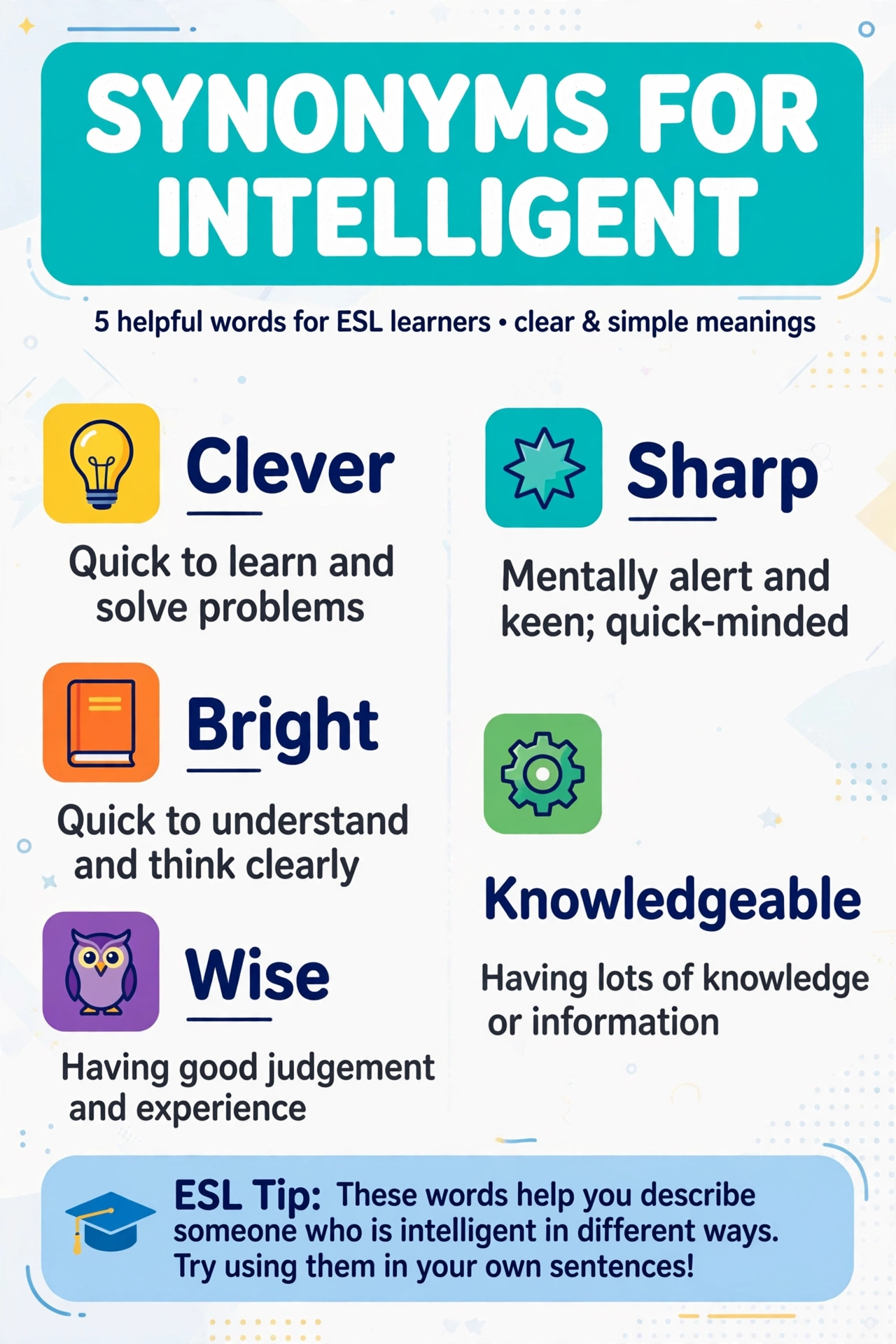
The five synonyms below divide intelligence into useful types: quick thinking, deep wisdom, and sharp perception. Learn the differences and your descriptions of smart people will come alive.
These five were picked to map the different kinds of smartness: brilliant for exceptional minds, clever for quick solutions, wise for seasoned judgment, sharp for fast perception, and astute for reading people and markets. The examples below deliberately mix ages and settings — a child, a grandparent, a detective, an investor — so you can feel how each word seeks its natural home.
A handy memory aid: brilliant and astute live in the world of reputation — people earn those labels over time. Clever, sharp, and wise live in the world of moments — a quick solution, a fast observation, a timely piece of advice. If the smartness took years to build, reach for the first pair; if it flashed in a single scene, reach for the second trio.
Brilliant
Meaning: Exceptionally smart, with ideas or work that stand far above the ordinary.
Example: The young researcher presented a brilliant solution to the energy problem.
Another example: Her brilliant novel won prizes on three continents.
Clever
Meaning: Quick at finding smart, practical solutions, often in surprising ways.
Example: She found a clever shortcut that saved the team two hours daily.
Another example: The clever fox waited until the farmer looked away.
Wise
Meaning: Showing deep understanding and good judgment gained through experience.
Example: His wise advice stopped me from making an expensive mistake.
Another example: The wise elder listened for an hour before offering a single sentence.
Sharp
Meaning: Quick to notice, understand, and respond to what is happening.
Example: The sharp detective noticed the unlocked window within seconds.
Another example: Her sharp questions exposed the holes in his story.
Astute
Meaning: Skilled at understanding situations and people, especially in practical matters.
Example: An astute investor sold her shares weeks before the market dropped.
Another example: The astute journalist sensed the mayor was hiding something.
How to Use These Words
Match the word to the type of smartness. Brilliant is for exceptional, standout intellect — use it sparingly or it loses force. Clever fits quick, practical problem-solving and can sound playful. Wise belongs to experience and judgment, so it suits older mentors better than quick children. Sharp describes fast perception in the moment. Astute is the business-world favorite for reading people and situations. Calling a toddler “astute” or a CEO “clever” would both sound slightly off — register matters.
Be especially careful with clever: it can carry a sly edge. “A clever lawyer” may praise skill, but “a clever trick” can hint at deception. When you want pure admiration without the shadow, brilliant or wise is the safer choice.
Common Mistakes to Avoid
- Overusing brilliant until it fades. Brilliant means exceptional. Calling every decent idea brilliant leaves you no word for the truly extraordinary ones.
- Using wise for quick thinking. Wisdom comes from experience and reflection, not speed. A fast answer is sharp or clever; a deep one is wise.
- Confusing sharp with harsh. A sharp mind perceives quickly; a harsh tone wounds. “Sharp criticism” can mean either, so add context to steer the reader.
Quick Practice
Choose the best word for each blank: brilliant, clever, wise, sharp, astute.
- The __________ professor’s theory reshaped the entire field of physics.
- Only a __________ negotiator would have spotted the trap in the contract.
- It was __________ of you to save the receipt — we needed it for the refund.
Answer key: 1. brilliant 2. astute 3. clever
Put Them Into Practice
Sharpen these words with a matching game. First, write the names of five people you know — a friend, a teacher, a family member, a public figure, a character from a book. Second, assign each one the synonym that fits best and write one sentence explaining why: who is clever, who is wise? Third, deliberately mismatch one pair (call the toddler astute) and notice how odd it sounds — that discomfort teaches register. Finally, collect one new example of each word from something you read this week and add it to a vocabulary journal. Five real sightings turn a memorized word into a known word.
Quick self-test: Without looking back, assign brilliant, clever, wise, sharp, and astute to five people you know — one word each — and say why in a single sentence. Then check the meanings above. If every assignment still feels right, the distinctions are yours; if one wobbles, that is the word to practice this week.
Related Words Worth Learning
Keep building your vocabulary with these closely connected word sets:
- Synonyms for Efficient: 5 sharp words for working smart, from resourceful to proficient.
- Synonyms for Flexible: 5 words for open, adaptable thinking, from open-minded to agile.
- Synonyms for Fascinating: 5 vivid words for gripping ideas, from intriguing to riveting.
FAQs
What is the difference between clever and intelligent?
Clever stresses quick, practical problem-solving, sometimes with a playful edge. Intelligent is broader and more formal, covering all kinds of mental ability including deep study.
Which synonym fits academic writing?
Brilliant and astute work well in academic and professional writing. “A brilliant analysis” or “an astute observation” both sound appropriately serious.
Is “wise” only for older people?
Mostly, yes — wisdom implies lessons learned over time. Describing a teenager as wise can work poetically, but in plain writing it may confuse readers.
Can “sharp” describe objects too?
Yes. Sharp also means having a fine edge or clear outline, as in “a sharp knife” or “a sharp image.” Context always tells the reader which sense you mean.
What is the difference between astute and shrewd?
Both describe practical cleverness with people and money, but astute is warmer and more admiring, while shrewd can sound calculating. “An astute mentor” praises; “a shrewd operator” warns.
Can animals be described as clever or wise?
Clever, yes — clever crows and clever foxes are stock characters in stories. Wise is rarer for animals, though fables make exceptions for owls and tortoises. Brilliant and astute almost never fit animals.
Conclusion
Intelligence wears many faces, and now you can name them: brilliant, clever, wise, sharp, and astute. Each word captures a different kind of smartness, from lightning-fast perception to lifetime wisdom. Use them precisely, and your writing about smart people and ideas will feel vivid and true. Notice smartness in the world around you this week, name it precisely, and these five words will never leave you.

Thomas Allen is a language writer and editor who loves exploring the subtle differences between words. He creates clear, practical guides that help readers understand English better — one word pair at a time.