Evaluate is a word you meet everywhere: teachers evaluate essays, managers evaluate performance, shoppers evaluate products before buying. It means forming a careful judgment about the quality or value of something. But like many common verbs, it gets overused — and a more exact word often says what you mean better.
The trick with evaluate’s synonyms is that each one leans toward a different kind of judgment. Some focus on quality, others on details, others on value. Here are five of the most useful alternatives, each with a clear meaning and an example sentence.
Below you will find five precise alternatives with two examples each, plus a guide to the kind of judgment each word implies, common mistakes to avoid, and a short practice exercise. By the end, choosing between assess, analyze, review, judge, and appraise will feel as natural as choosing between a knife, a spoon, and a fork.
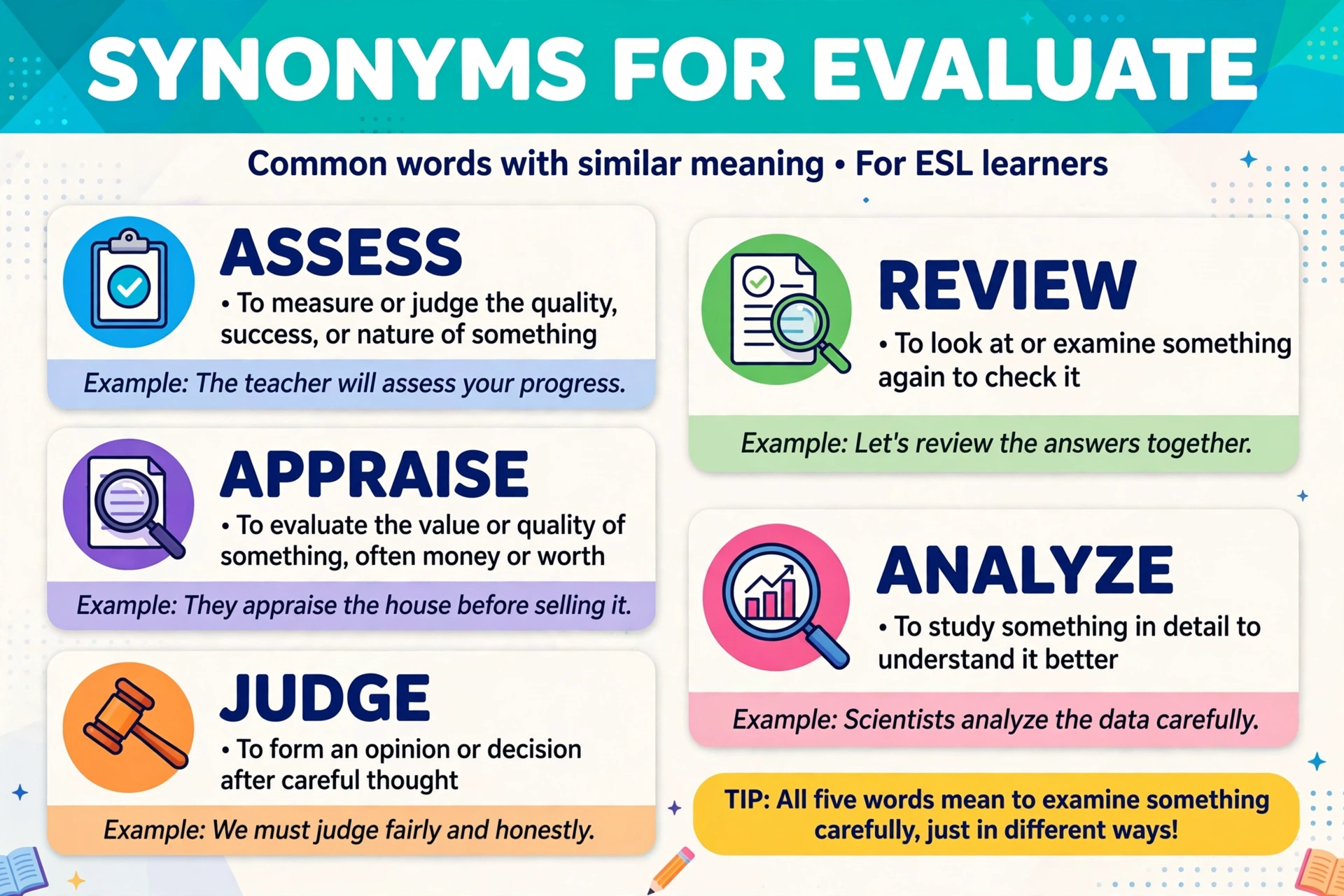
Assess
Meaning: To carefully judge the quality, condition, or importance of something.
Example: Before approving the budget, the committee will assess every department’s needs.
Example: The doctor assessed the injury before deciding on treatment.
Analyze
Meaning: To study something in detail, breaking it into parts to understand how it works.
Example: The marketing team analyzed last quarter’s sales data to find new trends.
Example: She analyzed the survey results to understand customer complaints.
Review
Meaning: To look over something again and give an opinion about how good or useful it is.
Example: Please review the contract carefully before you sign it.
Example: The editor reviewed the manuscript and suggested several cuts.
Judge
Meaning: To form an opinion about something’s quality or value after considering it.
Example: It is unfair to judge a new idea before you have tested it properly.
Example: The panel will judge the entries on creativity and originality.
Appraise
Meaning: To judge the monetary or market value of something, often by an expert.
Example: The jeweler appraised the antique ring at a surprisingly high price.
Example: They hired an expert to appraise the painting before the auction.
How to Use These Words
Choose by the kind of judgment you are making. Pick assess for a general, careful judgment — it is the closest all-rounder to evaluate. Pick analyze when the work is about studying details and evidence rather than judging worth. Pick review for a second look with an opinion attached. Pick judge when you are deciding quality or merit. Pick appraise only when money or market value is involved — it sounds wrong for anything else.
Pay attention to who is doing the judging, too. Analyze is the scientist’s word — detached and detail-focused. Appraise belongs to the expert with a price tag in mind. Judge carries moral or competitive weight — panels, courts, contests. Review suggests a second look by someone responsible, like an editor or a manager. Assess is the all-rounder that fits when no special role is involved. The judge and the judgment go together.
Common Mistakes to Avoid
- Analyzing when you should be judging. “We analyzed the candidates” means you studied their details; “we evaluated the candidates” means you decided who was best. In a hiring report, the second is usually what you mean — make sure your verb promises a verdict if a verdict is expected.
- Using “appraise” outside money. “The teacher appraised my essay” sounds odd — essays are evaluated or assessed, not priced. Reserve “appraise” for things with market value.
- Writing “judge” in sensitive feedback. “I judge your work as weak” sounds harsh and personal. In feedback, “assess” or “review” delivers the same message without the sting.
Related Words Worth Learning
- Synonyms for Efficient — judging how well systems perform
- Synonyms for Intelligent — the sharp thinking behind good analysis
- Synonyms for Evidence — what careful evaluation is built on
Quick Practice
Fill each blank with assess, analyze, review, judge, or appraise:
- “The insurance company sent someone to ___ the damage to the car.”
- “Scientists ___ the water samples for signs of pollution.”
- “Could you ___ my draft proposal before I send it to the client?”
Answer key: 1. assess (or appraise — both fit, since damage has a cost angle); 2. analyze (studying details and evidence); 3. review (a second look with an opinion). Notice how the first item has two good answers — real vocabulary often does.
FAQs
What is the closest synonym for evaluate?
“Assess” is usually the closest general match — both mean judging quality or value carefully. If your sentence is about studying details, “analyze” may fit better.
When should I use “appraise” instead of “evaluate”?
Use “appraise” when judging monetary or market value — houses, antiques, jewelry, businesses. For anything else, “evaluate” or “assess” sounds more natural.
Is there a difference between “analyze” and “evaluate”?
Yes. Analyzing means studying the parts and details to understand something. Evaluating means judging its quality or worth. You can analyze data without judging it, but evaluation always involves a verdict.
Can “review” replace “evaluate” in academic writing?
Sometimes, but “review” suggests looking over something again with an opinion, while “evaluate” is more formal and systematic. In research papers, “evaluate” or “assess” is usually the safer choice.
Evaluate vs estimate — what’s the difference?
Evaluate judges quality or worth; estimate guesses a number — cost, time, or size. You evaluate a performance but estimate a budget.
Is “assess” formal?
Somewhat. It is standard in education, business, and official reports. In casual speech, “check out” or “look at” often replaces it: “Let me assess the situation” becomes “Let me look at the situation” among friends.
Conclusion
Evaluate is a useful word, but precision beats repetition. Assess the situation, analyze the details, review the work, judge the quality, or appraise the value — each choice tells your reader exactly what kind of judgment you mean. Practice swapping these five into your next report or review, and your English will sound sharper immediately.
The next time you write “evaluate,” ask what kind of judgment you are really making — a study of details, a verdict on quality, a second look, or a price tag. Name the judgment, and the right word follows automatically.

Thomas Allen is a language writer and editor who loves exploring the subtle differences between words. He creates clear, practical guides that help readers understand English better — one word pair at a time.