The word interest is a shape-shifter. It can mean curiosity about a subject, enthusiasm for a hobby, attention to an issue, concern for a problem — and, in finance, the money charged on a loan. With so many jobs, it’s no wonder writers overuse it.
Each meaning deserves its own precise word. Whether you mean a spark of curiosity or a deep passion, a sharper alternative exists. Learning them makes your writing exact, colorful, and far more engaging.
Because ‘interest’ means so many things, guessing wrong can confuse your reader — are you curious, excited, or worried? These five words remove the guesswork, because each one fits a single, clear meaning. Pick the feeling first, then the word, and your message will always land exactly as intended. Keep this guide handy, and the perfect word will be waiting whenever ‘interest’ feels too vague — and your readers will thank you for it.
Polysemy — one word with many meanings — is English’s favorite trick, and “interest” is one of its best examples. Dictionaries list more than ten senses: curiosity, attention, concern, advantage, a share in a company, money on a loan. No wonder readers get confused. The professional solution is simple: never make your reader guess which “interest” you mean. Each synonym below locks onto exactly one meaning, so your sentence can only be read one way. That’s not just better vocabulary — it’s better communication.
When to Use a Synonym for Interest
First decide which “interest” you mean — curiosity, excitement, focus, or care. Then pick the word that matches.
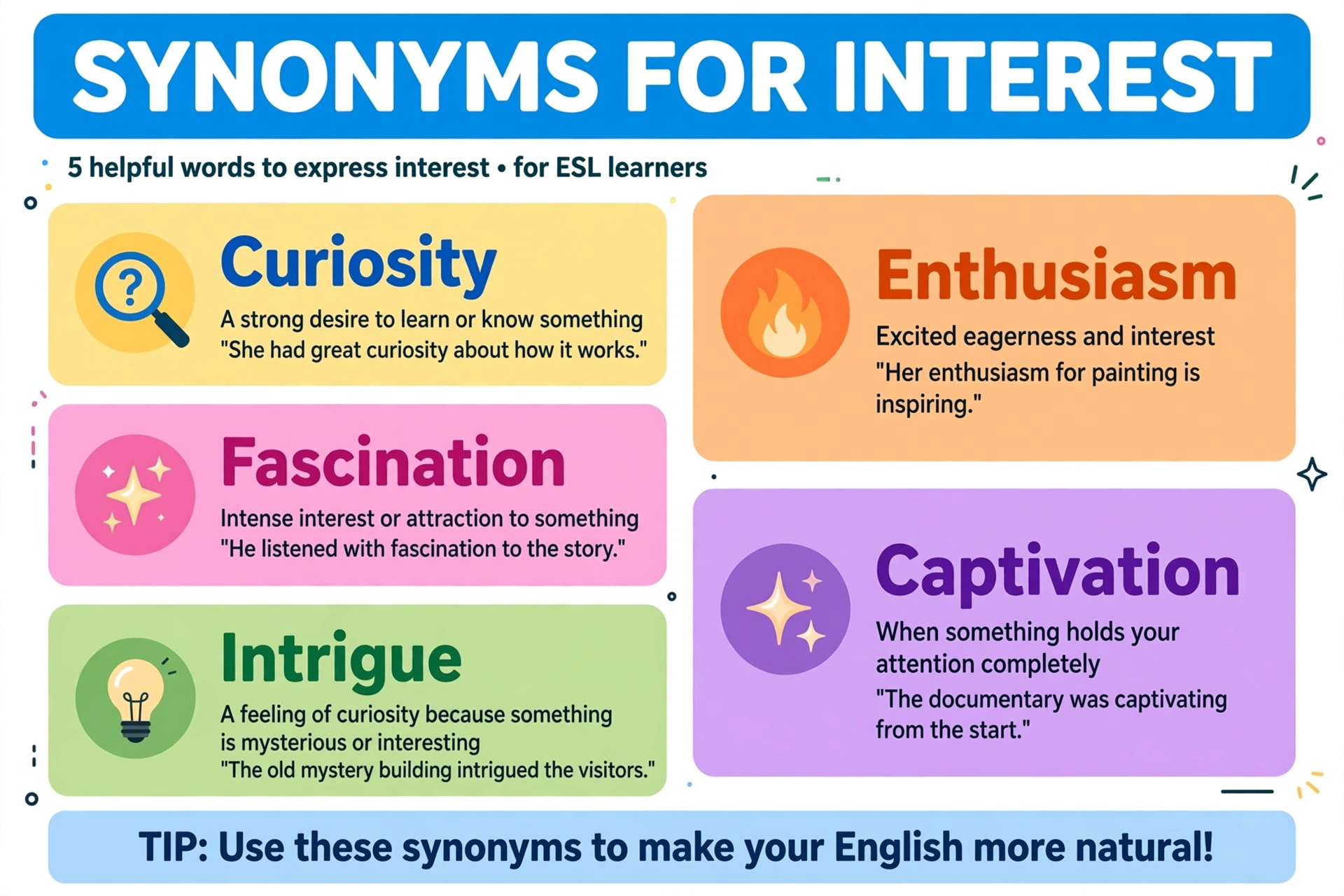
Curiosity
Meaning: A strong wish to know or learn more about something.
Example: Her curiosity about space began with a school telescope.
Another example: The strange lights in the sky sparked everyone’s curiosity.
Enthusiasm
Meaning: Strong excitement and lively interest in something.
Example: He showed great enthusiasm for the new project.
Another example: The crowd’s enthusiasm grew louder with every goal.
Fascination
Meaning: A very strong, almost magnetic feeling of interest.
Example: She has a lifelong fascination with ancient Egypt.
Another example: His fascination with robots began when he was a small child.
Attention
Meaning: Focusing your mind carefully on someone or something.
Example: The bright poster immediately caught my attention.
Another example: Pay close attention to the safety instructions before we begin.
Concern
Meaning: Caring about something because it matters or might be a problem.
Example: Road safety is a major concern for every parent.
Another example: The doctor expressed concern about my unhealthy diet.
How to Use These Words
Use curiosity for the desire to learn — students, readers, explorers. Use enthusiasm for energetic, positive excitement about activities and projects. Use fascination when the interest is deep and gripping, hard to look away from. Use attention for focus and concentration in the moment. Use concern when caring shades into worry or responsibility. The trick is simple: name the feeling behind the interest, and the right word appears.
Use the “money test” first: if your sentence is about finance, none of these five words fit — use “charges,” “returns,” or “dividends” instead. Once money is ruled out, ask about the emotion. Positive energy points to enthusiasm, quiet wonder to curiosity, magnetic pull to fascination, mental focus to attention, and caring worry to concern. Two quick questions, and the vague “interest” becomes the exact word.
Getting the exact word right is a learnable skill. Our guide to trick-or-treaters is a fun reminder that small spelling details carry real meaning — the same care turns a vague “interest” into the perfect word.
Related Words Worth Learning
- Synonyms for Interested — the adjective form, with its own rich options.
- Synonyms for Inspire — words that spark action.
- Synonyms for Fascinating — when something grips the mind.
Common Mix-Ups to Avoid
- Curiosity vs curiousness: use curiosity — “curiousness” is rare and sounds unnatural. “Her curiosity about space” is correct; “her curiousness” is not.
- Enthusiasm vs eagerness: enthusiasm is excited feeling about something; eagerness is readiness to act. You’re enthusiastic about the concert and eager to buy tickets.
- Concern vs worry: concern is calm, responsible caring (“concern for safety”); worry is anxious, uneasy feeling. A parent shows concern; a child feels worry.
Common Mistakes to Avoid
- “Interested” vs “interesting”: “I am interested” means you feel it; “it is interesting” means it causes the feeling. “I am interesting in music” is a classic error — the person is interested, the music is interesting.
- Spelling “curiosity”: The common misspelling “curiousity” appears in learner writing all the time. Remember: curiosity — the “u” follows the “o,” just like in “curious.”
- “Enthusiasm” without a preposition: “Enthusiasm the project” is wrong. You show enthusiasm for a project or about an idea — the preposition matters.
- “Concern” vs “concerned”: “Concern” is the noun (“a growing concern”); “concerned” is the adjective (“I am concerned”). “It is a big concerned” mixes them up.
Quick Practice
Pick the best word for each sentence: curiosity, enthusiasm, fascination, attention, concern.
- His ___ with dinosaurs began when he was only five years old.
- The team played the final with great ___ and energy.
- Air pollution is a growing ___ for doctors and scientists.
- The speaker held everyone’s ___ for two full hours.
Answer key: 1. fascination — a deep, magnetic pull. 2. enthusiasm — energetic, positive excitement. 3. concern — caring that shades into worry. 4. attention — focused minds in the moment.
FAQs
What is the best synonym for interest in an essay?
Curiosity fits learning and research; concern fits problems and issues; attention fits focus. Pick the one matching your essay’s angle rather than repeating “interest.”
What is the difference between interest and curiosity?
Curiosity is the desire to know more — it’s active and questioning. Interest is broader and calmer — you can be interested without being curious. Curiosity pulls you forward; interest keeps you watching.
Can enthusiasm replace interest?
When the interest is energetic and positive, yes: “enthusiasm for the project” is stronger than “interest in the project.” But enthusiasm doesn’t fit worry or calm attention — use concern or attention there.
What does “interest” mean in finance?
In finance, interest is the money a lender charges (or a saver earns) — a completely different meaning. Its synonyms there are dividends, returns, or charges, not the words in this article.
What is the verb form of “interest”?
Interest is also a verb: “The topic interests me.” Its past form is “interested” — which is why “I am interested” works as an adjective phrase too.
What does “vested interest” mean?
A vested interest is a personal stake in something — a reason to want a particular outcome. “He has a vested interest in the sale” means he personally benefits if it goes through.
Conclusion
Interest wears too many hats. Give each meaning its own word: curiosity for learning, enthusiasm for excitement, fascination for magnetic pull, attention for focus, and concern for caring. Your readers will always know exactly what you mean — and your vocabulary will look anything but boring.

Thomas Allen is a language writer and editor who loves exploring the subtle differences between words. He creates clear, practical guides that help readers understand English better — one word pair at a time.