The word intense describes something very strong — a feeling, an effort, a sensation, or an experience taken to a high degree. “Intense pressure.” “Intense joy.” “Intense training.” It is a strong word, but writers lean on it so often that it starts to feel generic.
English offers vivid alternatives, each painting a slightly different picture of strength. Some suggest force, others emotion, others severity. Learning them lets you describe powerful things powerfully — instead of just calling everything “intense.”
From sports commentary to love letters, strong feelings deserve strong words — not the same tired adjective on repeat. The five options below give you exact shades of intensity for any situation, each with a clear example. Learn when to use each one, and your descriptions will finally feel as powerful as the things they describe. The right word at the right moment is the difference between writing that shouts and writing that sings.
Adjectives are like spices: the same one in every dish ruins the meal. “Intense” is the black pepper of English — fine in small doses, overwhelming when it’s everywhere. “Intense workout, intense meeting, intense movie” — after three uses, your reader tastes nothing. The five words below are your spice rack. Fierce brings heat, severe brings gravity, extreme brings scale. Learning to season your descriptions is what separates competent writing from writing people actually enjoy reading.
When to Use a Synonym for Intense
Ask what kind of strength you mean: physical force? Deep emotion? Serious severity? The answer picks your word.
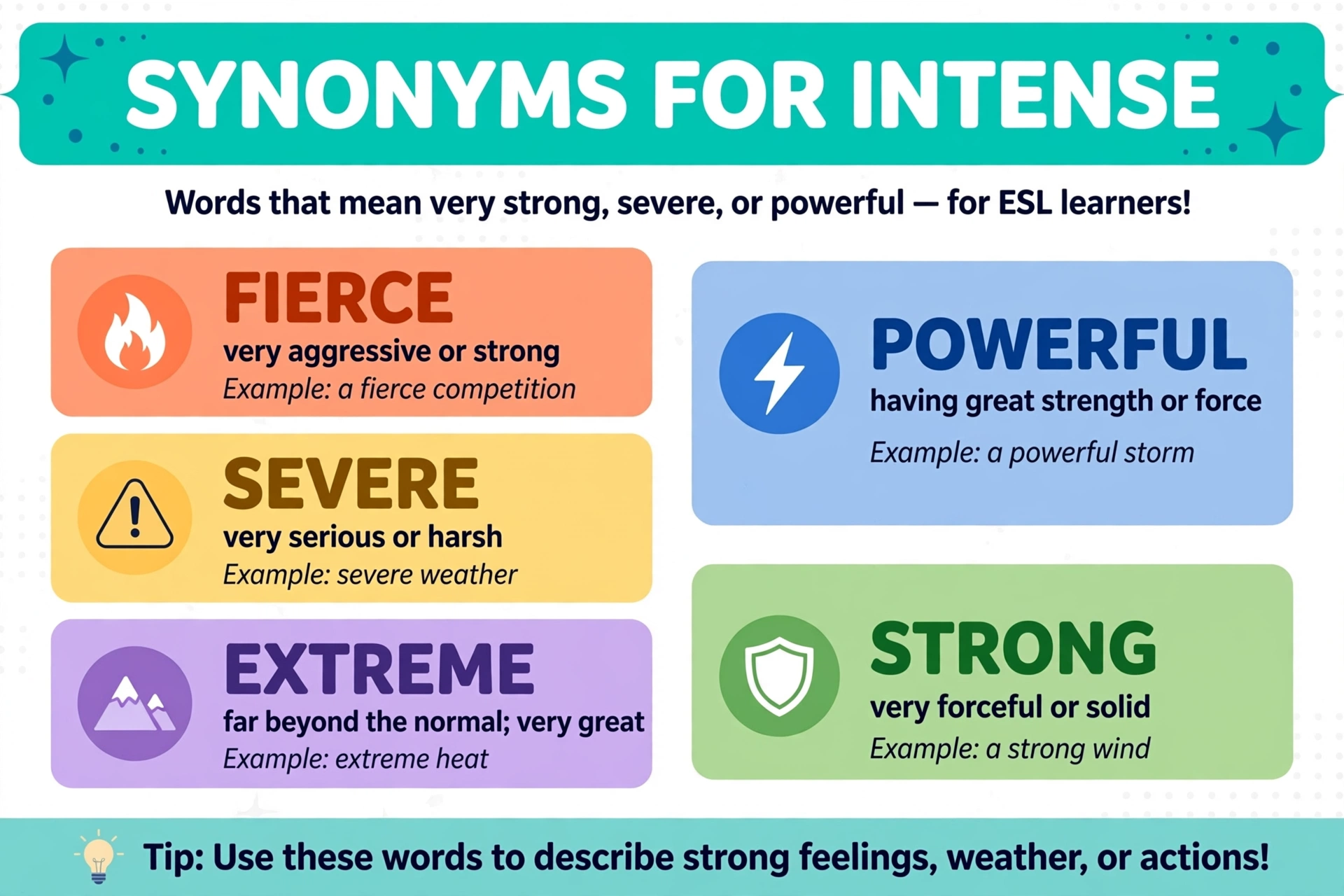
Strong
Meaning: Having great power; not weak — the simplest, most flexible option.
Example: She has a strong desire to win the competition.
Another example: The coffee was far too strong for my taste.
Powerful
Meaning: Full of force or energy; able to move people or things.
Example: His words had a powerful effect on the audience.
Another example: The engine is powerful enough to pull a heavy trailer.
Extreme
Meaning: Very great in degree; far beyond normal.
Example: The heat was extreme during the afternoon.
Another example: He loves extreme sports like skydiving and rock climbing.
Fierce
Meaning: Full of force and aggression; wild and strong.
Example: The two teams played a fierce match last night.
Another example: They faced fierce competition in the championship final.
Severe
Meaning: Very serious, strict, or harsh; strong in a difficult way.
Example: He felt severe pain after the injury.
Another example: The storm caused severe damage along the coast.
How to Use These Words
Use strong as your everyday all-rounder — it fits feelings, coffee, and arguments alike. Use powerful for speeches, emotions, and effects that move people. Use extreme for degrees and levels pushed far beyond normal — weather, sports, reactions. Use fierce for competition, storms, and anything wild or aggressive. Use severe for pain, problems, and punishment — strength with a serious edge. Naming the exact kind of strength is what makes writing vivid.
Pair each word with its natural partners — what linguists call collocations. Strong goes with coffee, opinions, and wind. Powerful goes with engines, speeches, and emotions. Extreme goes with sports, weather, and measures. Fierce goes with competition, battles, and loyalty. Severe goes with pain, storms, and criticism. Learning these partnerships is faster than memorizing definitions, and it makes your English sound instantly more natural.
Vivid writing rewards precision. Our guide to daddys-or-daddies shows how one small mark changes a word completely — choosing the exact synonym works the same magic on your sentences.
Related Words Worth Learning
- Synonyms for Powerful — more ways to describe strength.
- Synonyms for Inspire — words that lift and motivate.
- Synonyms for Determination — words for never giving up.
Common Mix-Ups to Avoid
- Intense vs intensive: intense describes strength of feeling or degree (“intense joy,” “intense heat”). Intensive describes concentrated effort over time (“intensive training,” “intensive care”). They look alike but are not interchangeable.
- Extreme vs severe: extreme marks the far end of a scale — the most, the highest (“extreme sports”). Severe marks seriousness with a harsh edge — pain, damage, punishment (“severe storm”). Joy can be extreme but never severe.
- Fierce vs ferocious: both mean wild and strong, but ferocious is wilder — it suggests something almost savage. A debate is fierce; a wild animal is ferocious.
Common Mistakes to Avoid
- “Very intense” as an intensifier: It’s weak — “intense” already means very strong. Use “extremely intense” for extra force, or pick a stronger word instead.
- “Severe” for positive things: “Severe happiness” is a contradiction. Severe always carries trouble — pain, damage, harsh weather, punishment.
- “Fierce” for gentle things: “A fierce whisper” is poetic but confusing. Fierce needs force or wildness — save it for real energy and real conflict.
- “Extreme” as a noun for people: “He’s an extreme” is slang, not standard English. The noun for a person with radical views is “extremist,” which carries political overtones — use it carefully.
Quick Practice
Pick the best word for each sentence: strong, powerful, extreme, fierce, severe.
- The ___ wind knocked over the garden fence last night.
- She suffers from ___ headaches almost every week.
- The movie’s ending was full of chases and explosions — truly ___.
- Lions are famous for their ___ hunting skills.
Answer key: 1. strong (or fierce) — natural force. 2. severe — serious pain. 3. extreme — pushed past normal limits. 4. fierce — wild, aggressive energy.
FAQs
What is the strongest word for intense?
Extreme suggests the highest degree of all — something pushed past normal limits. Fierce is strongest for wild, aggressive force, while severe is strongest for serious, harsh situations.
What is the difference between intense and intensive?
They look alike but differ. Intense describes strength of feeling or degree (“intense joy”). Intensive describes concentrated effort over time (“intensive training,” “intensive care”). Don’t swap them.
Can severe replace intense?
Only when the strength is serious or harsh — pain, damage, weather, criticism. You wouldn’t call joy “severe.” Match the word’s tone to your meaning.
Is “intense” formal or informal?
Intense is neutral — it works in both casual and formal writing. For formal essays, extreme, severe, or considerable often sound more polished.
What is the adverb form of “intense”?
Intensely — as in “she stared intensely at the screen.” Don’t confuse it with “intensive,” which is a different adjective meaning concentrated effort.
Can “intense” describe a person?
Yes, but it describes their personality: “an intense person” is passionate, serious, and deeply focused — sometimes too much so. It can be a compliment or a gentle warning, depending on your tone.
Conclusion
Intense says “very strong” — but these five say it better. Strong for everyday power, powerful for moving force, extreme for pushed limits, fierce for wild energy, and severe for serious strength. Stop calling everything intense, and your descriptions will finally feel as strong as the things they describe.

Thomas Allen is a language writer and editor who loves exploring the subtle differences between words. He creates clear, practical guides that help readers understand English better — one word pair at a time.