“Lost” is a word that tries to do too much. It can mean a missing wallet, a wrong turn in a new city, a blank mind during an exam, or a heavy feeling after failure. When one word covers missing objects, confusion, and emotion all at once, your reader has to guess which one you mean.
Precise synonyms remove the guessing. Missing is about things that cannot be found, misplaced is about your own mistake, confused is about the mind, vanished is dramatic and sudden, and uncertain is about doubt. Each one points at a different experience. Clear word choice matters everywhere in English — as our chose vs choose guide shows, even a single letter can redirect a sentence.
The confusion around “lost” is common because feelings and facts share the word. Saying “I feel lost” could mean confusion, grief, or aimlessness — three very different problems. Naming the real one, whether it is “uncertain” about a choice or “confused” by information, is the first step toward solving it, in writing and in life.
There is a practical side to this precision, too. In customer service, “your package is missing” triggers a search; “your package is delayed” triggers patience — and “lost” triggers panic. In a clinic, “the patient seems confused” leads to tests, while “the patient seems lost” leads nowhere. The sharper word does not just sound better; it gets better results.
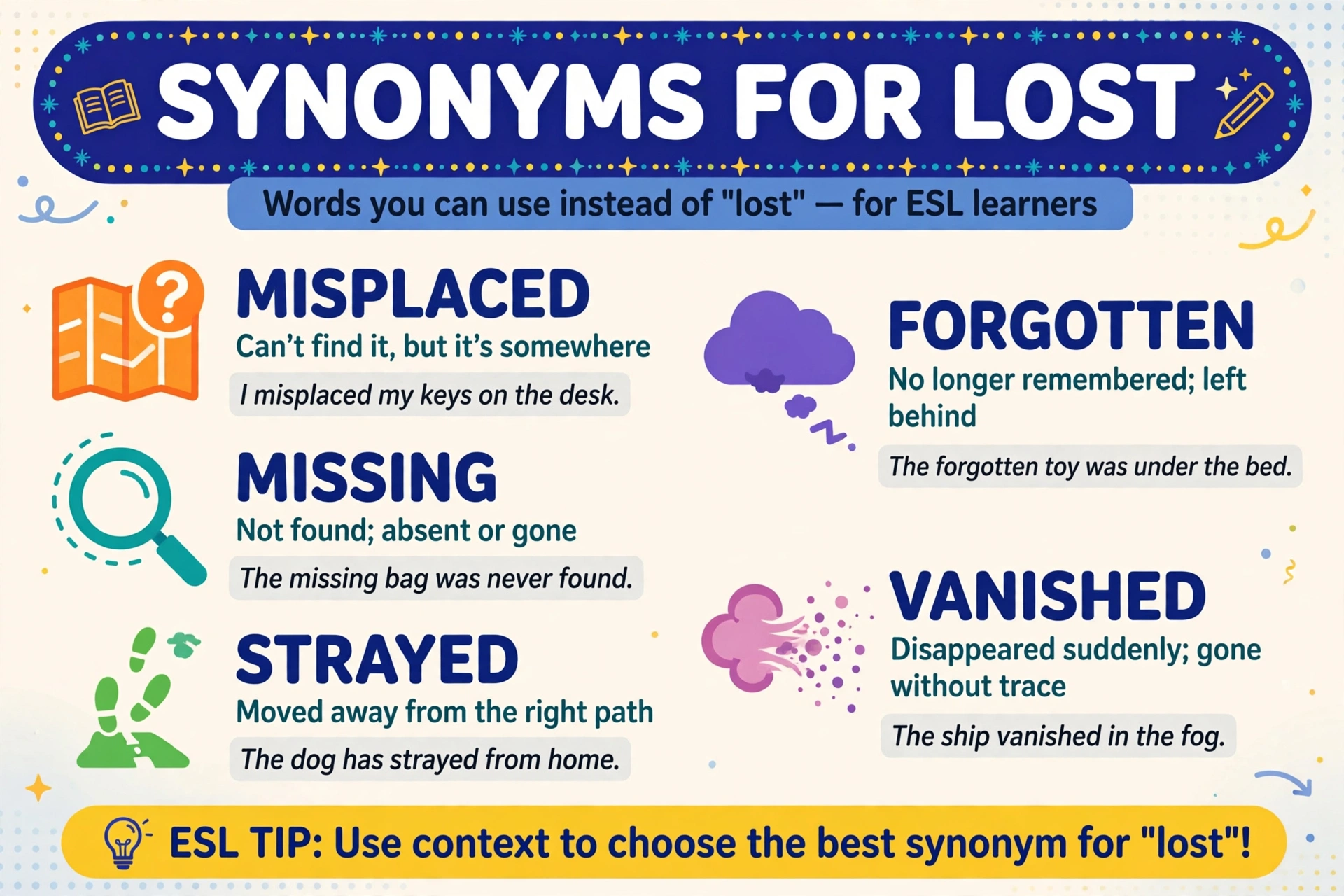
Missing
Meaning: Not able to be found; absent from where it should be.
Example: My wallet is missing, and I have searched the whole house.
Another example: Two pages were missing from the borrowed book.
Misplaced
Meaning: Put in the wrong place by mistake, usually by the speaker.
Example: I misplaced my glasses somewhere in the office yesterday.
Another example: He misplaced the receipt and could not return the shirt.
Confused
Meaning: Unable to think clearly or understand what is happening.
Example: The complicated instructions left me completely confused.
Another example: The new software update left many users confused.
Vanished
Meaning: Disappeared suddenly and completely, as if by magic.
Example: The rabbit vanished into the bushes before we could follow.
Another example: The magician’s assistant vanished from the locked box.
Uncertain
Meaning: Not sure about something; feeling doubt about a decision or future.
Example: She felt uncertain about accepting the new job offer.
Another example: Investors remain uncertain about the market’s direction.
Quick Comparison
| Word | Situation | Best for |
|---|---|---|
| Missing | Cannot be found | Objects, people |
| Misplaced | Your own mistake | Honest explanations |
| Confused | Unclear thinking | Minds, instructions |
| Vanished | Sudden disappearance | Stories, drama |
| Uncertain | Doubt | Decisions, future |
How to Use These Words
Sort your “lost” into a category first. For objects, choose “missing” (general) or “misplaced” (your fault) — the second one is more honest and more precise. For the mind, “confused” is the natural pick. For dramatic disappearances in stories, “vanished” adds energy that “lost” cannot. For feelings about decisions, “uncertain” is calmer and more adult than saying you feel lost. This habit of sorting meaning before choosing words is the same discipline our since vs because guide teaches for cause-and-effect language. Before you type “lost,” ask: is something missing, is my mind confused, or is my heart uncertain? The answer picks the word for you.
Urgency is another clue. “Missing” and “vanished” demand action — a missing child, a vanished plane. “Uncertain” and “confused” ask for patience and explanation. Matching the word to the urgency keeps your tone appropriate.
Common Mistakes to Avoid
- “Lose” vs “loose.” “Lose” (one O) is the opposite of find or win; “loose” (two O’s) means not tight. “Don’t lose your keys” vs “a loose tooth.”
- “Missing” for minor mix-ups. If you put the keys in the wrong drawer, you “misplaced” them — “missing” suggests they may be gone for good.
- “Vanished” in formal reports. It sounds dramatic, almost magical. In business or academic writing, “disappeared” is calmer and safer.
- Saying “I am lost” when you mean “I don’t understand.” In meetings, “I’m a bit confused by this slide” is clearer and more professional than “I’m lost.”
Quick Practice
Choose the best word for each sentence: missing, misplaced, confused, vanished, uncertain
- The hikers were ___ about which trail led back to camp.
- She ___ her passport somewhere between the hotel and the airport.
- The old mansion seemed to have ___ into the fog.
- He felt ___ whether to accept the offer or wait.
Answer key: 1. confused 2. misplaced 3. vanished 4. uncertain
Related Words Worth Learning
Words to Use With Care
Do not mix up “lose” and “loose” — “lose” is the opposite of find or win, while “loose” means not tight. Also, use “missing” carefully for people; “a missing child” is serious and formal, while “a missing sock” is everyday. Match the word’s weight to the situation.
FAQs
What is the difference between “missing” and “misplaced”?
“Missing” simply means something cannot be found. “Misplaced” adds that someone — usually you — put it in the wrong place by mistake.
Is “vanished” too dramatic for everyday use?
It has energy, so save it for sudden, complete disappearances. In a formal report, “disappeared” is calmer; in a story, “vanished” shines.
Can “lost” describe feelings?
Yes — “feeling lost” means confused or without direction in life. For that emotion, “uncertain,” “confused,” or “adrift” are more precise.
What is a polite way to say someone is “lost” in a discussion?
Say they seem “confused” or “uncertain.” Both are gentler than “lost” and describe the mind rather than the person.
What is the difference between “lose” and “loose”?
“Lose” (one O, rhymes with “news”) means to misplace something or fail to win. “Loose” (two O’s, rhymes with “goose”) means not tight or free. They are among the most confused pairs in English.
Can “lost” be positive?
Rarely, but yes — “lost in a good book” or “lost in thought” describes pleasant absorption. Outside those phrases, “lost” usually signals a problem.
Conclusion
“Lost” points in too many directions at once. Now you can aim better: missing for absent things, misplaced for your own mistakes, confused for cloudy thinking, vanished for sudden disappearances, and uncertain for doubt. Precise words respect your reader’s time. Use them, and your writing will say exactly what you mean. The next time “lost” feels too vague, you will know it is a signal — not a sentence — pointing you toward the sharper word underneath.

Thomas Allen is a language writer and editor who loves exploring the subtle differences between words. He creates clear, practical guides that help readers understand English better — one word pair at a time.