The word dynamic is a favorite in English because it packs two ideas into one: energy and change. A dynamic leader brings vigor to a team, a dynamic market never sits still, and a dynamic story keeps readers on edge. But because the word covers so much ground, it often feels vague. Saying “a dynamic person” could mean someone lively, someone adaptable, or someone powerful — and your reader has to guess which.
That is exactly why precise synonyms matter. When you pick the exact shade of meaning — lively for personality, adaptable for change, vibrant for atmosphere — your writing becomes sharper and more memorable. Below are five strong, everyday synonyms for dynamic, each with a clear meaning and a natural example sentence.
Whether you are writing an essay, a business email, or a social media caption, the right synonym signals that you truly understand the situation. That precision is what separates strong, confident English from vague, forgettable writing.
This guide gives you five of the strongest options, each with a clear meaning, two natural examples, and notes on when it fits best. By the end, you will not only know five new words — you will know exactly when to use each one, which is the skill that separates a large vocabulary from a useful one.
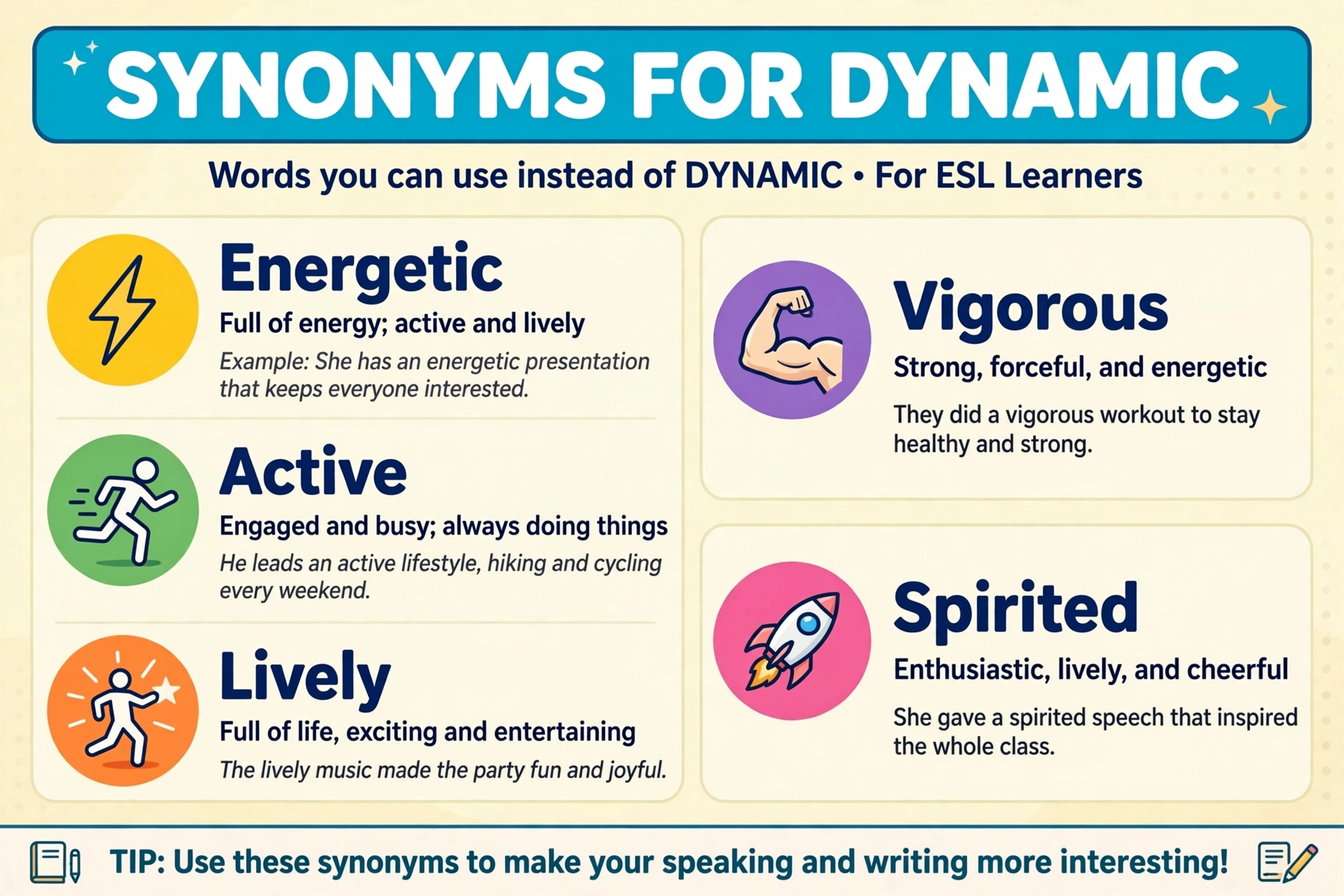
Energetic
Meaning: Having a great deal of physical or mental liveliness; always ready for action and rarely sitting still.
Example: The energetic coach kept the whole team moving through the final drill.
Example: His energetic morning routine includes a run, a big breakfast, and a dozen phone calls before nine.
Lively
Meaning: Full of life and spirit; cheerful and animated in a way that lifts the mood of everyone nearby.
Example: The lively discussion kept everyone in the classroom wide awake.
Example: The lively puppy chased its tail around the living room while the children laughed.
Vibrant
Meaning: Radiating strong, bright energy; vivid, colorful, and unmistakably full of life.
Example: The vibrant festival filled the streets with music and color.
Example: She painted the kitchen a vibrant yellow that made the whole room feel sunnier.
Active
Meaning: Busy doing things; engaged and involved in life rather than passive or idle.
Example: She stays active in her community by volunteering every weekend.
Example: Even in retirement, he leads an active life of hiking, reading, and travel.
Adaptable
Meaning: Able to adjust quickly when conditions change; comfortable and flexible in unfamiliar situations.
Example: An adaptable employee learns new software without complaint.
Example: An adaptable traveler enjoys street food in a new city as happily as fine dining at home.
How to Use These Words
Match the word to the situation. Describing a person’s character? Reach for energetic or lively. Painting the mood of a place? Vibrant does the heavy lifting. Talking about habits and involvement? Active fits best. And when the point is handling change itself, adaptable is the precise choice — and if you ever confuse adapt with a similar-looking word, our guide to adapt vs adopt clears it up in minutes.
Also think about intensity and time. Energetic and lively describe high spirit in the moment, while active describes a steady pattern over time — compare a lively guest at one party with an active member of a club. Vibrant leans visual and sensory, so it suits descriptions of places, art, and events. And adaptable is the odd one out in a good way: it is less about energy and more about response to change, which makes it perfect for résumés and professional profiles where “dynamic” itself often sounds empty.
Word Shades at a Glance
| Word | Reach for it when you mean… |
|---|---|
| Energetic | a person buzzing with readiness for action |
| Lively | cheerful, animated spirit that lifts a room |
| Vibrant | a bright, striking atmosphere or culture |
| Active | someone busy and involved as a habit |
| Adaptable | handling change smoothly and without fuss |
Common Mistakes to Avoid
- Calling a steady worker “dynamic.” If nothing is changing or moving fast, the word is wrong — “reliable” or “consistent” is more honest, and honesty builds trust with readers.
- Using “vibrant” for people in formal writing. Vibrant usually describes places, colors, or cultures (“a vibrant city”), not a manager’s leadership style. For people, prefer “lively” or “energetic.”
- Mixing up “adaptable” and “adaptive.” Adaptable describes a person or system that adjusts well (“an adaptable team”). Adaptive usually describes a tool designed to adjust itself (“adaptive software”). Close, but not the same.
- Describing calm situations as dynamic. A peaceful library or a stable routine is the opposite of dynamic. For steady, unchanging scenes, “calm,” “stable,” or “peaceful” is honest — “dynamic” would confuse the reader.
Related Words Worth Learning
Quick Practice
Choose the best word — energetic, lively, vibrant, active, or adaptable — for each sentence:
- “The ___ marketplace was full of shouting vendors and bright fabrics.”
- “After the restructuring, the company needed ___ managers who could handle new roles.”
- “He is an ___ volunteer who never misses a weekend event.”
Answer key: 1. vibrant (a bright, striking atmosphere); 2. adaptable (handling change smoothly); 3. active (busy and involved as a habit). Try writing your own three sentences next — using a new word immediately is the fastest way to own it.
FAQs
What is the best synonym for a dynamic personality?
Energetic or lively usually fits best, because personality is about character and spirit. Use adaptable only if you mean the person handles change well.
Can “dynamic” describe things, not just people?
Yes. Markets, systems, stories, and cities are all commonly called dynamic when they are full of movement or rapid change.
What is the difference between dynamic and energetic?
Energetic is about the level of energy right now. Dynamic adds the idea of change and force — a dynamic situation is not just lively, it is shifting and powerful.
Is “dynamic” a formal word?
It is neutral. It works in business reports, academic writing, and casual conversation alike, which is part of why it gets overused.
What is the opposite of dynamic?
Static or stagnant are the closest opposites. A static situation does not move or change, while a dynamic one is full of motion and energy.
Which synonym works best in a job application?
Adaptable is the safest choice for résumés — it is specific and credible. Energetic works for roles needing drive, but avoid “dynamic” itself, since hiring managers see it so often that it has lost its impact.
Conclusion
Dynamic is a useful word, but its broadness is also its weakness. Swapping in energetic, lively, vibrant, active, or adaptable lets you say exactly what you mean — and exact words are what make writing stick. Try replacing “dynamic” with one of these five in your next email or essay and notice how much clearer the sentence becomes.
The next time you reach for the word dynamic, pause for two seconds and ask what you really mean: high spirits, a bright atmosphere, steady involvement, or smooth handling of change. That two-second pause is the habit that builds a precise vocabulary — and precise words are what make readers remember your writing long after they finish it.

James Reed is a writer and English language enthusiast with a passion for making vocabulary simple and fun. He writes about words, meanings, and everyday English to help learners speak and write with confidence.