Vulnerable describes being open to harm — physically, emotionally, or socially. It is a sensitive word that appears in essays about feelings, reports about safety, and discussions of health. Because the topic is delicate, choosing the exact right synonym matters even more than usual: the wrong word can sound cold, exaggerated, or simply wrong.
The five alternatives below range from fragile objects to exposed people. Each comes with a clear meaning and an original example, so you can describe weakness and risk with care and accuracy.
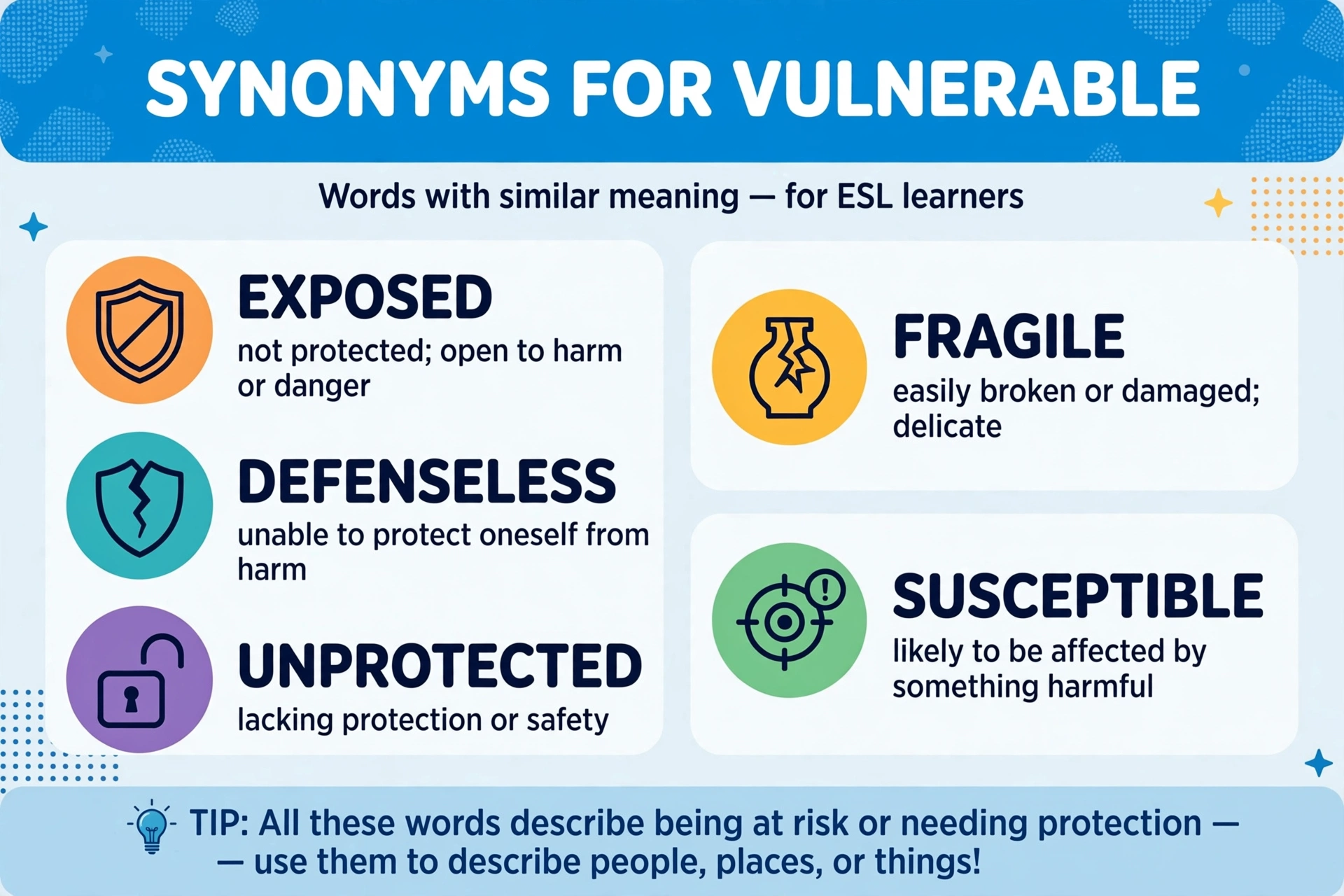
These five were chosen with care because vulnerability is a delicate topic. Fragile suits breakable things and tender feelings, defenseless and exposed describe lack of protection, susceptible names a specific threat, and helpless marks the inability to act. The examples below keep a gentle tone on purpose — describing weakness well means writing with sensitivity, not drama.
A word of caution about tone: these five words all describe weakness, so they can wound when aimed at people. In personal writing, soften them with context — “a fragile moment” hurts less than “a fragile person.” Precision here is not just good style; it is kindness.
Fragile
Meaning: Easily broken or hurt, whether an object, a feeling, or a situation.
Example: After the argument, the trust between them remained fragile for weeks.
Another example: The newborn’s health was fragile during those first difficult days.
Defenseless
Meaning: Without any means of protection against attack or criticism.
Example: The small village was defenseless when the floodwaters arrived.
Another example: Without encryption, the old database was defenseless against hackers.
Exposed
Meaning: Left uncovered and unprotected, open to danger or view.
Example: Hikers felt exposed on the ridge as the storm clouds gathered.
Another example: The whistleblower felt exposed after his name appeared in the report.
Susceptible
Meaning: Likely to be affected by something harmful, such as illness or pressure.
Example: Tired children are more susceptible to catching colds in winter.
Another example: First-time buyers are often susceptible to high-pressure sales tactics.
Helpless
Meaning: Unable to act or protect yourself in a difficult moment.
Example: She felt helpless watching the flight get cancelled with no alternatives.
Another example: The lost tourist felt helpless without a phone signal or a map.
How to Use These Words
First decide what is at risk. For breakable things and tender feelings, fragile is the natural word. When someone has no protection at all, use defenseless; when the danger comes from being uncovered or visible, exposed fits better. Susceptible works best with a specific threat named after it — susceptible to criticism, to flu, to flattery. Reserve helpless for moments when a person cannot act, not for objects. Because these words describe weakness, use them gently when writing about real people.
Grammar note: susceptible is almost always followed by “to” plus the threat — “susceptible to infection,” “susceptible to flattery.” Exposed pairs with “to” as well — “exposed to danger,” “exposed to criticism.” Fragile, defenseless, and helpless usually stand alone. These patterns are worth memorizing because a missing preposition is the fastest way to sound unnatural.
Common Mistakes to Avoid
- Calling people “fragile” casually. Fragile suits objects and feelings; aimed at a person it can sound insulting. “A fragile ego” is fine in analysis, but avoid labeling people themselves as fragile.
- Using helpless for mild inconvenience. Helpless means truly unable to act. A delayed train is annoying, not helpless-making — save the word for genuine powerlessness.
- Forgetting the “to” after susceptible. The pattern is always “susceptible to something.” Writing “susceptible of” or dropping the preposition entirely marks you as a learner immediately.
Quick Practice
Choose the best word for each blank: fragile, defenseless, exposed, susceptible, helpless.
- The peace talks left both sides in a surprisingly __________ mood.
- Without a firewall, the network was completely __________.
- Elderly patients are more __________ to winter infections.
Answer key: 1. fragile 2. defenseless 3. susceptible
Put Them Into Practice
Handle these words thoughtfully with this drill. First, sort the five into two groups: words for things (fragile) and words for people and situations (the rest). Second, write one careful sentence for each, keeping the tone respectful — for example, describe a fragile friendship rather than a fragile person. Third, practice the pattern ‘susceptible to’ by completing it five different ways, since that preposition is the word’s most common partner. Finally, review your sentences and ask: would the person described feel respected reading this? If yes, you have mastered both the vocabulary and the tact it requires.
Quick self-test: Without looking back, sort fragile, defenseless, exposed, susceptible, and helpless into two columns: words for breakable things and words for people facing risk. Then write one gentle, respectful sentence for each word. If you can do this calmly and accurately, you have mastered both the vocabulary and the sensitivity it demands. Repeat the drill with fresh sentences tomorrow; two short sessions beat one long session.
Related Words Worth Learning
Keep building your vocabulary with these closely connected word sets:
- Synonyms for Confidence: 5 strong words for self-belief — the right way to describe “fragile confidence.”
- Synonyms for Inspire: 5 gentle words for lifting people up, from encourage to uplift.
- Synonyms for Resilience: 5 words for recovering and standing strong again.
FAQs
What is the difference between vulnerable and fragile?
Vulnerable is broader — it covers emotional, social, and physical exposure. Fragile is narrower and more physical: it suggests something that could actually break, like glass or a recovering relationship.
Which synonym suits an essay about emotions?
Fragile and exposed work beautifully for emotions. “Fragile confidence” and “feeling exposed” both sound natural and sensitive without being dramatic.
Is “helpless” too strong for everyday use?
It can be. Helpless implies a total inability to act, so save it for genuinely serious moments. For mild situations, exposed or susceptible sound more measured.
Can “susceptible” be used positively?
Rarely. Susceptible almost always points to a negative influence — disease, pressure, or temptation. For positive openness, choose receptive instead.
What is the difference between defenseless and helpless?
Defenseless means lacking protection against an outside threat; helpless means unable to act at all. A city can be defenseless against floods while its people still act bravely — the words describe different kinds of weakness.
Can “exposed” be positive?
Sometimes. A photographer wants her work exposed to a wide audience, and an idea gains strength when exposed to debate. The word is neutral — the context decides whether exposure is danger or opportunity.
Conclusion
Describing vulnerability well is a mark of careful writing. Fragile, defenseless, exposed, susceptible, and helpless each capture a different kind of openness to harm. Choose the one that matches your exact situation, handle the topic with sensitivity, and your words will land exactly as you intend. Use them gently, choose them precisely, and your writing about difficult subjects will earn your readers’ trust. Keep practicing; precision with delicate words is a skill well worth building.

James Reed is a writer and English language enthusiast with a passion for making vocabulary simple and fun. He writes about words, meanings, and everyday English to help learners speak and write with confidence.