Confidence is the quiet belief that you can handle whatever comes your way. It shows in how you speak, how you stand, and how you make decisions under pressure. Students need it before exams, professionals need it in meetings, and writers need it on every page. Yet repeating the same word in every essay, speech, or conversation quickly makes your English sound flat and repetitive.
That is where synonyms earn their place. Each alternative carries its own shade of meaning, and choosing the right one makes your message sharper, more precise, and more memorable. Below are five strong synonyms for confidence, each with a clear meaning and a practical example sentence. Learn them one by one, and you will never be stuck repeating yourself again.
These five were picked because they cover the whole landscape of confidence — the calm of poise, the daring of boldness, the steadiness of self-assurance. Some describe feelings, others describe actions, and together they form a complete toolkit. As you read, notice how each example places the word in a realistic situation; picturing the scene is the fastest way to lock a new word into memory.
One more tip before you begin: say each new word aloud as you meet it. Confidence vocabulary is meant to be spoken — in interviews, presentations, and everyday conversation — so training your mouth as well as your eyes doubles the benefit. If a word feels stiff the first time, repeat its example sentence twice; the sound becomes natural quickly, and natural-sounding words are the ones you will actually use.
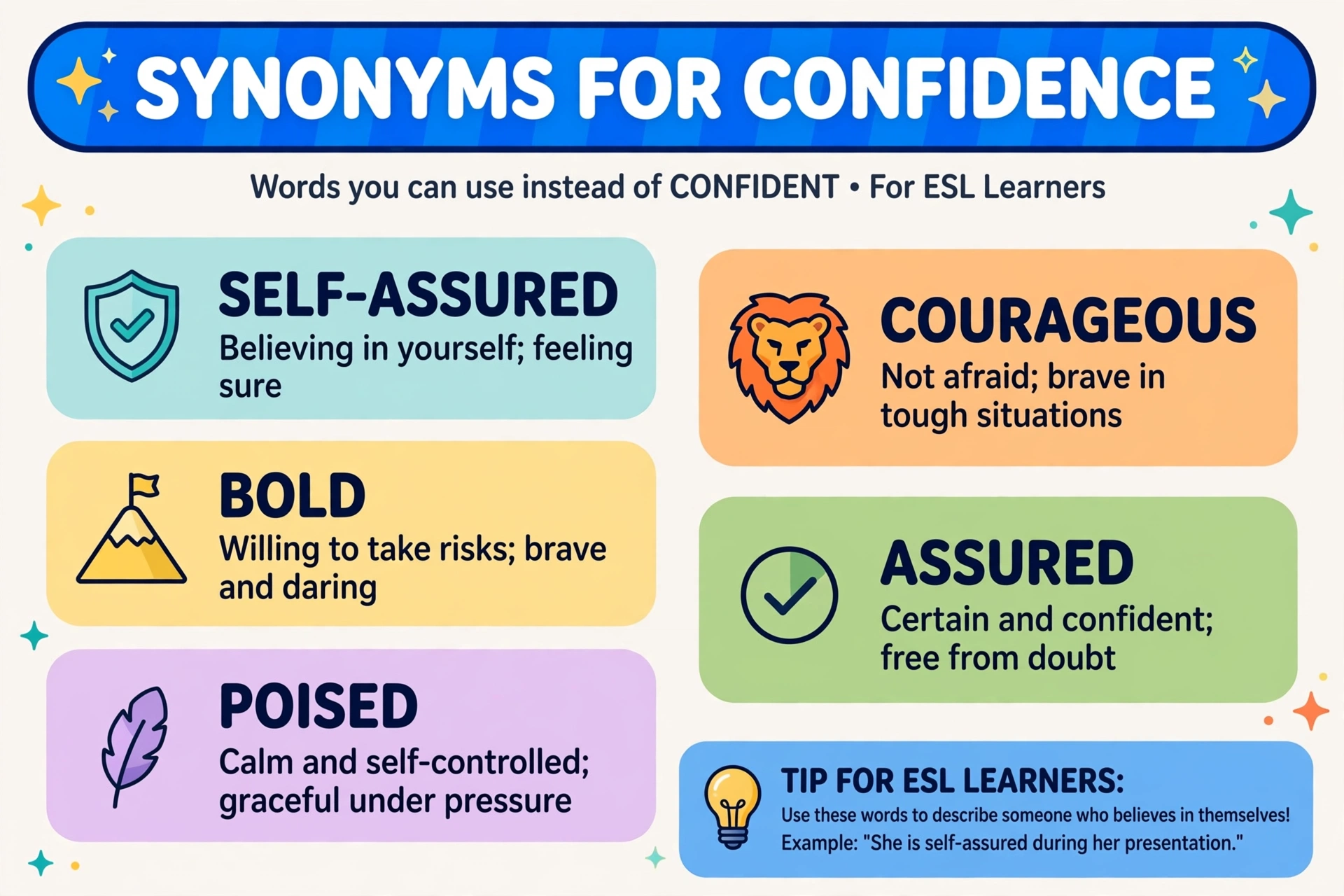
Self-Assurance
Meaning: A calm, steady trust in your own abilities, expressed without arrogance or nervousness.
Example: She answered the panel’s toughest questions with complete self-assurance.
Example: Even after the project’s first failure, his self-assurance never wavered.
Courage
Meaning: The inner strength to take action even when you feel afraid or uncertain about the outcome.
Example: It took real courage for him to admit the mistake in front of the whole team.
Example: She showed quiet courage by changing careers at the age of forty.
Boldness
Meaning: A willingness to take risks and to speak or act without hesitation or apology.
Example: Her boldness in pitching such an unusual idea won over the investors.
Example: The startup’s boldness in ignoring the critics paid off within a single year.
Poise
Meaning: Graceful calm and self-control, especially visible in stressful or unexpected moments.
Example: The young speaker kept her poise even after the microphone suddenly stopped working.
Example: Despite the hostile questions, the diplomat answered with perfect poise.
Assertiveness
Meaning: The skill of expressing your opinions and needs clearly, firmly, and respectfully.
Example: Learning assertiveness helped him decline extra work without feeling guilty afterward.
Example: Her assertiveness in the meeting made sure the team’s concerns were heard.
How to Use These Words
Match the word to the moment, because near-synonyms are rarely perfect swaps. Use poise when someone stays calm under pressure, such as a speaker handling a tough crowd. Choose boldness when someone takes a daring risk, like launching a new business. Pick assertiveness when the topic is communication — saying what you think without being rude. Reserve courage for situations that involve real fear, and self-assurance for steady, quiet competence in everyday work. Reading your sentence aloud is a quick test: if the word feels forced, try another one from the list.
Also mind the register: poise and self-assurance sound polished in formal writing, while boldness and courage suit vivid storytelling. In an academic essay, “the author’s self-assurance” reads better than “the author’s boldness,” which can sound like showing off. Small choices like these are what make advanced vocabulary feel natural rather than memorized.
Common Mistakes to Avoid
- Using boldness when you mean rudeness. Boldness describes brave, confident action — not ignoring other people’s feelings. “He was bold” praises courage; if you mean he was rude, say so directly.
- Confusing poise with posing. Poise is genuine calm under pressure; posing is pretending. A speaker with poise is truly composed, not acting a part.
- Saving courage only for battlefields. Courage also covers quiet everyday bravery — admitting a mistake, changing direction, speaking up for someone who is absent. Do not reserve it for dramatic scenes.
Quick Practice
Choose the best word for each blank: self-assurance, courage, boldness, poise, assertiveness.
- She walked into the interview with complete __________.
- It took real __________ to tell the truth after hiding it for months.
- His __________ in questioning the budget impressed the board — and annoyed his manager.
Answer key: 1. self-assurance 2. courage 3. boldness
Put Them Into Practice
New words fade unless you use them, so try this short routine. First, cover the meanings above and quiz yourself: can you recall each word from its definition alone? Second, write one fresh sentence per word about your own life — for example, a moment when you showed poise or needed courage. Third, speak one of your sentences aloud; hearing a word in your own voice makes it stick far better than silent reading. Finally, drop one of the five into a real message, email, or class discussion today. A word used once in real life is a word you will remember next month.
Related Words Worth Learning
Keep building your vocabulary with these closely connected word sets:
- Synonyms for Determination: 5 precise words for the refusal to give up, from quiet resolve to raw grit.
- Synonyms for Inspire: 5 exact words for moving people to act, from motivate to empower.
- Synonyms for Resilience: 5 strong words for bouncing back, from endurance to fortitude.
FAQs
What is the difference between confidence and self-assurance?
They are close, but self-assurance describes a calmer, more settled kind of confidence — the opposite of nervous energy. Confidence is the broader term that covers every shade, while self-assurance points to quiet steadiness.
Which synonym works best for a job interview?
Self-assurance and poise fit interviews best, since both suggest calm competence rather than loud bravado. Saying you handled a project “with poise” sounds more polished than simply saying you were “confident.”
Is boldness always a positive word?
Not always. Boldness sounds admirable in business and creativity, but it can sound reckless when safety or other people are involved. Always check the context before choosing it.
Can poise describe body language?
Yes. Poise often refers to physical calm as well — steady posture, controlled gestures, and an unhurried voice. That is why it appears so often in descriptions of speakers, dancers, and athletes.
Can confidence become a weakness?
Yes, when it hardens into arrogance. Healthy confidence trusts your abilities; arrogance dismisses everyone else’s. Words like self-assurance and poise keep the positive tone, while boldness sits closest to the line — use it thoughtfully.
How can I sound confident without sounding proud?
Pick calm words over loud ones. “She handled the crisis with poise” sounds confident and modest, while “she boldly saved the day” sounds like boasting. Let the facts carry the praise and keep the adjective quiet.
Conclusion
Confidence is a big idea, and now you have five precise words to express it. Self-assurance, courage, boldness, poise, and assertiveness each highlight a different side of believing in yourself, from quiet calm to daring action. Practice them in real sentences this week — in messages, essays, or everyday conversations — and watch your vocabulary grow stronger with every single use. Keep this list somewhere visible — a notebook, a phone note, or a sticky note on your desk — and glance at it whenever your writing starts repeating itself.

James Reed is a writer and English language enthusiast with a passion for making vocabulary simple and fun. He writes about words, meanings, and everyday English to help learners speak and write with confidence.