Have you ever typed “allways” and wondered if it should actually be “always”? You are not alone. This is one of the most common spelling mistakes in English. Many people search for “allways or always” because the two words look similar, and the pronunciation can make the extra “l” seem correct.
English spelling is often tricky. Some words use double letters, while others do not. As a result, writers sometimes add an extra letter where it does not belong. This confusion frequently happens with always, especially for students, English learners, and even native speakers typing quickly.
The good news is that the answer is simple. Only one spelling is accepted in standard English. Knowing the correct form helps you write better emails, school assignments, business documents, social media posts, and professional content.
In this guide, you’ll learn the correct spelling, the history of the word, common mistakes, real-life examples, and practical advice on how to use it correctly. By the end, you’ll never have to question whether to write allways or always again.
Allways or Always – Quick Answer
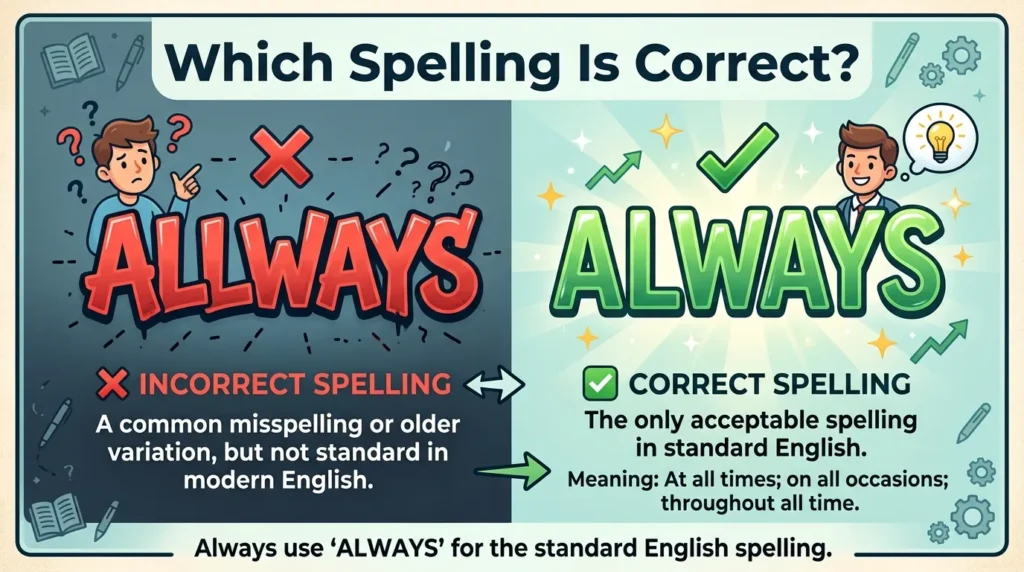
Always is the correct spelling.
Allways is a misspelling and is not recognized as a standard English word.
Examples
✅ Correct:
- I always arrive on time.
- She always helps her friends.
- We always check our work before submitting it.
❌ Incorrect:
- I allways arrive on time.
- She allways helps her friends.
Quick Rule
If you mean at all times, every time, or forever, use always.
The Origin of Allways or Always
The word always has existed in English for hundreds of years.
It comes from the combination of two older English elements:
- all
- way
Historically, the word developed to mean at all times or continually.
Over time, the spelling became standardized as always.
Why Does “Allways” Appear?
The mistake happens because many English words contain double letters.
Examples include:
- all
- allow
- alliance
Because always begins with “al,” some writers mistakenly add an extra “l” and create allways.
However, dictionaries, style guides, and grammar experts recognize only always.
British English vs American English Spelling
There is no difference between British and American English for this word.
Both use always.
Comparison Table
| Language Version | Correct Spelling | Incorrect Spelling |
|---|---|---|
| British English | always | allways |
| American English | always | allways |
| Canadian English | always | allways |
| Australian English | always | allways |
| New Zealand English | always | allways |
Examples
British English
- He always remembers birthdays.
American English
- She always arrives early.
The spelling remains the same worldwide.
Which Spelling Should You Use?
The answer is simple.
Use always in every situation.
For US Audiences
Use always.
For UK Audiences
Use always.
For Commonwealth Countries
Use always.
For Global Audiences
Use always.
Quick Recommendation Table
| Audience | Recommended Spelling |
|---|---|
| United States | always |
| United Kingdom | always |
| Canada | always |
| Australia | always |
| International | always |
There are no exceptions in standard English.
Common Mistakes with Allways or Always
Many writers accidentally use the wrong spelling.
Mistake 1: Adding an Extra “L”
❌ I allways enjoy reading.
✅ I always enjoy reading.
Mistake 2: Typing Too Quickly
❌ She allways responds fast.
✅ She always responds fast.
Mistake 3: Assuming Double Letters Are Needed
Many people think the word should contain two “l” letters because of words like all.
❌ allways
✅ always
Quick Corrections Table
| Incorrect | Correct |
|---|---|
| allways | always |
| allways happy | always happy |
| allways ready | always ready |
| allways helpful | always helpful |
Allways or Always in Everyday Examples
In Emails
- I always appreciate your support.
In News Articles
- The company has always focused on customer service.
On Social Media
- Always keep learning.
In School Writing
- The character always tells the truth.
In Business Communication
- We always strive to improve our services.
In Formal Writing
- The organization has always followed industry standards.
Allways or Always – Google Trends & Usage Data
Search interest strongly favors always because it is the correct spelling.
Searches for allways usually come from people checking whether they have spelled the word correctly.
Countries with Frequent Searches
- United States
- United Kingdom
- Canada
- Australia
- India
Common Search Questions
Users often ask:
- Is allways a word?
- How do you spell always?
- Why is allways incorrect?
- Which spelling should I use?
Usage Comparison
| Variation | Dictionary Accepted | Popularity |
|---|---|---|
| always | Yes | Extremely High |
| allways | No | Misspelling Only |
The correct spelling dominates books, websites, newspapers, and professional writing.
Allways vs Always Comparison Table
| Feature | Always | Allways |
|---|---|---|
| Correct English word | Yes | No |
| Found in dictionaries | Yes | No |
| Used in professional writing | Yes | No |
| Accepted worldwide | Yes | No |
| Recommended spelling | Yes | No |
| Means “at all times” | Yes | No |
| Common typing mistake | No | Yes |
FAQs
1. Is allways a real word?
No. Allways is a spelling mistake.
2. Which spelling is correct: allways or always?
Always is the correct spelling.
3. Why do people write allways?
Many people mistakenly add an extra “l” because of words like all and allow.
4. Is allways accepted in British English?
No. British English uses always.
5. Is allways accepted in American English?
No. American English also uses always.
6. What does always mean?
It means at all times, every time, or continually.
7. How can I remember the correct spelling?
Remember that always has only one “l” after the “a.”
Conclusion
The answer to “allways or always” is clear: always is the correct spelling, while allways is a common misspelling. The word always has been part of the English language for centuries and is used to mean at all times, every time, or continually. Whether you are writing an email, a school essay, a business report, or a social media post, always is the spelling you should use.
Another important point is that there is no difference between British English and American English in this case. Every major English-speaking country uses always. The confusion usually happens because writers mistakenly think the word needs two “l” letters, but standard English spelling rules do not support that form.
If you want your writing to look professional and error-free, make a habit of checking for the misspelling allways during proofreading. Remember this simple rule: if you mean at all times, write always—with one “l” after the “a.” Following this rule will help you avoid a very common spelling mistake.