Adapt vs adopt is a common English word confusion. The two words look and sound similar, but they have different meanings. Both are verbs, and both can be used when talking about change, ideas, methods, or behavior. However, they describe two different kinds of change.
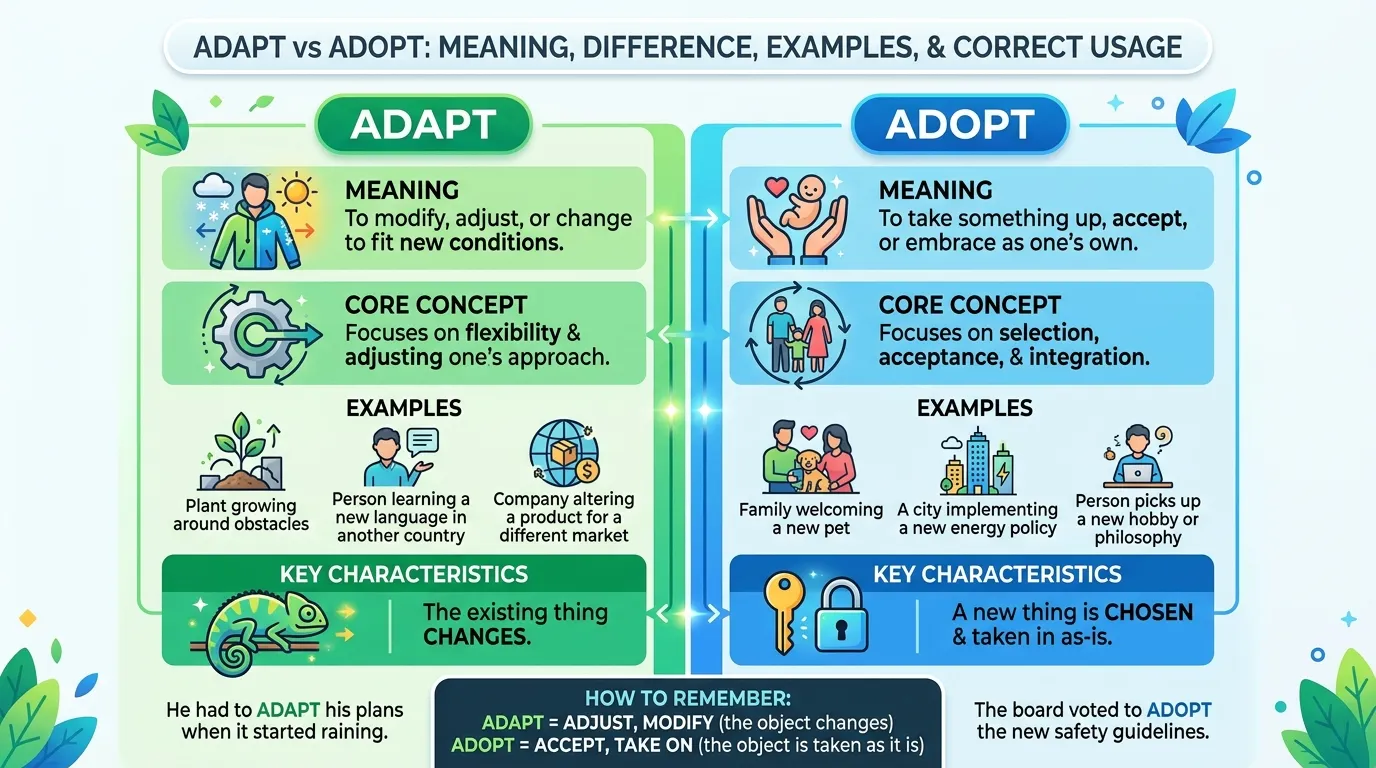
Adapt means to change something so it works better in a new situation. For example, “The company adapted its strategy to changing market conditions.” The strategy was changed to fit a new situation.
Adopt means to accept, choose, or start using something. For example, “The company adopted a new safety policy.” The company accepted and began using the policy.
People often search for adapt vs adopt because the words differ by only one letter, yet their meanings can change the whole sentence. This confusion is common in business writing, education, technology, science, and everyday English.
This guide explains adapt vs adopt with simple definitions, examples, grammar tips, common mistakes, pronunciation, and memory tricks. You will learn when to use each word in emails, reports, news articles, social media posts, and formal writing.
Adapt vs Adopt – Quick Answer
The easiest way to remember the difference is:
- Adapt = change something to fit a new situation.
- Adopt = accept, choose, or begin using something.
Adapt Examples
We need to adapt our plan to the new conditions.
Animals adapt to their environment.
She adapted the lesson for younger students.
In these examples, something is changed to make it suitable for a new situation.
Adopt Examples
The company decided to adopt a new policy.
They adopted a different approach.
The school adopted new safety rules.
Here, something is accepted or chosen for use.
Easy Memory Trick
Think:
Adapt = Adjust
Adopt = Accept
For example:
Adapt a plan = change the plan.
Adopt a plan = accept or start using the plan.
The Origin of Adapt vs Adopt
Adapt and adopt both come from Latin, which helps explain why they look similar.
Origin of Adapt
Adapt comes from the Latin word adaptare, meaning “to fit” or “to adjust.”
The word entered English through French and developed the meaning of changing something so it becomes suitable for a new purpose or situation.
Today, adapt is commonly used in:
- Biology
- Business
- Education
- Technology
- Literature
- Everyday life
Examples:
Plants adapt to their environment.
We must adapt to new technology.
Origin of Adopt
Adopt comes from the Latin adoptare, meaning “to choose” or “to take as one’s own.”
It entered English through French and developed several meanings.
Today, adopt can mean:
- Accept an idea
- Start using a method
- Approve a policy
- Take a child legally as one’s own
- Choose a particular approach
Examples:
The company adopted a new strategy.
The couple adopted a child.
Why Are They Confused?
The words look almost identical:
adapt
adopt
They also share a similar Latin background. However, their meanings are different.
| Word | Main Idea |
|---|---|
| Adapt | Change to fit |
| Adopt | Accept or take up |
British English vs American English Spelling
There is no major spelling difference between British and American English for adapt and adopt.
Both varieties use:
- adapt = adjust or modify
- adopt = accept, choose, or begin using
Comparison Table
| Meaning | British English | American English | Example |
|---|---|---|---|
| Change to fit | adapt | adapt | We must adapt to change. |
| Modify something | adapt | adapt | Adapt the plan. |
| Accept an idea | adopt | adopt | They adopted the proposal. |
| Start using something | adopt | adopt | The company adopted new software. |
| Legally take a child | adopt | adopt | They adopted a child. |
British English Examples
Businesses must adapt to new technology.
The company decided to adopt a new policy.
American English Examples
Businesses must adapt to new technology.
The company decided to adopt a new policy.
The spellings are the same in both forms of English.
Which Spelling Should You Use?
Your choice depends on what you mean.
Use Adapt for Change
Use adapt when something is modified to fit a new situation, purpose, or environment.
We need to adapt our strategy.
The machine was adapted for industrial use.
Students must adapt to new learning methods.
Use Adopt for Acceptance
Use adopt when someone accepts, chooses, approves, or begins using something.
The company adopted a new strategy.
The government adopted new rules.
The team adopted a different approach.
Adapt vs Adopt in One Sentence
Sometimes both words can appear in the same sentence.
The company adopted a new system and adapted its workflow to use it effectively.
This means:
- The company accepted and started using the system.
- It changed its workflow to fit the system.
For US Readers
American English uses the same distinction.
For UK and Commonwealth Readers
British and Commonwealth English also use the same meanings.
For Global English
Remember:
Adapt = make changes.
Adopt = make a choice.
Common Mistakes with Adapt vs Adopt
Mistake 1: “Adapt a New Policy”
Incorrect in most contexts:
The company adapted a new policy.
If the company accepted and started using the policy, use adopted.
Correct:
The company adopted a new policy.
Mistake 2: “Adopt to Change”
Incorrect:
Businesses must adopt to change.
Correct:
Businesses must adapt to change.
The phrase adapt to means change to fit new conditions.
Mistake 3: “Adapt a New Method”
If you mean accept and begin using a method:
The school adopted a new teaching method.
If you mean modify the method:
The school adapted the teaching method for younger students.
The context determines the correct word.
Mistake 4: “Adopt the Plan to Local Needs”
If you mean modify the plan so it fits local needs, use adapt:
We adapted the plan to local needs.
Mistake 5: “Adapt a Child”
If you mean legally take a child as your own, the correct word is:
Adopt a child
Example:
They decided to adopt a child.
Adapt vs Adopt in Everyday Examples
In Emails
Adapt:
We may need to adapt the schedule because of the new requirements.
Adopt:
The management team decided to adopt the proposed schedule.
In News
Adapt:
Businesses are adapting to changing economic conditions.
Adopt:
The government adopted new regulations.
On Social Media
Adapt:
Life changes quickly. Learn to adapt.
Adopt:
I decided to adopt a healthier daily routine.
In Formal Writing
Adapt:
Organizations must adapt their policies to changing customer needs.
Adopt:
Organizations may adopt new policies to improve customer service.
In Science
Adapt:
Species adapt to changes in their environment.
Adopt:
Researchers may adopt new methods for collecting data.
In Technology
Adapt:
Companies must adapt their systems to new security requirements.
Adopt:
Many businesses have adopted cloud-based technology.
Adapt vs Adopt – Comparison Table
| Word | Part of Speech | Main Meaning | Example |
|---|---|---|---|
| Adapt | Verb | Change to fit | We adapted the plan. |
| Adapt | Verb | Adjust to conditions | Animals adapt to their environment. |
| Adapt | Verb | Modify for a new purpose | The book was adapted for television. |
| Adopt | Verb | Accept or choose | They adopted the proposal. |
| Adopt | Verb | Start using | The company adopted new software. |
| Adopt | Verb | Take legally as one’s child | They adopted a child. |
Adapt vs Adopt Pronunciation
The pronunciation of adapt and adopt is similar, which can cause additional confusion.
Adapt
Adapt is commonly pronounced approximately:
uh-DAPT
The main stress falls on the second syllable.
We must adapt to change.
Adopt
Adopt is commonly pronounced approximately:
uh-DOPT
The main stress also falls on the second syllable.
They decided to adopt the plan.
Pronunciation Table
| Word | Approximate Sound | Meaning |
|---|---|---|
| Adapt | uh-DAPT | Change or adjust |
| Adopt | uh-DOPT | Accept or begin using |
The final consonant sound is the key difference: adapt ends with a t sound, while adopt ends with a pt sound.
How to Remember Adapt vs Adopt
Adapt = Adjust
Both adapt and adjust start with A.
Adapt = Adjust
If you need to change something so it fits a situation, use adapt.
Adapt the plan.
Adapt to change.
Adopt = Accept
Think:
Adopt = Accept
If you accept or start using an idea, plan, rule, or method, use adopt.
Adopt a policy.
Adopt an approach.
Adopt a strategy.
Ask Yourself One Question
Ask:
Am I changing it, or am I accepting it?
If you are changing it → adapt.
If you are accepting or choosing it → adopt.
Adapt vs Adopt – Google Trends & Usage Data
Search interest for adapt vs adopt is mainly linked to English vocabulary, grammar, writing, education, business communication, and language learning.
Both words are widely used, but their contexts differ.
Adapt is common in discussions about change and adjustment. It frequently appears in business, biology, education, technology, and personal development. Common phrases include adapt to change, adapt to new conditions, and adapt a plan.
Adopt is common in business, government, education, technology, law, and family-related contexts. Common phrases include adopt a policy, adopt a strategy, adopt a method, and adopt a child.
Search interest can vary by country and over time. Exact Google Trends numbers should be checked directly before publishing specific statistics because search patterns change.
The main search intent is usually to understand whether a sentence requires adapt or adopt.
FAQs About Adapt vs Adopt
1. What is the difference between adapt and adopt?
Adapt means to change or adjust something to fit a new situation. Adopt means to accept, choose, or begin using something.
Adapt the plan.
Adopt the plan.
2. Is it “adapt to change” or “adopt to change”?
The correct phrase is:
Adapt to change.
It means to adjust yourself or something else to changing conditions.
3. Is it “adopt a policy” or “adapt a policy”?
Both can be correct, but they have different meanings.
Adopt a policy = accept or begin using it.
Adapt a policy = modify it to fit a specific situation.
4. Is it “adapt a child” or “adopt a child”?
The correct phrase is:
Adopt a child.
It means legally take a child as your own.
5. Can adapt and adopt be used in the same sentence?
Yes.
The company adopted a new system and adapted its processes to support it.
The company accepted the system and then changed its processes to fit it.
6. What is an easy way to remember adapt vs adopt?
Remember:
Adapt = Adjust
Adopt = Accept
If you are changing something, use adapt. If you are accepting or choosing something, use adopt.
7. Are adapt and adopt spelled differently in British and American English?
No. Both British and American English use the same spellings and meanings for adapt and adopt.
Conclusion
The difference between adapt vs adopt becomes easy when you focus on the type of change involved. Adapt means to change, adjust, or modify something so it works in a new situation. Adopt means to accept, choose, approve, or begin using something.
For example, a company may adopt a new safety policy. This means the company accepts and starts using the policy. It may then adapt its training program to match the new policy. This means the training program is changed to fit the new situation.
A simple memory trick is adapt = adjust and adopt = accept. You can also ask yourself: Am I changing something, or am I choosing something? If you are changing it, use adapt. If you are accepting or choosing it, use adopt.
British and American English use the same spelling, so there is no regional spelling issue. The key is meaning and context.
These words are especially important in professional writing. Using the correct word makes reports, emails, business documents, and academic work clearer. Once you understand the difference, phrases such as adapt to change, adapt a plan, adopt a policy, and adopt a strategy become much easier to use correctly.