Have you ever typed “canceling” and wondered if it should actually be “cancelling”? You’re not alone. This is one of the most common spelling questions in English. Many writers, students, bloggers, and professionals search for “cancelling or canceling” because they see both versions used online, in books, and in official documents.
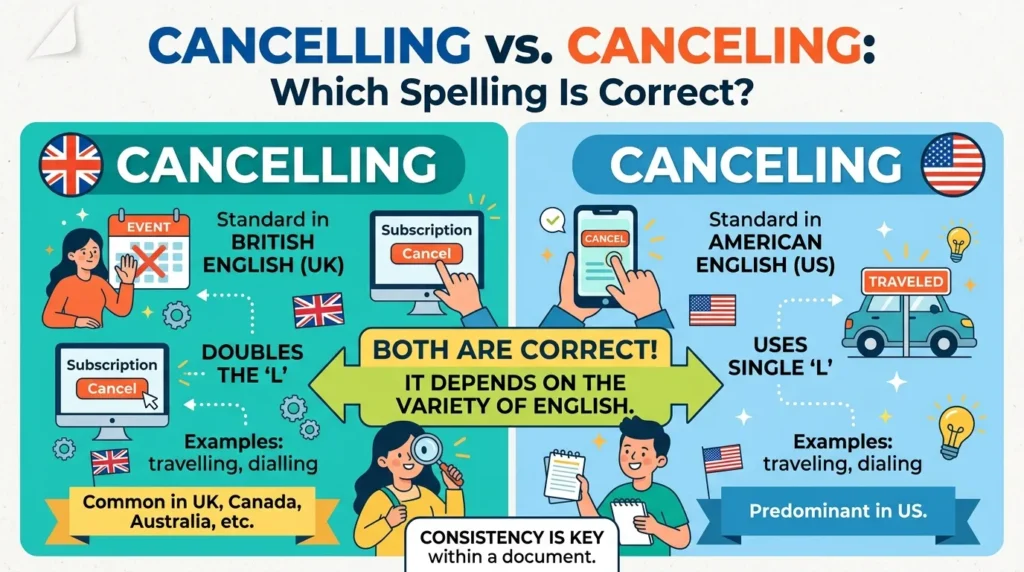
The confusion happens because both spellings are correct. The difference depends on whether you follow British English or American English rules. In the United States, people usually write “canceling” with one “l.” In the United Kingdom and many Commonwealth countries, “cancelling” with two “l”s is the standard form.
Understanding this difference can improve your writing and help you match your audience’s expectations. Whether you’re writing an email, a blog post, a school assignment, or business content, using the correct spelling creates a more professional impression.
This guide explains the difference between cancelling and canceling, their origins, usage rules, common mistakes, and practical examples so you can choose the right spelling with confidence.
Cancelling or Canceling – Quick Answer
The quick answer is simple:
- Canceling = American English spelling.
- Cancelling = British English spelling.
Examples
- American English: The airline is canceling several flights today.
- British English: The airline is cancelling several flights today.
Both spellings mean the same thing: stopping, ending, or calling something off.
The Origin of Cancelling or Canceling
The word cancel comes from the Latin word cancellare, which meant “to cross out” or “to make invalid.” It entered English through Old French and eventually became part of everyday vocabulary.
Over time, spelling conventions evolved differently in various English-speaking regions.
British English generally follows a rule of doubling the final consonant before adding endings such as -ing or -ed when the stress pattern allows it.
American English often simplifies spellings by avoiding unnecessary doubled consonants.
As a result, two accepted forms developed:
- Cancelling (British English)
- Canceling (American English)
The difference is historical rather than grammatical.
British English vs American English Spelling
The main distinction lies in regional spelling preferences.
British English
British English doubles the final “l” before adding -ing.
Examples:
- Cancel → Cancelling
- Travel → Travelling
- Label → Labelling
American English
American English usually keeps a single “l”.
Examples:
- Cancel → Canceling
- Travel → Traveling
- Label → Labeling
Comparison Table
| Feature | British English | American English |
|---|---|---|
| Base Word | Cancel | Cancel |
| Present Participle | Cancelling | Canceling |
| Past Tense | Cancelled | Canceled |
| Common Regions | UK, Australia, Canada, New Zealand | United States |
| Meaning | Same | Same |
Which Spelling Should You Use?
The correct choice depends on your audience.
Use “Canceling” If:
- You write for American readers.
- Your organization follows US style guides.
- You publish mainly in the United States.
Use “Cancelling” If:
- You write for UK readers.
- Your audience is in Australia or New Zealand.
- You follow British English standards.
For Global Audiences
Choose one spelling style and stay consistent throughout your document.
Consistency matters more than preference.
Common Mistakes with Cancelling or Canceling
Many people mix the two spellings without realizing it.
Mistake 1: Mixing Styles
❌ The company is canceling flights and has cancelled bookings.
✅ American: The company is canceling flights and has canceled bookings.
✅ British: The company is cancelling flights and has cancelled bookings.
Mistake 2: Assuming One Is Wrong
❌ Thinking only one spelling is correct.
✅ Both spellings are correct in their respective regions.
Mistake 3: Ignoring Audience
❌ Using British spelling for a US publication.
✅ Match your spelling to your readers.
Cancelling or Canceling in Everyday Examples
Seeing words in context makes them easier to remember.
Emails
- We are canceling tomorrow’s meeting due to scheduling conflicts.
- We are cancelling tomorrow’s meeting due to scheduling conflicts.
News Headlines
- Airline canceling hundreds of flights.
- Railway company cancelling weekend services.
Social Media
- I’m canceling my gym membership this month.
- I’m cancelling my streaming subscription today.
Formal Writing
- The organization is canceling the planned event.
- The organisation is cancelling the planned event.
Cancelling or Canceling – Google Trends & Usage Data
Search behavior shows clear regional preferences.
Canceling
Most common in:
- United States
- American publications
- US educational materials
Cancelling
Most common in:
- United Kingdom
- Australia
- New Zealand
- Many Commonwealth countries
Canada often uses both spellings, depending on the style guide followed.
Online usage reflects the global spread of English, which is why readers frequently encounter both versions.
Comparison Table: Keyword Variations
| Variation | Region | Correct? | Example |
|---|---|---|---|
| Canceling | American English | Yes | She is canceling the appointment. |
| Cancelling | British English | Yes | She is cancelling the appointment. |
| Canceled | American English | Yes | The flight was canceled. |
| Cancelled | British English | Yes | The flight was cancelled. |
FAQs
1. Is canceling or cancelling correct?
Both are correct. Canceling is American English, while cancelling is British English.
2. Which spelling is more common?
It depends on location. Americans prefer canceling, while British writers prefer cancelling.
3. Is cancelling wrong in the US?
It is not technically wrong, but canceling is the preferred American spelling.
4. Why does British English use two “l”s?
British spelling often doubles the final consonant before adding suffixes.
5. Which spelling should bloggers use?
Use the version that matches your target audience and remain consistent.
6. What about canceled and cancelled?
The same rule applies. Americans use canceled, while British writers use cancelled.
7. Does Google accept both spellings?
Yes. Search engines recognize both forms and understand their regional differences.
Conclusion
The debate over cancelling or canceling is not about right versus wrong. Instead, it reflects the fascinating differences between British and American English. Both spellings are correct and carry exactly the same meaning. The key is understanding your audience and choosing the version they expect.
If you write for American readers, use canceling and canceled. If your audience is in the United Kingdom or other Commonwealth countries, choose cancelling and cancelled. For international audiences, consistency is essential. Once you choose a style, apply it throughout your writing.
Knowing these spelling differences can improve your confidence, strengthen your professionalism, and prevent unnecessary confusion. Whether you’re drafting an email, publishing a blog post, posting on social media, or preparing formal documents, selecting the right spelling helps your message connect more effectively with readers around the world.