Have you ever paused while writing and wondered whether to use “weather or not”? Many people search for this phrase because it sounds very similar to another common expression: “whether or not.” The confusion is understandable. The words weather and whether are pronounced almost the same, but they have completely different meanings.
The phrase “whether or not” is used to show a choice, possibility, or uncertainty. On the other hand, “weather” relates to conditions in the atmosphere, such as rain, sunshine, wind, or snow. Because these words are homophones, writers often mix them up in emails, social media posts, academic papers, and professional documents.
This guide will help you understand the difference between weather or not and whether or not, explain their origins, show real-life examples, highlight common mistakes, and offer practical advice on choosing the correct spelling. By the end of this article, you’ll know exactly which phrase to use and why.
Weather or Not – Quick Answer
The quick answer is simple:
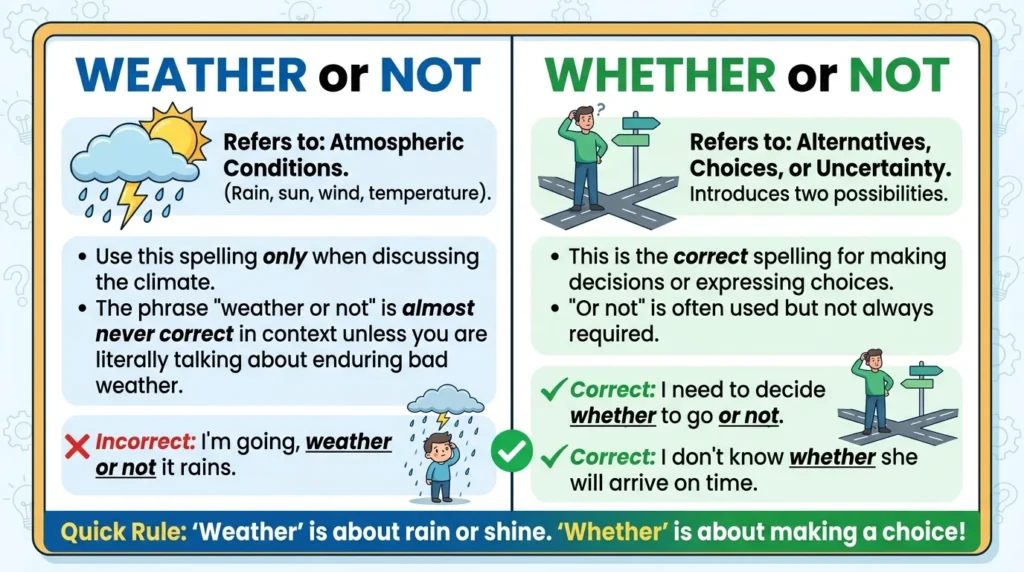
- Whether or not = Correct phrase when expressing a choice or uncertainty.
- Weather or not = Usually incorrect unless discussing climate or atmospheric conditions.
Examples
✅ Correct: I don’t know whether or not I will attend the meeting.
❌ Incorrect: I don’t know weather or not I will attend the meeting.
✅ Correct: The event will happen regardless of the weather.
The confusion happens because weather and whether sound alike.
The Origin of Weather or Not
The difference comes from the origins of the two words.
Weather
The word weather comes from Old English weder, meaning atmospheric conditions such as rain, wind, heat, or storms.
Examples:
- Bad weather delayed the flight.
- Sunny weather makes people happy.
Whether
The word whether comes from Old English hwæther, meaning “which of two” or expressing doubt between alternatives.
Examples:
- I cannot decide whether to stay or leave.
- Tell me whether you agree.
Over time, their pronunciation became similar, leading to frequent spelling confusion.
British English vs American English Spelling
Unlike many English spelling differences, whether and weather do not change between British and American English.
Both countries use the same spellings.
Examples
British English:
- I don’t know whether she will come.
- The weather is cold today.
American English:
- I don’t know whether she will come.
- The weather is cold today.
Comparison Table
| Meaning | Correct Word | British English | American English |
|---|---|---|---|
| Choice or uncertainty | Whether | Whether | Whether |
| Climate conditions | Weather | Weather | Weather |
| Phrase meaning “regardless” | Whether or not | Whether or not | Whether or not |
| Common mistake | Weather or not | Incorrect | Incorrect |
Which Spelling Should You Use?
The answer depends on what you mean.
Use “Whether or Not” When:
- Showing uncertainty.
- Presenting alternatives.
- Discussing choices.
- Writing formal documents.
- Sending professional emails.
Examples:
- Whether or not you agree, we must proceed.
- Please confirm whether or not you can attend.
Use “Weather” When:
- Talking about climate.
- Discussing forecasts.
- Describing atmospheric conditions.
Examples:
- The weather looks terrible.
- Hot weather can be exhausting.
For Global Audiences
Use the same rules worldwide because there is no regional spelling difference.
Common Mistakes with Weather or Not
Mistake 1: Using “Weather” Instead of “Whether”
❌ I don’t know weather or not he will arrive.
✅ I don’t know whether or not he will arrive.
Mistake 2: Assuming They Are Interchangeable
❌ The weather we go depends on the schedule.
✅ Whether we go depends on the schedule.
Mistake 3: Ignoring Context
❌ Weather or not you agree, the policy remains.
✅ Whether or not you agree, the policy remains.
The easiest trick is simple:
- Choice = Whether
- Climate = Weather
Weather or Not in Everyday Examples
Emails
- Please let me know whether or not you can join the meeting.
News Headlines
- Severe weather affects travel plans nationwide.
Social Media
- Whether or not I pass the exam, I tried my best.
- Loving this sunny weather today!
Formal Writing
- The committee will decide whether or not to approve the proposal.
Weather or Not – Google Trends & Usage Data
Search interest in “weather or not” remains high because many users want to verify the correct phrase.
Why People Search This Keyword
- They confuse weather and whether.
- They hear the phrase in conversation.
- They want to improve writing accuracy.
- They need clarification for academic work.
Popular Contexts
- Students completing assignments.
- Bloggers writing articles.
- Professionals drafting emails.
- Social media users checking grammar.
The phrase “whether or not” dominates formal and professional writing, while searches for “weather or not” often reflect spelling uncertainty.
Comparison Table: Keyword Variations
| Variation | Correct? | Meaning | Example |
|---|---|---|---|
| Whether or not | Yes | Choice or uncertainty | Whether or not you agree |
| Weather or not | Usually No | Common mistake | Weather or not you agree |
| Weather | Yes | Climate conditions | The weather is sunny |
| Whether | Yes | Alternative or choice | I wonder whether to go |
FAQs
1. Is “weather or not” correct?
Usually no. The correct phrase is “whether or not.”
2. What does “whether or not” mean?
It means regardless of a choice or uncertainty between possibilities.
3. Why do people confuse weather and whether?
They are homophones, meaning they sound alike but have different meanings.
4. Is there a British and American difference?
No. Both British and American English use the same spellings.
5. Can “weather or not” ever be correct?
Only if weather is being discussed separately in the sentence, not as a replacement for whether.
6. Which phrase should I use in formal writing?
Use “whether or not” when expressing doubt or alternatives.
7. How can I remember the difference?
Think of whether = choice and weather = climate.
Conclusion
The confusion between weather or not and whether or not is common because the two words sound almost identical. However, their meanings are completely different. Whether deals with choices, alternatives, and uncertainty, while weather refers to atmospheric conditions such as rain, sunshine, or storms.
Unlike many English spelling debates, there is no British versus American difference here. The correct phrase for expressing uncertainty is always “whether or not.” Understanding the context is the key to avoiding mistakes. If you’re discussing decisions or possibilities, choose whether. If you’re talking about climate, use weather.
Keeping this simple rule in mind will improve your writing, boost your confidence, and help you communicate more clearly in emails, academic papers, social media posts, and professional documents. The next time you hesitate, remember: choice means whether, climate means weather.