The words “roll” and “role” are one of the most common spelling confusions in English. Many students, writers, and even professionals search this keyword when writing emails, essays, job applications, or social media posts. The problem is simple: both words sound the same when spoken, but their meanings are completely different. This creates confusion and leads to frequent spelling mistakes.
For example, someone might write “He has an important roll in the company,” while the correct sentence is “He has an important role in the company.” This small error can change the meaning of a sentence and make writing look unprofessional.
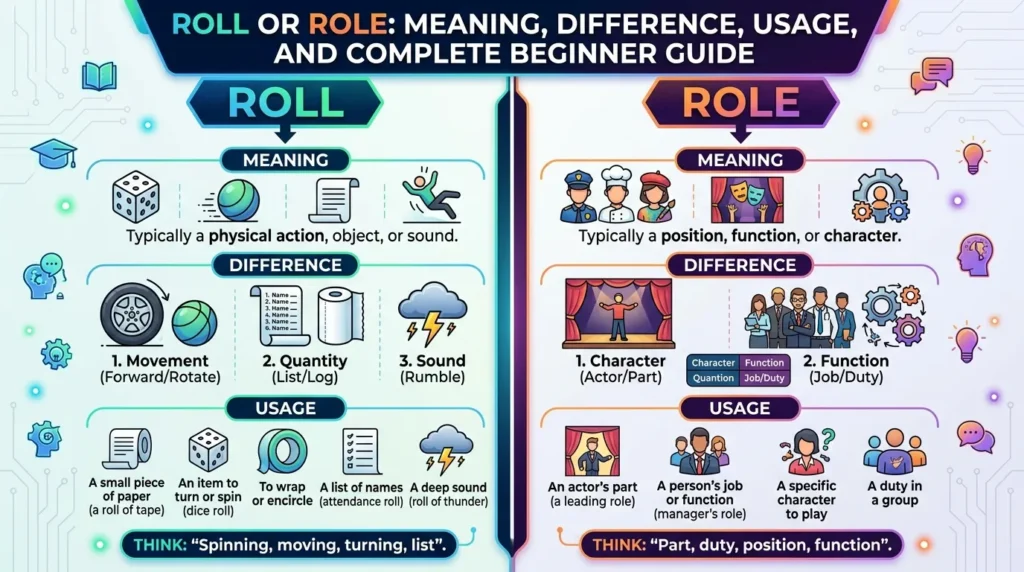
The confusion happens because English has many homophones—words that sound the same but are spelled differently. “Roll” usually relates to movement, action, or something cylindrical, while “role” refers to a position, responsibility, or function in a group or organization.
People search for “roll or role” to understand which spelling is correct in different contexts. This guide explains the difference in a simple way with clear examples, usage rules, origin, and common mistakes. By the end, you will never confuse these two words again and will be able to use them correctly in any situation.
Roll or Role – Quick Answer
“Roll” means movement, turning, or a list.
“Role” means a position, job, or responsibility.
Examples:
- Roll: “The ball will roll down the hill.”
- Role: “She plays a key role in the project.”
👉 Rule:
- Physical action = roll
- Job or responsibility = role
The Origin of Roll or Role
The word “roll” comes from Old French roller, meaning “to turn over” or “to rotate.” Over time, it developed several meanings in English, including:
- To move by turning
- A list of names (class roll)
- Food item (bread roll)
The word “role” comes from the French word rôle, originally meaning “a part played by an actor.” This comes from theater, where actors were assigned written “roles” on rolled-up paper scripts.
That is why:
- Roll = movement or list
- Role = responsibility or character part
British English vs American English Spelling
There is no spelling difference between British and American English for these words. Both use “roll” and “role” in the same way.
| Feature | British English | American English |
|---|---|---|
| Roll | Same spelling | Same spelling |
| Role | Same spelling | Same spelling |
| Meaning difference | Same rules | Same rules |
| Usage | Movement / job role | Movement / job role |
👉 Conclusion: Confusion is not regional—it is meaning-based.
Which Spelling Should You Use?
Use the words based on meaning, not region:
- Academic writing: role (job), roll (movement/list)
- Business communication: role = responsibility
- Everyday speech: both depending on context
- Social media: same rule applies
👉 Simple rule:
- If it’s about a job → role
- If it’s about movement or list → roll
Common Mistakes with Roll or Role
- ❌ “She has a big roll in the company.”
- ✔ “She has a big role in the company.”
- ❌ “The car will role down the hill.”
- ✔ “The car will roll down the hill.”
- ❌ Confusing both in job descriptions
- ❌ Using “role” for physical actions
Roll or Role in Everyday Examples
Emails
- “Your role in the team is project management.”
News
- “The government played a key role in the reforms.”
Social Media
- “New role unlocked at my job 🎉”
School Context
- “Please sign the attendance roll.”
Daily Life
- “Let the ball roll down the slope.”
Roll or Role – Google Trends & Usage Data
📊 Usage insights:
- “Role”
- Very common in job searches and HR content
- High usage in professional writing
- Frequently searched in career-related contexts
- “Roll”
- Common in everyday language
- Used in food, movement, and casual speech
- Appears in school and informal contexts
👉 Insight: “role” is more searched in professional and career contexts, while “roll” is more general.
Comparison Table: Roll vs Role
| Feature | Roll | Role |
|---|---|---|
| Meaning | Turn, list, movement | Job or responsibility |
| Origin | Old French roller | French rôle (theatre) |
| Usage | Physical action | Professional function |
| Example | “Roll the ball” | “Play a role” |
| Category | Verb / noun | Noun |
FAQs About Roll or Role
1. What is the difference between roll and role?
“Roll” is movement or list; “role” is responsibility or position.
2. Is role and roll pronounced the same?
Yes, they are homophones.
3. Why do people confuse roll and role?
Because they sound identical but have different meanings.
4. Can roll and role be used interchangeably?
No, they have completely different meanings.
5. What is an example of role in a sentence?
“She plays a leadership role in the company.”
6. What is an example of roll in a sentence?
“The dough will roll easily.”
7. Is this difference British or American English?
Neither—it is a meaning-based difference.
Conclusion
The confusion between “roll” and “role” is very common, but the solution is simple once you understand the meaning. Both words sound the same, but they serve completely different purposes in English. “Roll” refers to movement, rotation, lists, or objects, while “role” refers to a position, job, or responsibility.
Many writing mistakes happen because people rely on sound instead of meaning. However, in English grammar, context is always more important than pronunciation. Learning this difference helps improve writing accuracy in school, business, and everyday communication.
A simple trick is to remember: role = job, roll = action. This memory rule can help avoid confusion in exams, emails, and professional documents.
In conclusion, mastering “roll or role” is a small but important step in improving English grammar. Once you understand the difference clearly, your writing becomes more precise, professional, and easier to understand in any situation.