Have you ever stopped while writing and wondered whether to use “everyone’s” or “everyones”? It is a common question. Many people get confused because the two forms look very similar. A single apostrophe can change the meaning of a word, and that often leads to spelling mistakes in emails, social media posts, school assignments, and business documents.
People search for “everyone’s or everyones” because they want to know which form is grammatically correct. They may have seen both versions online and are unsure which one should be used in professional writing. Understanding the difference is important because using the wrong form can make your writing appear careless.
The good news is that the rule is simple. One form is correct in standard English, while the other is usually considered incorrect. In this guide, you will learn the correct spelling, the history behind the word, differences between British and American English, common mistakes, practical examples, FAQs, and expert advice on choosing the right form every time.
Everyone’s or Everyones – Quick Answer
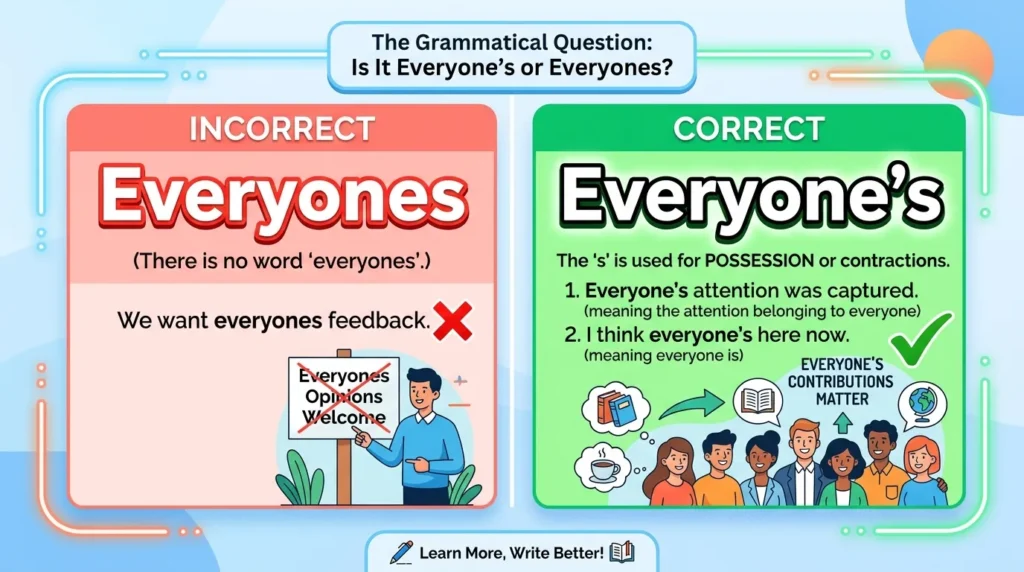
The correct spelling is usually everyone’s.
✅ Correct: everyone’s
❌ Incorrect: everyones
Everyone’s is the possessive form of everyone, meaning something belongs to or relates to every person.
Examples
- Everyone’s opinion matters.
- Everyone’s phone was collected before the exam.
- We want everyone’s feedback.
The spelling everyones without an apostrophe is generally incorrect in standard English.
The Origin of Everyone’s or Everyones
The word everyone comes from combining two words:
- every
- one
Together, they mean “all people” or “each person.”
The possessive form follows a common English grammar rule. When something belongs to a noun or pronoun, an apostrophe and s are often added.
For example:
- Someone → Someone’s
- Anyone → Anyone’s
- Everyone → Everyone’s
Because everyone refers to a group of people collectively, everyone’s is used when showing possession or ownership.
The form everyones developed mainly through typing mistakes and misunderstanding apostrophe rules rather than through historical language changes.
British English vs American English Spelling
Unlike some English words, there is no spelling difference between British and American English in this case.
Both forms follow the same grammar rules.
Comparison Table
| English Version | Correct Form | Incorrect Form |
|---|---|---|
| American English | Everyone’s | Everyones |
| British English | Everyone’s | Everyones |
| Australian English | Everyone’s | Everyones |
| Canadian English | Everyone’s | Everyones |
| New Zealand English | Everyone’s | Everyones |
Examples
| Region | Example Sentence |
|---|---|
| United States | Everyone’s ticket was checked. |
| United Kingdom | Everyone’s contribution was appreciated. |
| Australia | Everyone’s safety comes first. |
The apostrophe is required in all major English varieties.
Which Spelling Should You Use: Everyone’s or Everyones?
The correct spelling is everyone’s when you need the possessive form of everyone. The apostrophe is important because it shows possession or indicates a contraction of everyone is or everyone has.
For US Audiences
Use everyone’s in American English for academic, professional, business, and everyday writing.
Example:
- Everyone’s opinion matters.
- Everyone’s invited to the meeting.
For UK Audiences
British English also uses everyone’s according to standard English grammar. The spelling does not change between American and British English.
Example:
- Everyone’s responsibility is different.
- Everyone’s ready to leave.
For Commonwealth Countries
Countries such as Australia, Canada, New Zealand, India, and South Africa generally use everyone’s in standard English writing.
Example:
- Everyone’s contribution is appreciated.
For Global Audiences
If you are writing for an international audience, everyone’s is the correct and widely accepted form. Use it when showing possession or when everyone is or everyone has is shortened.
Examples:
- Everyone’s favorite food is different. → possession
- Everyone’s coming to the party. → everyone is
- Everyone’s finished the assignment. → everyone has
Avoid Everyones
Everyones without an apostrophe is generally incorrect when you mean the possessive form of everyone.
❌ Everyones opinion matters.
✅ Everyone’s opinion matters.
The apostrophe in everyone’s is essential because it distinguishes the correct possessive or contraction form from the incorrect spelling everyones.
Quick Rule to Remember
Everyone = all people
Everyone’s = belonging to everyone, or a contraction of everyone is/has
Everyones = generally incorrect
So, when in doubt, use everyone’s rather than everyones.
Common Mistakes with Everyone’s or Everyones
Many writers forget the apostrophe because they think everyone is already plural.
Common Errors
| Incorrect | Correct |
|---|---|
| Everyones opinion matters. | Everyone’s opinion matters. |
| Everyones ideas were shared. | Everyone’s ideas were shared. |
| Everyones feedback helped. | Everyone’s feedback helped. |
| Everyones seat was reserved. | Everyone’s seat was reserved. |
Why the Mistake Happens
Common reasons include:
- Forgetting the apostrophe.
- Typing too quickly.
- Confusing possession with plurality.
- Assuming “everyone” works like a plural noun.
Remember: everyone is singular, and everyone’s is the possessive form.
Everyone’s or Everyones in Everyday Examples
The correct form in everyday English is everyone’s when you want to show possession or use it as a contraction of everyone is or everyone has. The spelling everyones without an apostrophe is generally incorrect.
Here are some examples from different types of writing and communication.
In Emails
Use everyone’s when referring to something that belongs to, concerns, or is associated with everyone.
- Everyone’s report has been submitted.
- Please review everyone’s comments before the meeting.
- Everyone’s feedback will be considered before we make a final decision.
In News Articles
In news and journalistic writing, everyone’s can be used to describe something affecting or belonging to all people involved.
- The event improved everyone’s understanding of the issue.
- Officials appreciated everyone’s efforts during the emergency.
- The new policy could affect everyone’s daily lives.
On Social Media
Everyone’s is also common in casual online communication. It can show possession or work as a contraction.
- Hope everyone’s having a great day!
- Everyone’s excited about the new release.
- Looks like everyone’s ready for the weekend.
In the second and third examples, everyone’s means everyone is.
In Formal Writing
Formal writing also uses everyone’s when the meaning requires a possessive form or contraction.
- The policy protects everyone’s rights.
- The organization values everyone’s contribution.
- The program is designed to support everyone’s needs.
In Academic Writing
In academic and educational contexts, everyone’s may be used when referring to the rights, responsibilities, opinions, or contributions of all people.
- Everyone’s perspective should be considered carefully.
- The project depends on everyone’s cooperation.
- Everyone’s responsibility is to follow the established guidelines.
Why the Apostrophe Matters
The apostrophe in everyone’s is important because it changes the grammatical function of the word. It can indicate possession, as in everyone’s opinion, or form a contraction, as in everyone’s ready, meaning everyone is ready.
❌ Everyones opinion matters.
✅ Everyone’s opinion matters.
So, whether you are writing an email, news article, social media post, academic paper, or formal document, use everyone’s when the context requires it. Everyones without an apostrophe is generally not the correct standard form.
Everyone’s or Everyones – Google Trends & Usage Data
Search data shows that many users look for “everyone’s or everyones” because apostrophe rules often cause confusion.
Usage Trends
- Everyone’s appears frequently in books, websites, newspapers, and academic writing.
- Everyones mainly appears as a spelling error or search query.
- Searches increase during school terms when students study grammar and punctuation.
Popular Countries for Searches
The keyword is commonly searched in:
- United States
- United Kingdom
- Canada
- Australia
- India
- Pakistan
Most users want a quick grammar check before publishing or submitting written work.
Everyone’s vs Everyones Comparison Table
| Feature | Everyone’s | Everyones |
|---|---|---|
| Standard English | Yes | No |
| Dictionary Approved | Yes | No |
| Shows Possession | Yes | No |
| British English | Yes | No |
| American English | Yes | No |
| Professional Writing | Yes | No |
| Recommended Usage | Yes | No |
Frequently Asked Questions About Everyone’s and Everyones
1. Is everyone’s or everyones correct?
Everyone’s is the correct standard form. Everyones without an apostrophe is generally considered incorrect when you mean the possessive form of everyone.
Example:
✅ Everyone’s opinion matters.
❌ Everyones opinion matters.
2. Why does everyone’s need an apostrophe?
The apostrophe is used to show possession. Everyone’s means that something belongs to, concerns, or is associated with everyone.
Example:
- Everyone’s responsibility is important.
- We should respect everyone’s opinion.
The apostrophe can also be used in everyone’s as a contraction of everyone is or everyone has.
Examples:
- Everyone’s ready. = Everyone is ready.
- Everyone’s finished. = Everyone has finished.
3. Is everyones ever correct?
In standard English, everyones without an apostrophe is generally not correct when you mean everyone’s. If you are showing possession or using a contraction, the apostrophe should be included.
❌ Everyones ideas are different.
✅ Everyone’s ideas are different.
4. Is everyone singular or plural?
Everyone is grammatically singular, even though it refers to a group of people. That is why we normally use singular verbs with everyone.
Examples:
- Everyone is welcome.
- Everyone has a different opinion.
- Everyone’s opinion matters.
Although everyone refers to many individuals, grammatically it functions as a singular indefinite pronoun.
5. Can I use everyone’s in formal writing?
Yes. Everyone’s is completely acceptable in formal, academic, professional, and business writing when used correctly.
Examples:
- The organization respects everyone’s rights.
- The policy considers everyone’s needs.
- The manager reviewed everyone’s suggestions.
6. Do British and American English use different spellings?
No. Both British English and American English use everyone’s. There is no standard spelling difference between the two varieties.
The same form is also commonly used in other varieties of English, including Australian, Canadian, and New Zealand English.
7. How can I remember the correct form?
A simple way to remember it is: if something belongs to or concerns everyone, use everyone’s with an apostrophe.
Example:
- Everyone → all people
- Everyone’s → belonging to or concerning everyone
Quick tip: If you can replace everyone’s with everyone is or everyone has, the apostrophe is also correct.
Examples:
- Everyone’s happy. → Everyone is happy.
- Everyone’s finished. → Everyone has finished.
8. What is the difference between everyone, everyone’s, and everyones?
These forms are not interchangeable:
- Everyone = all people
- Everyone’s = belonging to everyone, or a contraction of everyone is/has
- Everyones = generally incorrect in standard English
For example:
✅ Everyone should attend the meeting.
✅ Everyone’s opinion is important.
❌ Everyones opinion is important.
9. Should I use everyone’s or everyones in an article?
Use everyone’s. It is the standard and grammatically correct form when you need the possessive or contraction.
Example:
Everyone’s contribution can make a difference.
10. Is everyone’s always possessive?
No. Everyone’s can be either a possessive form or a contraction.
Possessive:
- Everyone’s opinion matters.
Contraction of everyone is:
- Everyone’s ready to begin.
Contraction of everyone has:
- Everyone’s completed the task.
The context tells you which meaning is intended.
Conclusion
The confusion between everyone’s and everyones is easy to understand because the words look nearly identical. However, standard English grammar provides a clear answer. Everyone’s is the correct form when you want to show possession, ownership, responsibility, or association. The apostrophe plays an important role because it indicates that something belongs to every person in a group.
The spelling everyones without an apostrophe is generally considered incorrect and should be avoided in professional, academic, and everyday writing. This rule remains the same in American English, British English, and other major forms of English used around the world.
Whether you are writing emails, articles, reports, social media posts, or school assignments, choosing everyone’s will help your writing look polished and grammatically correct. Whenever you are unsure, remember this simple rule: if something belongs to everyone, use everyone’s with an apostrophe.