Have you ever seen the words “gibberish” and “jibberish” and wondered which one is correct? You are not alone. Many English speakers, students, writers, and professionals often search for “gibberish or jibberish” because both words sound almost the same when spoken aloud.
This confusion happens because English contains many words where the letters g and j produce similar sounds. As a result, people often assume that jibberish is an acceptable alternative spelling. You may even see it used on social media, in online comments, or in casual conversations.
The good news is that the answer is simple. Standard English dictionaries recognize only one spelling as correct. Knowing the right version can help you write more accurately in emails, reports, articles, academic papers, and everyday communication.
In this guide, you’ll learn the correct spelling, where the word comes from, how it is used in different English-speaking countries, common mistakes to avoid, real-life examples, and practical advice for choosing the right spelling every time.
Gibberish or Jibberish – Quick Answer
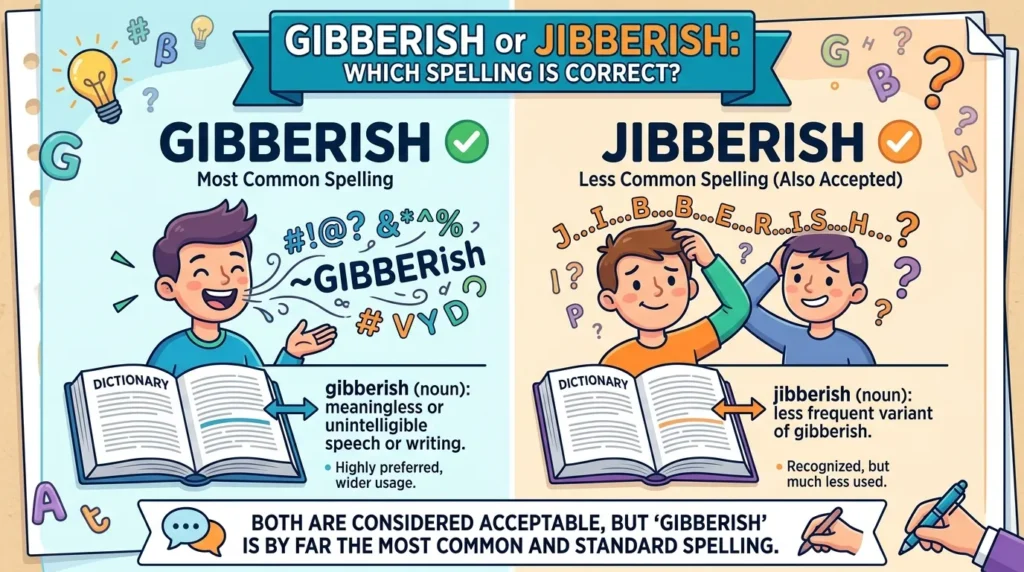
The correct spelling is gibberish.
✅ Correct: gibberish
❌ Incorrect: jibberish
Gibberish means language, speech, or writing that is difficult or impossible to understand.
Examples
- The damaged recording sounded like gibberish.
- His explanation was complete gibberish.
- The document contained random gibberish text.
While many people write jibberish, it is generally considered a misspelling of gibberish.
The Origin of Gibberish or Jibberish
The exact origin of gibberish is not fully known, but linguists believe it appeared in English during the 16th century.
One theory connects it to the verb gibber, which means to speak rapidly, meaninglessly, or unintelligibly. Another theory links it to the name of medieval scholar Jabir ibn Hayyan, although this connection is debated.
Over time, gibberish became the accepted English word for meaningless speech or nonsense language.
The spelling jibberish likely developed because the first sound in gibberish sounds similar to the letter j. As people heard the word without seeing it written, they often guessed the spelling incorrectly.
Today, dictionaries, style guides, and grammar experts recognize gibberish as the standard form.
British English vs American English Spelling
Unlike words such as “colour” and “color,” there is no spelling difference between British and American English for this word.
Both versions of English use gibberish.
Comparison Table
| English Version | Correct Spelling | Incorrect Spelling |
|---|---|---|
| American English | Gibberish | Jibberish |
| British English | Gibberish | Jibberish |
| Canadian English | Gibberish | Jibberish |
| Australian English | Gibberish | Jibberish |
| New Zealand English | Gibberish | Jibberish |
Examples
| Region | Example Sentence |
|---|---|
| United States | The message looked like gibberish. |
| United Kingdom | The note contained gibberish. |
| Australia | The audio file turned into gibberish. |
The spelling remains the same worldwide.
Which Spelling Should You Use?
The answer is easy: always use gibberish.
For US Audiences
Use gibberish in business writing, journalism, education, and online content.
For UK Audiences
Use gibberish in formal and informal communication.
For Commonwealth Countries
Canada, Australia, New Zealand, India, and South Africa all use gibberish.
For Global Audiences
Gibberish is the internationally accepted spelling and is understood everywhere English is spoken.
Avoid jibberish in professional writing because many readers will view it as a spelling mistake.
Common Mistakes with Gibberish or Jibberish
Many writers make errors because they spell the word based on how it sounds.
Common Errors
| Incorrect | Correct |
|---|---|
| Jibberish text | Gibberish text |
| Jibberish language | Gibberish language |
| Complete jibberish | Complete gibberish |
| Random jibberish | Random gibberish |
Why the Mistake Happens
Common reasons include:
- Spelling by sound rather than by memory.
- Seeing incorrect versions online.
- Confusing the “g” sound with a “j” sound.
- Learning the word through speech rather than reading.
The safest choice is always gibberish.
Gibberish or Jibberish in Everyday Examples
In Emails
- The attachment appears to contain gibberish.
- Some characters turned into gibberish after conversion.
In News Articles
- Experts said the message looked like gibberish.
- The corrupted file displayed gibberish text.
On Social Media
- My phone translated the message into gibberish.
- That comment is pure gibberish.
In Formal Writing
- The software generated unreadable gibberish.
- The researcher excluded sections containing gibberish text.
In every context, gibberish is the correct spelling.
Gibberish or Jibberish – Google Trends & Usage Data
Search behavior shows that many people are unsure about the correct spelling.
Usage Trends
- Gibberish dominates books, newspapers, websites, and academic writing.
- Jibberish appears frequently in search engines because users are checking the spelling.
- Online grammar tools often flag jibberish as incorrect.
Popular Countries for Searches
The keyword is commonly searched in:
- United States
- United Kingdom
- Canada
- Australia
- India
- Pakistan
Most searches come from students, writers, and professionals who want to verify the correct spelling before publishing content.
Gibberish vs Jibberish Comparison Table
| Feature | Gibberish | Jibberish |
|---|---|---|
| Standard English | Yes | No |
| Dictionary Approved | Yes | No |
| Used in Professional Writing | Yes | No |
| British English | Yes | No |
| American English | Yes | No |
| Academic Writing | Yes | No |
| Recommended Usage | Yes | No |
Frequently Asked Questions (FAQs)
1. Is gibberish or jibberish correct?
Gibberish is correct. Jibberish is considered a misspelling.
2. What does gibberish mean?
It means speech, writing, or language that is meaningless or difficult to understand.
3. Why do people write jibberish?
Many people spell the word based on its pronunciation rather than its accepted spelling.
4. Is jibberish in the dictionary?
Most major dictionaries recognize gibberish as the standard spelling and may list jibberish only as a common misspelling.
5. Do British and American English spell it differently?
No. Both use gibberish.
6. Can I use jibberish in professional writing?
No. Professional writing should use gibberish.
7. How can I remember the correct spelling?
Remember that the word starts with G, just like garbled, another word related to unclear communication.
Conclusion
The confusion between gibberish and jibberish is understandable because both words sound similar when spoken. However, standard English grammar and dictionaries clearly identify gibberish as the correct spelling. It is the accepted term for speech, writing, or sounds that are difficult to understand or completely meaningless.
The spelling jibberish has become common through pronunciation-based mistakes and informal online usage, but it is not considered standard English. Whether you are writing a business email, academic paper, blog post, news article, or social media update, using gibberish will ensure your writing appears accurate and professional.
The rule is the same in American English, British English, Canadian English, Australian English, and other forms of English worldwide. There is no regional spelling variation to remember.
If you ever find yourself choosing between gibberish or jibberish, remember one simple rule: gibberish is correct, jibberish is not.