A proper noun is one of the most important grammar concepts in English, but many learners still struggle to identify and capitalize it correctly. If you have ever wondered whether words such as London, Monday, Sarah, or Amazon should begin with a capital letter, understanding proper nouns can solve that confusion.
People often search for proper noun because they want a simple definition, clear examples, capitalization rules, and an easy way to tell proper nouns from common nouns. The confusion often comes from words that can be either common or proper nouns depending on how they are used.
For example, city is a common noun, while London is a proper noun. Similarly, river is a common noun, but Nile is a proper noun.
This guide explains what a proper noun means, where the term comes from, how capitalization works in British and American English, common mistakes, everyday examples, usage trends, and frequently asked questions. By the end, you will know how to recognize and use proper nouns with confidence.
Proper Noun – Quick Answer
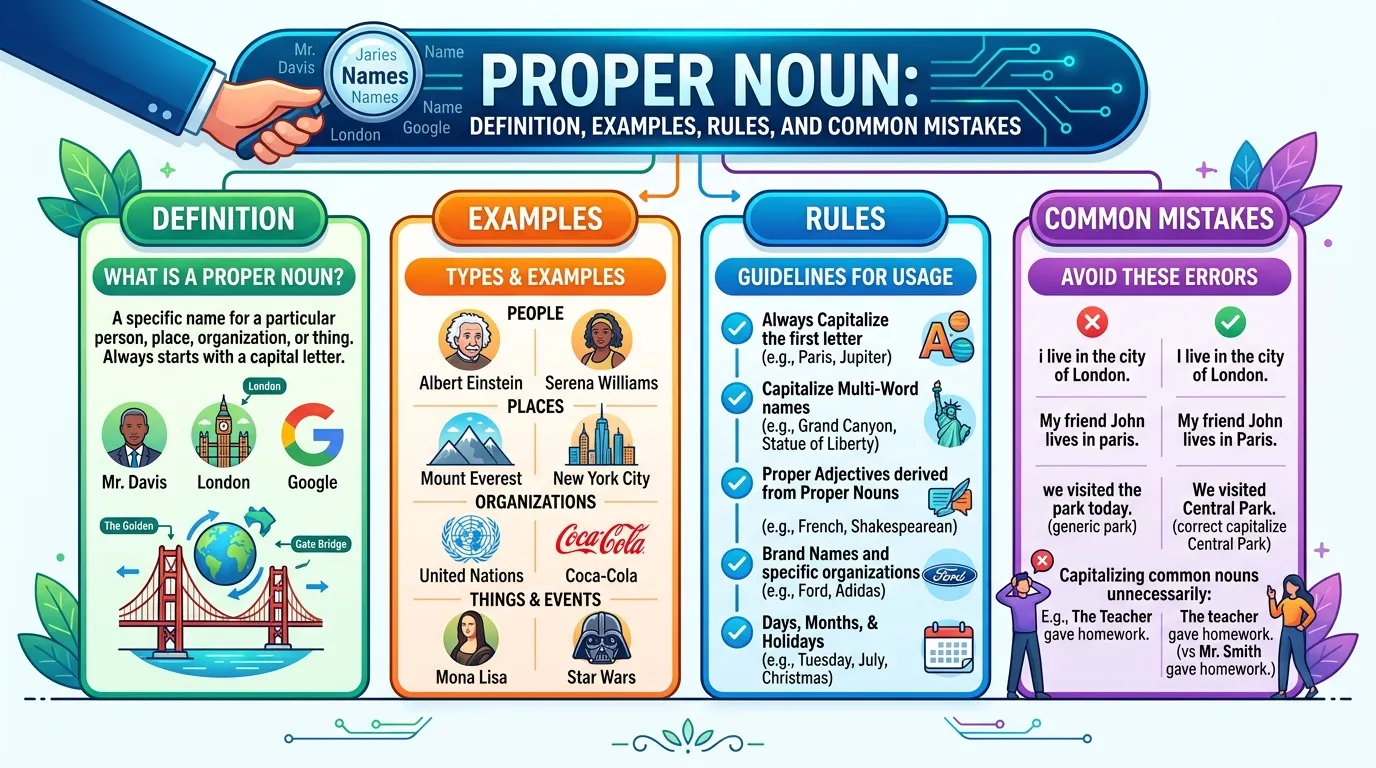
A proper noun is the specific name of a particular person, place, organization, animal, event, or other unique entity. Proper nouns usually begin with a capital letter.
Examples of Proper Nouns
- Person: Sarah, William Shakespeare, Albert Einstein
- Place: London, India, Mount Everest
- Country: Pakistan, Canada, Japan
- Organization: Google, Microsoft, United Nations
- Day: Monday, Friday
- Month: January, August
- Holiday: Christmas, Eid
- Book: Harry Potter
- Movie: Titanic
Compare these examples:
- city → common noun
- London → proper noun
- country → common noun
- Pakistan → proper noun
- river → common noun
- Nile River → proper noun
The easiest rule is:
A common noun names a general thing. A proper noun names a specific thing.
The Origin of Proper Noun
The word proper comes from the Latin proprius, meaning “one’s own” or “belonging to oneself.” The term later developed in English to describe something specific or particular.
The word noun comes from the Latin nomen, meaning “name.” Therefore, the basic idea behind proper noun is a name that belongs specifically to a particular person, place, or thing.
The distinction between common and proper nouns developed as grammar systems became more detailed. Writers needed a way to distinguish general names from specific names.
For example:
- boy = a general name
- James = a specific name
Similarly:
- city = a general name
- London = a specific name
Capitalization became an important way to identify proper nouns in English writing.
British English vs American English Spelling
There is no major spelling difference between British and American English for the term proper noun. Both varieties use the same spelling and the same basic concept.
The main difference is not the term itself but some capitalization conventions in specific situations.
| Feature | British English | American English |
|---|---|---|
| Proper noun | proper noun | proper noun |
| Person names | Capitalized | Capitalized |
| Country names | Capitalized | Capitalized |
| City names | Capitalized | Capitalized |
| Days | Capitalized | Capitalized |
| Months | Capitalized | Capitalized |
| Languages | Capitalized | Capitalized |
| Nationalities | Capitalized | Capitalized |
| General nouns | Usually lowercase | Usually lowercase |
Examples
British English:
I visited London in August.
American English:
I visited London in August.
The spelling remains the same.
A Note About Titles
Capitalization of words in titles can vary by style guide.
For example:
- President Biden
- the president
- Queen Elizabeth II
- the queen
When a title is used as part of a specific name, it may be capitalized. When it is used as a general description, it is usually lowercase.
Proper Noun Variations Compared
Understanding the difference between common nouns and proper nouns makes capitalization much easier.
| Common Noun | Proper Noun | Example |
|---|---|---|
| person | Sarah | Sarah is my friend. |
| city | London | London is a large city. |
| country | India | India is in South Asia. |
| river | Nile | The Nile is a major river. |
| company | Google is a technology company. | |
| school | Harvard University | She studies at Harvard University. |
| month | January | January is the first month. |
| day | Monday | Monday is a busy day. |
| language | English | English is widely spoken. |
| holiday | Christmas | Christmas is celebrated in many countries. |
Which Spelling Should You Use?
The spelling proper noun is correct for both American and British English. There is no need to change the spelling based on your audience.
For US Audiences
Use proper noun in American English grammar, academic writing, business writing, and everyday communication.
Example:
New York is a proper noun because it identifies a specific city.
For UK Audiences
Use proper noun in British English as well.
Example:
London is a proper noun because it identifies a specific place.
For Commonwealth Countries
Countries such as Australia, Canada, New Zealand, and India also use the term proper noun.
For Global Audiences
Proper noun is the safest and most widely understood term. The spelling does not need to change for an international audience.
Common Mistakes with Proper Noun
Many learners understand the definition but still make capitalization mistakes.
Mistake 1: Not Capitalizing a Proper Noun
❌ I live in london.
✅ I live in London.
Why? London is the specific name of a city.
Mistake 2: Capitalizing Every Noun
❌ I visited the City with my Friend.
✅ I visited the city with my friend.
Why? General nouns do not normally need capital letters.
Mistake 3: Confusing a Common Noun With a Proper Noun
❌ I traveled to country Pakistan.
✅ I traveled to Pakistan.
Why? Pakistan is the proper name of the country.
Mistake 4: Forgetting to Capitalize Days
❌ We will meet on monday.
✅ We will meet on Monday.
Mistake 5: Forgetting to Capitalize Months
❌ My birthday is in august.
✅ My birthday is in August.
Mistake 6: Treating Brand Names as Common Nouns
❌ I bought a phone from apple.
✅ I bought a phone from Apple.
Why? Apple is a company name and therefore a proper noun.
Proper Noun in Everyday Examples
Proper nouns appear in almost every type of English writing. Knowing how they work can improve emails, articles, social media posts, and formal documents.
In Emails
- I will travel to Dubai next week.
- Please send the document to Sarah.
- Our meeting is scheduled for Monday.
In News Articles
- Microsoft announced a new technology update.
- The event took place in London.
- India won the match.
On Social Media
- Just arrived in Dubai!
- Happy birthday, Emma!
- Visiting New York this weekend.
In Formal Writing
- The company is based in California.
- Harvard University is a well-known institution.
- The agreement was signed in January.
In Everyday Sentences
- John lives in Canada.
- We visited the Eiffel Tower.
- English is my second language.
- The meeting is on Friday.
Proper Noun – Google Trends & Usage Data
Interest in the term proper noun is closely connected with grammar education, English learning, school assignments, and writing improvement. Searches are commonly associated with questions such as “what is a proper noun,” “proper noun examples,” “common noun vs proper noun,” and “proper noun definition.”
Search interest can vary by country and season. Educational searches may increase during school terms, exam periods, and times when students are completing grammar exercises.
The term is especially useful for:
- English learners
- Students
- Teachers
- Parents helping children with homework
- Writers
- Bloggers
- ESL learners
- Grammar researchers
Rather than focusing only on search volume, content about proper nouns should answer several related questions. A useful article should explain the definition, capitalization rules, examples, and difference between common and proper nouns.
Common Noun vs Proper Noun
| Common Noun | Proper Noun |
|---|---|
| boy | James |
| girl | Emma |
| city | London |
| country | Japan |
| river | Amazon River |
| company | Microsoft |
| school | Oxford University |
| ocean | Atlantic Ocean |
| language | English |
| day | Tuesday |
A simple test is to ask:
“Is this the general name or the specific name?”
If it is general, it is usually a common noun.
If it identifies one specific person, place, organization, or thing, it is usually a proper noun.
FAQs About Proper Noun
1. What is a proper noun?
A proper noun is the specific name of a person, place, organization, event, or other unique entity. It usually begins with a capital letter.
Example: Sarah, London, India, Microsoft.
2. What is an example of a proper noun?
London is a proper noun because it is the specific name of a city. Other examples include John, Pakistan, Monday, January, Google, and Christmas.
3. What is the difference between a common noun and a proper noun?
A common noun gives a general name, while a proper noun gives a specific name.
Example:
- city → common noun
- London → proper noun
4. Does a proper noun always start with a capital letter?
In standard English, proper nouns normally begin with capital letters.
Example:
✅ Pakistan
❌ pakistan
5. Is English a proper noun?
Yes. English is a proper noun when it refers to the English language. It is capitalized because it is the name of a specific language.
6. Are days and months proper nouns?
Yes. Names of days and months are normally capitalized in English.
Examples: Monday, Friday, January, August.
7. Is “school” a proper noun?
Usually, school is a common noun. However, the official name of a specific school can be a proper noun.
Example:
- school → common noun
- Harvard University → proper name
Conclusion
A proper noun gives the specific name of a person, place, organization, language, day, month, holiday, or other particular entity. Unlike common nouns, proper nouns are normally capitalized in English. Examples include Sarah, London, India, Monday, January, Google, and Christmas.
The term proper noun is used in both British and American English, so there is no spelling difference to remember. The most important skill is knowing when a word identifies something specific and when it describes something in general.
A simple rule can help: common nouns name general things, while proper nouns name specific things. For example, city is a common noun, but London is a proper noun.
If you are writing for school, business, social media, or a website, using proper nouns correctly makes your writing clearer and more professional. Always capitalize specific names, but avoid capitalizing ordinary nouns unless a grammar or style rule requires it.