An advocate is someone who publicly supports an idea, a cause, or another person — and argues in its favor. Lawyers advocate for clients, citizens advocate for cleaner streets, and friends advocate for each other in difficult moments. The word carries weight because it suggests active, committed backing rather than passive agreement.
From courtrooms to street protests, advocates shape the world by refusing to stay quiet. History’s turning points — civil rights, public health, workplace safety — all began with people who stood up and spoke out. Yet in everyday writing, students and professionals lean on the single word “advocate” until it loses its force. The five nouns below let you show exactly what kind of supporter you mean: the quiet donor, the fierce protector, the public champion, the street-level organizer, or the formal reasoner.
But “advocate” is used in two ways — as a noun (the person) and as a verb (the act of supporting) — and repeating it quickly becomes dull. The five nouns below give you sharper ways to describe people who stand up for something. Each carries a slightly different tone, from friendly to fierce. When your support shades into reassurance rather than promotion, you may actually want assure vs ensure — a pair learners often mix with this one.
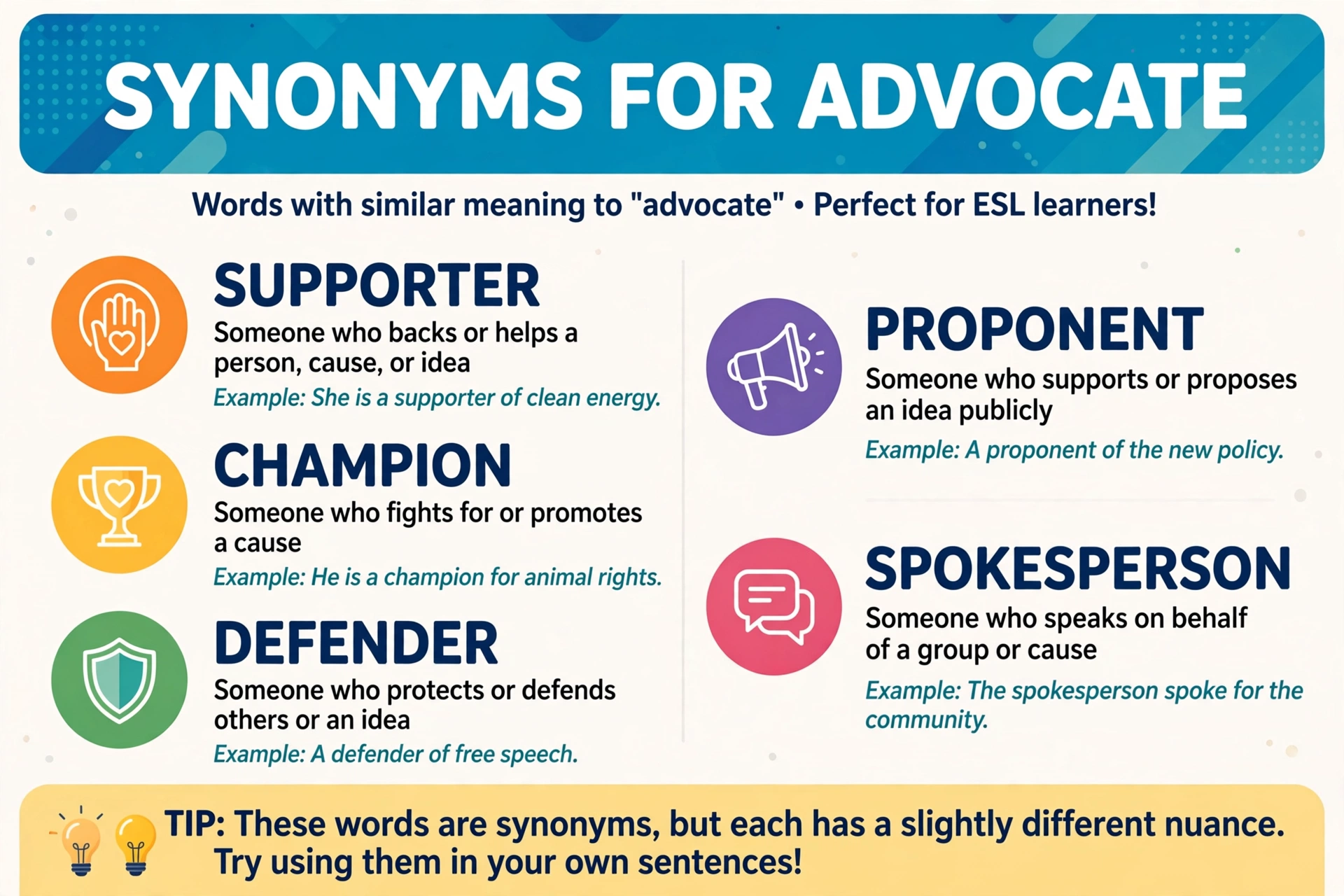
Supporter
Meaning: A person who agrees with an idea or cause and helps it, either actively or quietly.
Example: She has been a loyal supporter of the local library for over a decade.
Example 2: Thousands of supporters gathered outside the stadium before the final.
Defender
Meaning: Someone who protects an idea, person, or principle, especially when it is under attack or criticism.
Example: He became a vocal defender of free speech on campus.
Example 2: She has always been a defender of animal rights.
Champion
Meaning: A person who fights energetically and publicly for a cause they believe in.
Example: The young athlete is now a champion for mental health awareness.
Example 2: The mayor became a champion of affordable housing.
Activist
Meaning: Someone who takes direct, organized action — marches, campaigns, petitions — to bring about change.
Example: The activist organized a neighborhood cleanup that drew two hundred volunteers.
Example 2: The young activist spoke passionately at the climate rally.
Proponent
Meaning: A person who argues in favor of an idea or proposal, especially in formal or professional settings.
Example: She is a leading proponent of teaching coding in primary schools.
Example 2: He is a well-known proponent of remote work.
Advocate at a Glance
A quick comparison to lock in the differences:
| Word | Tone | Use it when… |
|---|---|---|
| Supporter | Neutral | describing general backing of a cause |
| Defender | Strong | someone protects an idea under criticism |
| Champion | Energetic | the support is passionate and public |
| Activist | Bold | describing organized, visible action |
| Proponent | Formal | making a reasoned case in professional settings |
How to Use These Words
Match the word to the energy involved. A supporter may simply donate or vote; a defender steps in when something is threatened; a champion leads the charge with passion; an activist organizes action in the streets or online; and a proponent makes the reasoned case in meetings and essays. In academic writing, “proponent” and “advocate” sound most professional, while “champion” adds warmth. Choosing among them shows readers you understand not just support, but the style of support — a nuance that matters whenever principles are at stake, as in moral vs morale.
A practical trick: picture the scene before you choose. A petition signature is a supporter; a lawyer in court is a defender; a celebrity posting daily about a cause is a champion; marchers with banners are activists; and the expert presenting slides to a board is a proponent. If your sentence works with more than one, pick the one whose energy matches your story — the reader will feel the difference even if they cannot name it.
Also watch the noun-verb split. “Advocate” works as both: you can be an advocate and you can advocate a policy. The five words here are nouns only — they name people. If your sentence needs an action, switch to the matching verb: a supporter backs, a defender protects, a champion promotes, an activist campaigns, and a proponent argues for. Keeping the person and the action straight will keep your sentences clean and your meaning exact.
Common Mistakes to Avoid
- Calling every helper an activist. Signing a petition makes you a supporter, not an activist. Reserve “activist” for people who organize visible, sustained action.
- Using “champion” carelessly as a verb. “Champion” can be a verb (“she champions the cause”), but as a noun it names the person. Do not mix the two jobs inside one sentence.
- “Proponent” for casual opinions. Liking a movie does not make you its “proponent” — the word belongs to formal proposals and debates, not everyday tastes.
- Defender without a threat. “Defender” implies something is under attack. If nothing is threatened, “supporter” is the honest word.
Related Words Worth Learning
- Synonyms for Inspire — what great advocates do to others
- Synonyms for Determination — the quality every advocate needs
- Synonyms for Flexible — adapting your message to your audience
Quick Practice
Choose the best word for each sentence:
- The ___ collected signatures outside the supermarket. (activist / proponent)
- He is a quiet ___ of the museum who donates every year. (supporter / champion)
- The lawyer acted as a fierce ___ of her client’s rights. (defender / activist)
- As a ___ of electric cars, she gave talks at three conferences. (proponent / defender)
Answer key: 1. activist — 2. supporter — 3. defender — 4. proponent
FAQs
What is the best single synonym for advocate (noun)?
Supporter is the safest general choice. It works in almost every context where “advocate” as a noun would fit.
What is the difference between an advocate and an activist?
An advocate supports and argues for a cause, which can be quiet or formal. An activist takes visible, organized action — protests, campaigns, petitions. All activists are advocates, but not all advocates are activists.
Is “champion” too informal for academic writing?
It is vivid but acceptable in most essays, especially in the humanities. For very formal papers, “proponent” or “advocate” is safer.
Can “defender” have a negative meaning?
It can sound combative if the context is hostile, since it implies something is under attack. In neutral contexts, though, it simply means someone who stands up for something.
What verb goes with “proponent”?
Proponents argue for, support, or put forward ideas: “She put forward a strong case for reform.” Avoid vague phrasing like “proponents do things” — name the action.
Is “advocate” countable?
Yes. One advocate, many advocates. The same is true for all five nouns here: supporters, defenders, champions, activists, proponents.
Conclusion
Whether you call someone a supporter, defender, champion, activist, or proponent, you are describing a person who refuses to stay silent about what matters. The difference lies in how they show it — quietly, protectively, passionately, publicly, or persuasively. Learn these five shades of support, and your writing about people and causes will carry far more precision and power.

Thomas Allen is a language writer and editor who loves exploring the subtle differences between words. He creates clear, practical guides that help readers understand English better — one word pair at a time.