To assist means to help someone do something — and few ideas appear more often in English. Resumes promise you “assisted clients,” emails offer to “assist with” projects, and teachers “assist” struggling students. It is useful precisely because it is general, but that generality is also its weakness: it never says how you helped.
Think of the last time someone truly helped you. Perhaps they guided you through a confusing process, supported you during a hard month, or cooperated with you on a shared project. Each kind of help felt different — and deserves a different word. Vague “assistance” on a resume or in an essay hides exactly the detail that would impress the reader. The five words below make the shape of your help visible.
The five synonyms below specify the kind of help. Some describe hands-on aid, others describe guidance, and one describes teamwork itself. Using them turns a flat claim of “helping” into a vivid picture. Mind your prepositions as you do — we assist with a task and cooperate with people; the little words matter, as our guide to of or for shows.
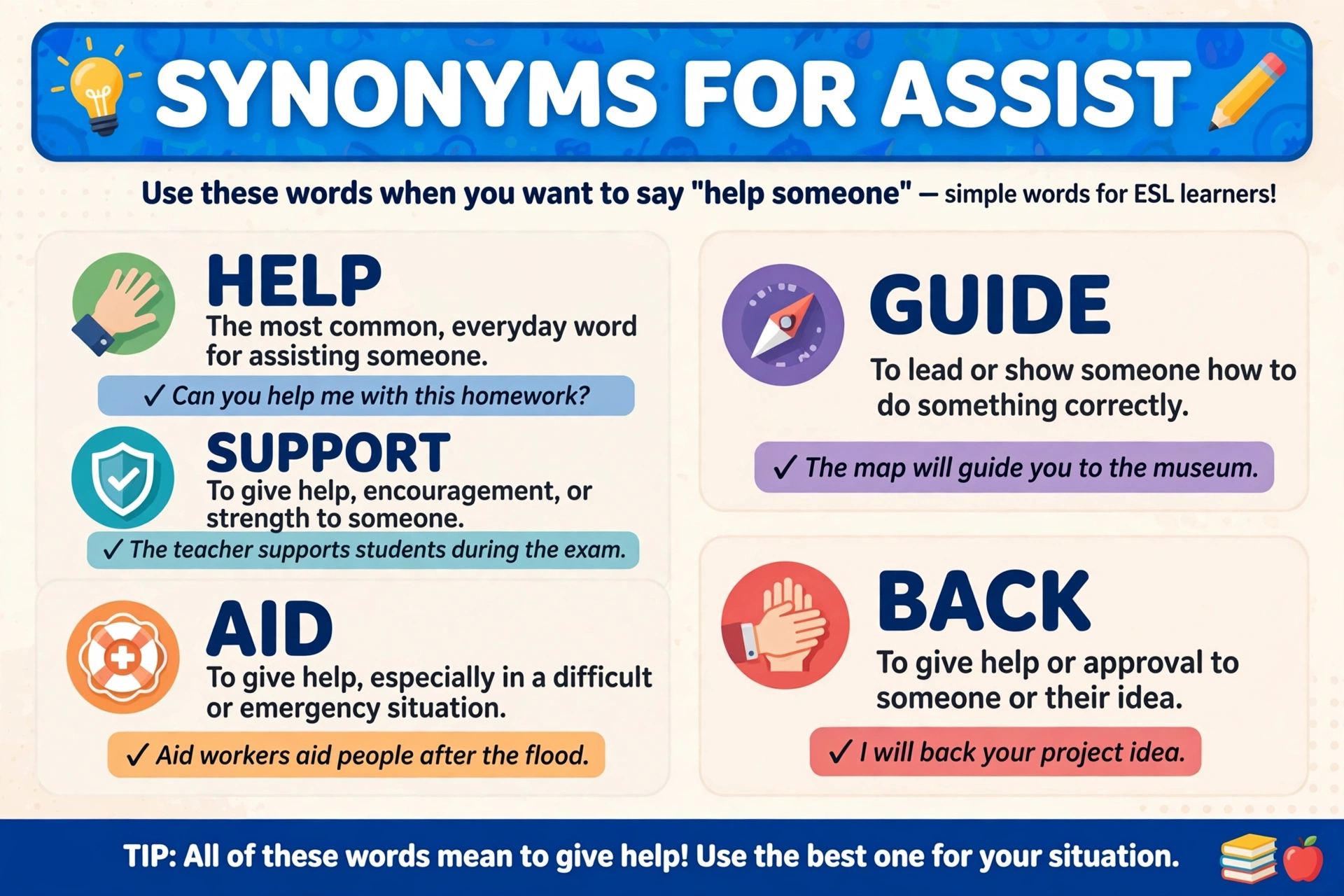
Aid
Meaning: To give help or support, especially in a difficult or urgent situation.
Example: Volunteers arrived quickly to aid families after the flood.
Example 2: The charity sent food to aid victims of the earthquake.
Help
Meaning: To make something easier or better for someone; the simplest and most versatile choice.
Example: Could you help me carry these boxes upstairs?
Example 2: The instructions helped me assemble the furniture.
Support
Meaning: To stand behind someone or something, giving strength, encouragement, or resources over time.
Example: Her parents supported her decision to study abroad.
Example 2: Friends supported him through the long recovery.
Guide
Meaning: To help someone by showing the way, explaining steps, or giving direction.
Example: The mentor guided the new intern through her first week.
Example 2: The tutorial guided users through the setup process.
Cooperate
Meaning: To work together with others toward a shared goal.
Example: The two departments cooperated to finish the launch on time.
Example 2: Rival teams cooperated to solve the technical problem.
Assist at a Glance
A quick comparison to lock in the differences:
| Word | Tone | Use it when… |
|---|---|---|
| Aid | Formal | helping in emergencies or official contexts |
| Help | Neutral | the everyday, all-purpose choice |
| Support | Warm | backing someone over time |
| Guide | Friendly | the help takes the form of direction |
| Cooperate | Neutral | everyone works together, no sides |
How to Use These Words
Choose by the shape of the help. Aid suits emergencies and formal contexts (“first aid,” “financial aid”). Help is the everyday default — friendly and unlimited. Support implies ongoing backing, emotional or practical, rather than a single act. Guide is the word when your help takes the form of direction or teaching. Cooperate shifts the focus: nobody is the helper and nobody is the helped — everyone works together. On resumes, replace a flat “assisted” with the precise verb: “guided new hires,” “supported the launch,” “cooperated across teams.” And when help shades into reassurance, double-check you do not mean “assure” — see assure vs ensure — while easily mixed-up pairs like trouper or trooper remind us that small spelling differences change meaning.
A practical trick: finish the sentence “I ___ed them by ___.” If the blank fills with “showing the steps,” you mean guide. If it fills with “being there for months,” you mean support. If it fills with “working alongside them,” you mean cooperate. This test forces the shape of the help into view, and the shape is exactly what separates these five. Vague helping claims become concrete stories — and concrete stories are what make resumes, references, and personal statements persuasive.
Prepositions are the hidden test here. We aid someone directly (“aid the victims”) or aid in an effort (“aid in the rescue”). We help someone with a task, or help + bare infinitive (“help me carry”). We support a person, cause, or decision — no preposition needed. We guide someone through a process or to a place. We cooperate with people and on projects. Getting these little words right is what makes your sentences sound native rather than translated.
Common Mistakes to Avoid
- “Assist” as a resume crutch. “Assisted clients” says nothing. Replace it with the precise verb: “guided new clients,” “supported the sales team,” “cooperated with designers.”
- “Cooperate” for one-sided help. If only you helped, you did not “cooperate” — cooperation is mutual. Use “aided” or “supported” for one-way help.
- “Support” for physical tasks. You help someone carry boxes; you support a decision, a person over time, or a cause. “Support me with these boxes” sounds odd.
- “Guide” without direction. Guiding implies showing a way. If you merely did the task for someone, “helped” is the honest word.
Related Words Worth Learning
- Synonyms for Inspire — help that lifts people higher
- Synonyms for Vulnerable — the people who need assistance most
- Synonyms for Resilience — what good support builds
Quick Practice
Choose the best word for each sentence:
- Nurses ___ doctors during complex operations. (assist / cooperate)
- The two firms ___ on the new research project. (cooperated / guided)
- Her coach ___ her through every stage of training. (guided / aided)
- The charity ___ victims with food and shelter. (aided / guided)
Answer key: 1. assist — 2. cooperated — 3. guided — 4. aided
FAQs
What is the best formal synonym for assist?
Aid is the most formal single word (“aid workers,” “financial aid”). In business writing, “support” and “facilitate” also sound professional.
What is the difference between help and assist?
They overlap heavily. “Assist” is slightly more formal and often implies helping someone who is already doing something (“assist the surgeon”). “Help” is warmer and works everywhere.
Is “cooperate” really a synonym for assist?
It is a near-synonym with a twist: cooperation means mutual help rather than one-sided assistance. Use it when everyone contributes.
Can “guide” replace “assist”?
When the help involves direction, teaching, or showing steps — yes, and it is more vivid. “She guided me through the process” beats “she assisted me with the process.”
What is the noun form of “assist”?
“Assistance” — “Thank you for your assistance.” “Aid” and “help” are also nouns: “financial aid,” “a big help.” “Support” works as a noun too: “thanks for your support.”
Is “aid” always serious?
Mostly — “aid” suits emergencies, charities, and official contexts (“foreign aid,” “first aid”). For everyday favors, “help” is warmer and more natural.
Conclusion
Aid in emergencies, help every day, support over time, guide with direction, and cooperate side by side — five ways to say you were there for someone, each with its own shape. Stop letting “assist” do all the work alone, and your descriptions of helpfulness will finally sound as generous as the acts themselves.

Thomas Allen is a language writer and editor who loves exploring the subtle differences between words. He creates clear, practical guides that help readers understand English better — one word pair at a time.