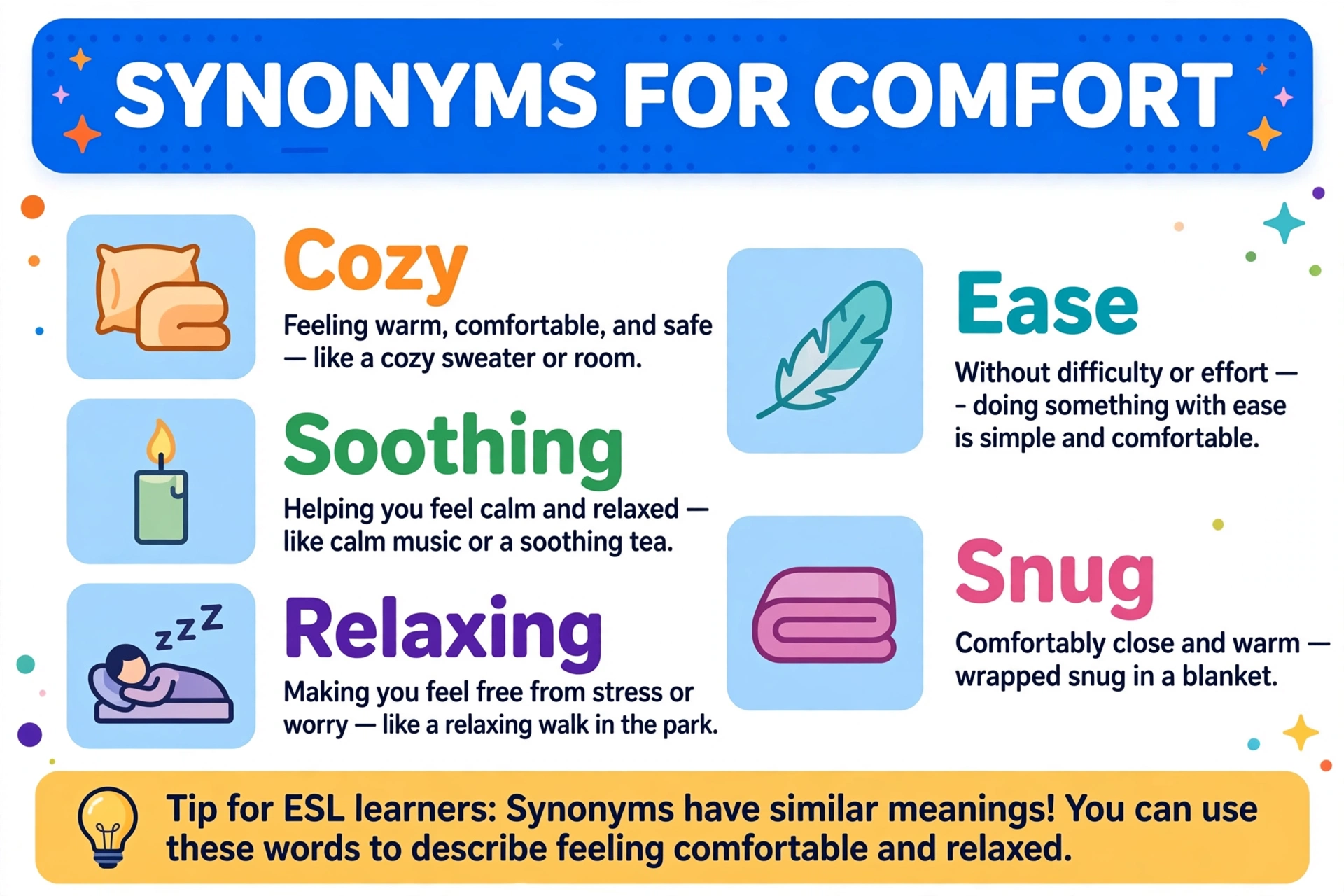
Comfort is a warm, wide word. It can mean physical ease, emotional support, relief from pain, or the calm feeling of being safe. Because it covers so much ground, using “comfort” for everything makes your writing vague — readers cannot tell which kind of comfort you mean.
Picture two scenes: a tired traveler sinking into a soft hotel bed, and a friend sitting beside you after bad news. Both bring “comfort,” but they feel completely different. Calling the first “ease” and the second “solace” tells your reader exactly what you mean without extra explanation. Precision turns a generic sentence into a vivid one.
Learning exact synonyms for comfort lets you name the feeling precisely. Whether someone needs relief from worry, solace after a loss, or simply ease after a long day, the right word shows you understand. This matters in essays, stories, emails, and everyday conversation.
Getting this right has a real emotional payoff. When someone is hurting, a precise word shows that you truly see their situation — “I hope this brings you some solace” feels deeper than “I hope you feel comfortable.” Writers, too, gain power from these words: a novelist who writes “relief” instead of “comfort” paints a sharper picture, and a student who uses “reassurance” in an essay sounds more mature. These five words are small tools with a big effect on how warm and thoughtful your English feels.
In this guide, you will learn five powerful synonyms for comfort, each with a clear meaning and natural example sentences.
Ease
Meaning: A relaxed state with no pain, stress, or difficulty; feeling comfortable and calm.
Example: The soft armchair helped him rest with ease after the long trip.
Example: She moved through the crowded room with surprising ease.
Example: Years of practice allowed the pianist to play the difficult piece with ease.
Relief
Meaning: The pleasant feeling when pain, stress, or worry fades or goes away.
Example: She felt great relief when the exam finally ended.
Example: The cool shade brought relief from the afternoon heat.
Example: The good news brought instant relief to the worried parents.
Solace
Meaning: Comfort that helps you feel better during sadness or grief.
Example: He found solace in long walks after his grandmother passed away.
Example: Music gave her solace during the lonely winter months.
Example: After the defeat, the coach found solace in the team’s fighting spirit.
Consolation
Meaning: Something that makes you feel better after a loss or disappointment.
Example: Her kind message was a real consolation after the bad news.
Example: The team’s only consolation was that they had played their best.
Example: Winning the silver medal was small consolation after missing the gold.
Reassurance
Meaning: Words or actions that make someone feel less worried or afraid.
Example: The doctor’s calm voice gave the patient reassurance before surgery.
Example: A quick phone call from her son gave the worried mother reassurance.
Example: The teacher’s reassurance helped the nervous students before the exam.
Quick Comparison Table
| Synonym | Best Used For |
|---|---|
| Ease | Relaxed physical or mental comfort |
| Relief | When pain, stress, or worry fades |
| Solace | Comfort during grief or deep sadness |
| Consolation | Feeling better after disappointment |
| Reassurance | Calming someone’s worries or fears |
How to Use These Words
Pick the word that matches the feeling. Use ease for relaxed physical comfort, relief when trouble fades, solace for grief, consolation after disappointment, and reassurance to calm worry. A good rule: if someone is sad, reach for solace or consolation; if someone is worried, reach for reassurance; if someone is tired, reach for ease or relief. To comfort someone is often to assure them — and using the right verb matters, as assure vs ensure explains. Precise words make your kindness land exactly where you intend.
Tone matters here too. Solace and consolation carry a serious, literary weight — they belong in speeches, condolence messages, and thoughtful essays. Relief and ease are everyday words that work everywhere, from chats with friends to formal reports. Reassurance sits naturally in caring conversations and professional settings alike, such as a manager calming a team before a big change. When in doubt, choose the word that matches how serious the situation feels; a light word for a heavy moment can sound careless.
Common Mistakes to Avoid
- Offering “relief” to someone who is grieving. Relief means a bad thing has ended, which can sound insensitive after a loss. For grief, “solace” or “consolation” is the respectful choice.
- Using “consolation” for big victories. A “consolation prize” is given to losers, not winners. Do not call a real achievement a consolation — it cheapens the win.
- Mixing up “reassurance” and “insurance.” They sound a little alike but mean nothing alike. Reassurance calms fears with words; insurance is a financial product. Learners sometimes write “give me insurance” when they mean “give me reassurance.”
- Saying “comfort” when you mean “relief from pain.” If a headache stops, that is relief, not comfort. Comfort is the ongoing pleasant state; relief is the moment the bad feeling leaves.
Quick Practice
Choose the best word from the list: ease, relief, solace, consolation, reassurance.
- The nurse’s calm words gave the frightened child some ___.
- He found ___ in gardening after his business failed.
- When the lost dog was found, the family felt enormous ___.
- Her only ___ after losing the final was knowing she had trained hard.
Answer key: 1. reassurance 2. solace 3. relief 4. consolation
Related Words Worth Learning
- Synonyms for Resilience — strength that grows through hard times
- Synonyms for Vulnerable — when comfort is needed most
- Synonyms for Inspire — lifting others with your words
FAQs
What is the difference between solace and consolation?
They are close, but “solace” usually refers to comfort during grief or deep sadness, while “consolation” fits smaller disappointments, like losing a game.
Is “relief” always about comfort?
Mostly. “Relief” describes the good feeling when something bad ends — pain stops, stress lifts, or danger passes.
Can “ease” be a verb too?
Yes. As a verb, “ease” means to make something less painful or difficult, as in “This cream will ease the pain.”
What is a formal synonym for comfort?
“Solace” and “consolation” are the most formal of the five and work well in literature, speeches, and serious writing.
Can “relief” describe physical feelings?
Yes. “Relief” often describes the moment pain or pressure ends — “the medicine brought relief from the headache.” It is one of its most common uses.
What is the difference between reassurance and encouragement?
Reassurance calms an existing fear (“do not worry, you will be fine”), while encouragement pushes someone toward action (“you can do it, go ahead”). One removes worry; the other adds courage.
Conclusion
Comfort comes in many forms, and now you have the words to name each one. Ease, relief, solace, consolation, and reassurance let you express care with precision and warmth. Use them thoughtfully, and your English will feel richer — and kinder.

Thomas Allen is a language writer and editor who loves exploring the subtle differences between words. He creates clear, practical guides that help readers understand English better — one word pair at a time.