Reason is one of the most flexible words in English — and that is exactly the problem. It can mean why something happened, why someone acted, the explanation behind a decision, or the ability to think logically. When one word does that many jobs, your meaning can get blurry.
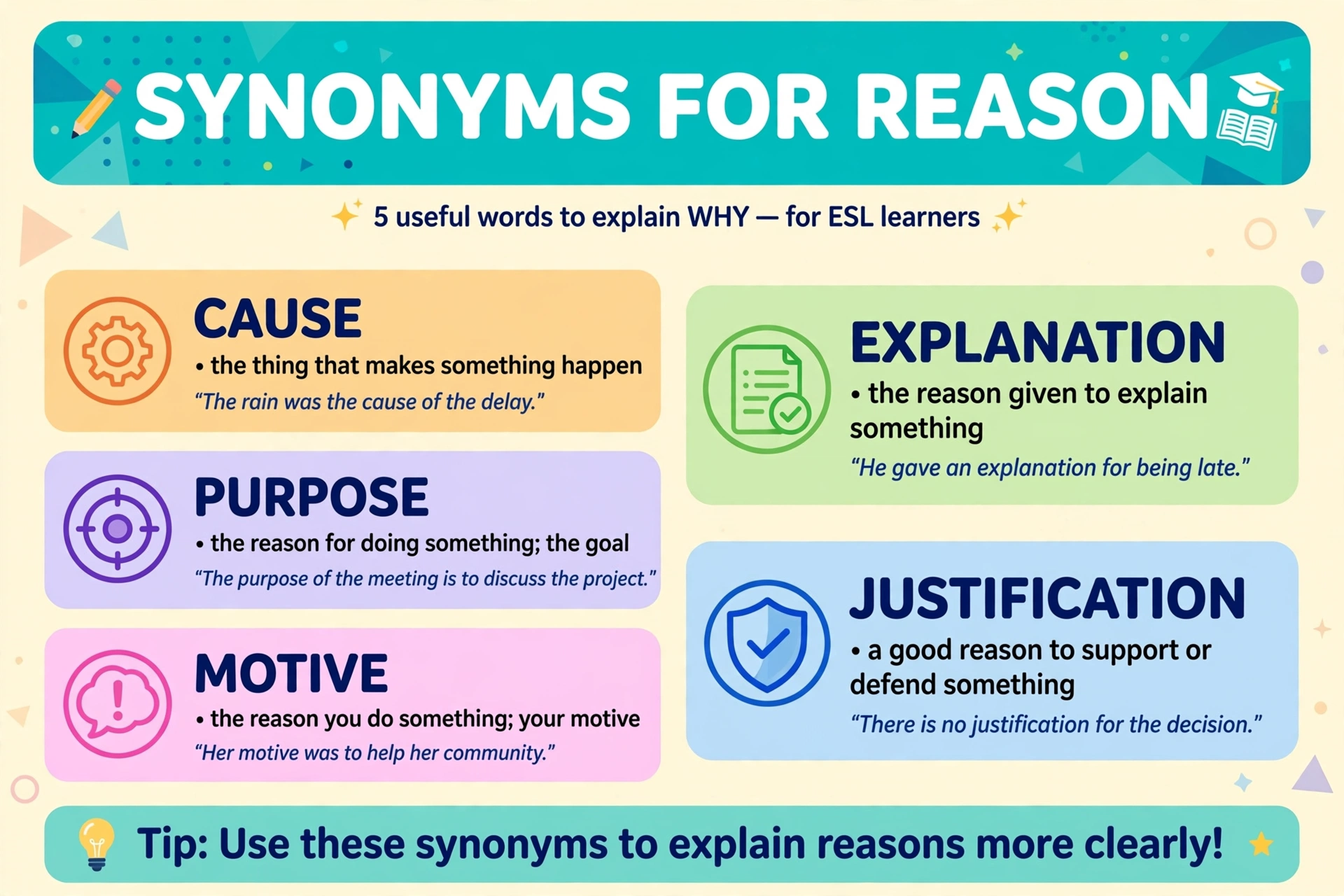
The fix is choosing the synonym that matches your exact sense. A cause explains events, a motive explains people, a rationale explains decisions. Here are five of the most useful synonyms for reason, each with a clear meaning and an example.
There is a fourth job “reason” does that many learners miss: the power of thinking itself. “Human reason,” “the age of reason,” “listen to reason” — here the word means logical thought, not a cause at all. Philosophers have debated for centuries what reason is and how far it can take us. You do not need the philosophy, but you do need to recognize the sense: when someone says “be reasonable,” they are asking you to think clearly, not to give them a cause. Spotting which “reason” you are dealing with — cause, motive, explanation, or thinking — is the master skill this guide teaches.
This precision pays off in arguments and essays most of all. Weak writing says “the reason is…” for everything; strong writing names the cause of the problem, the motive of the people, and the rationale of the solution in three separate, exact words. Readers trust writers who make these distinctions, because precision about “why” signals precision of thought.
Cause
Meaning: The factor or event that makes something happen.
Example: The investigation found that faulty wiring was the cause of the fire.
Another example: Lack of rain was the main cause of the poor harvest this year.
Motive
Meaning: The inner drive or personal incentive behind someone’s actions.
Example: The detective spent weeks trying to uncover the suspect’s motive.
Another example: Jealousy was the motive behind the crime, the police said.
Explanation
Meaning: A statement that makes something clear or easy to understand.
Example: Her explanation of the new policy cleared up everyone’s confusion.
Another example: The teacher gave a simple explanation of the grammar rule.
Rationale
Meaning: The logical thinking or set of reasons behind a decision or belief.
Example: The manager shared the rationale for changing the team’s schedule.
Another example: The committee explained the rationale behind the new membership fees.
Justification
Meaning: A reason that shows an action or belief is right, fair, or acceptable.
Example: He struggled to find any justification for missing the important deadline.
Another example: There is no justification for cheating on an exam, no matter the pressure.
How to Use These Words
Ask what kind of “why” you mean. For events and outcomes, use cause — it points to what made it happen. For human behavior, use motive — it points to what drove the person. For decisions and plans, use rationale — it points to the thinking behind the choice. For making things clear, use explanation. For defending an action as right or fair, use justification. Notice how each word narrows the meaning: “the reason for the delay” is vague, but “the cause of the delay” tells you it was an event, not a person.
Take it one step further and watch the grammar. “Cause” usually appears as “the cause of” plus a noun: “the cause of the delay.” “Motive” pairs with “behind” or “for”: “the motive behind the decision,” “a motive for lying.” “Rationale” takes “for” or “behind”: “the rationale for the change.” These little partnerships are fixed — mixing them (“the cause behind the delay”) may still be understood, but the natural pattern sounds far more fluent.
Common Mistakes to Avoid
- Using “explanation” for causes. “The explanation of the fire” sounds odd when you mean what started it. Causes need “cause”: “the cause of the fire.”
- Using “motive” for events. “Motive” is for people and their inner drives. A storm has a cause, not a motive — motives need a mind behind them.
- Using “rationale” for accidents. “Rationale” explains deliberate decisions and beliefs. A car crash has a cause; only the driver’s choice beforehand has a rationale.
- Sounding defensive with “justification.” “Justification” defends an action as right — so “he offered no justification” quietly suggests the action may have been wrong. Use it deliberately, not by accident.
Quick Practice
Choose the best word for each sentence: cause, motive, explanation, rationale, justification.
- What was the ___ of yesterday’s sudden power cut?
- The police are still searching for a ___ behind the robbery.
- Can you give me one good ___ for arriving an hour late?
Answer key: 1. cause — 2. motive — 3. justification
Related Words Worth Learning
- Synonyms for Evidence — the facts that back up your reasoning
- Synonyms for Efficient — reasons that lead to smart action
- Synonyms for Determination — the drive behind strong motives
FAQs
What is the best synonym for reason in academic writing?
“Rationale” is the top choice for academic and professional writing — it specifically means the logical reasoning behind a decision or method. “Cause” works for explaining events and results.
What is the difference between “motive” and “reason”?
“Motive” is a type of reason: the inner drive behind a person’s actions, often used in crime and psychology contexts. “Reason” is the broader word covering causes, explanations, and motives alike.
Can “explanation” replace “reason”?
Often, yes — when you mean the statement that makes something clear. But “explanation” does not work for causes (“the explanation of the fire” sounds odd; “the cause of the fire” is natural).
Is “justification” always positive?
It usually defends something as right or acceptable, so it carries a positive or neutral tone. But it can sound defensive — “he offered no justification” implies the action may have been wrong.
What is the difference between “reason” and “excuse”?
A reason explains why something happened; an excuse tries to avoid blame for it. “The reason I was late was traffic” is neutral information. “My excuse was traffic” suggests you are dodging responsibility. In serious writing, prefer “reason” — “excuse” can make you sound like you are hiding something.
What does “within reason” mean?
It means within sensible, acceptable limits. “You can borrow anything within reason” means take what you need, but do not be greedy or extreme. It is a polite way of setting a boundary without naming an exact number.
Conclusion
Reason does many jobs, but precision wins. Name a cause for events, a motive for people, a rationale for decisions, an explanation for clarity, and a justification for defense. With these five words, your “why” will always be crystal clear.
Next time you catch yourself writing “the reason is,” stop and ask which kind of “why” you mean. Replacing it with the exact word takes five seconds — and it is one of the clearest signs of a mature English writer.

James Reed is a writer and English language enthusiast with a passion for making vocabulary simple and fun. He writes about words, meanings, and everyday English to help learners speak and write with confidence.