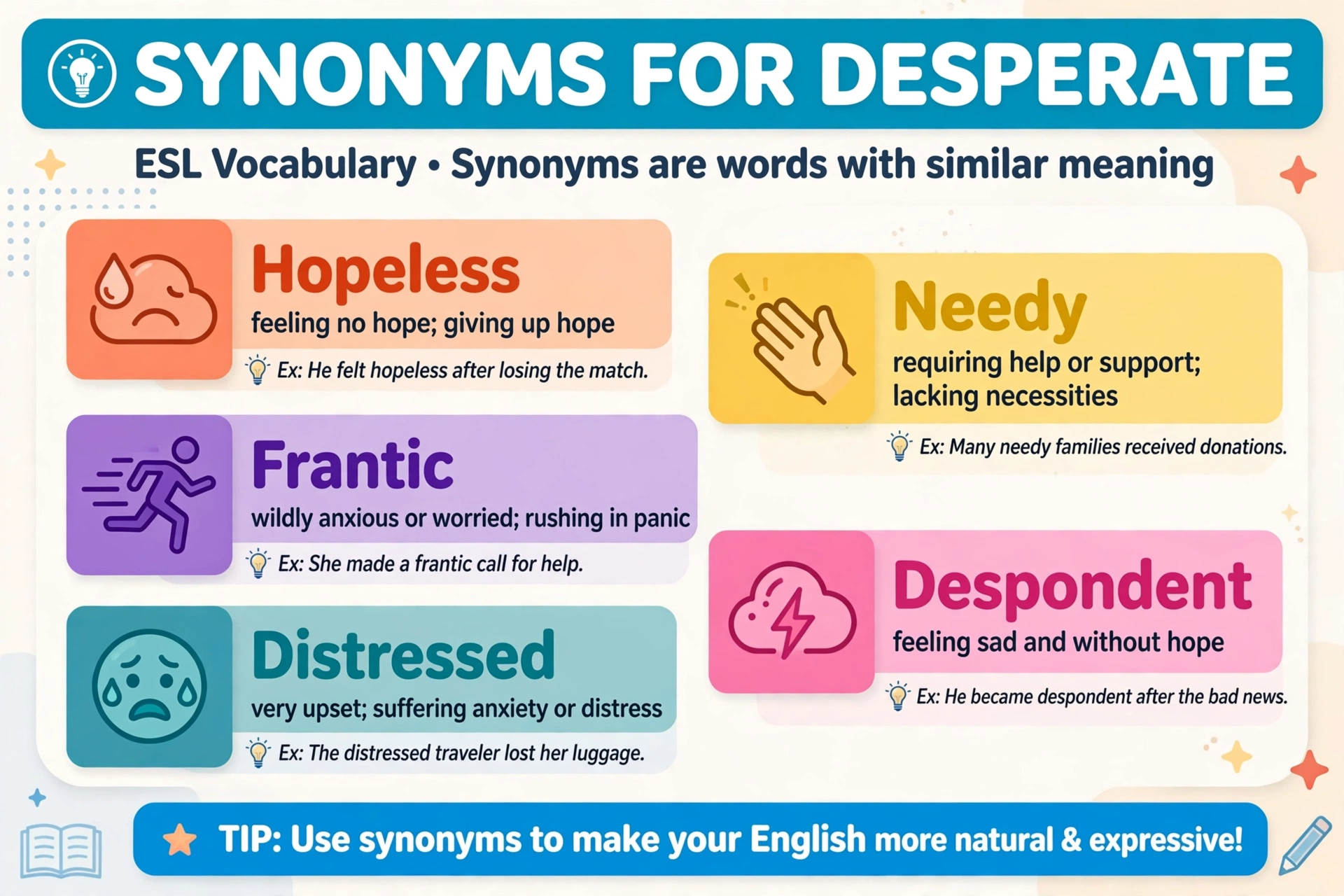
“Desperate” is an emotional word — it can mean urgently needing something, feeling hopeless, or wanting something so badly it hurts. Because it covers so many feelings at once, writers often reach for it when a more exact word would work better.
Choosing the right synonym sharpens your message: urgency is not the same as hopelessness, and desire is not the same as panic. Here are five strong alternatives, each with a clear meaning and a practical example.
Desperation is universal: the student before final exams, the traveler who missed the last train, the dreamer chasing one big chance. Naming the exact shade of that feeling is a mark of strong English. These five words give you that precision.
Learning them also protects you from a common trap: overusing “desperate” until it loses all force. In stories, essays, and even job interviews, a precise emotion word shows maturity and control. The five words below will help you describe pressure, panic, hopelessness, and burning desire — each with exactly the right tone.
Urgent
Meaning: Needing immediate action or attention; very pressing.
Example: The patient had an urgent need for medical care.
Example: The company sent an urgent email asking all staff to update their passwords.
Frantic
Meaning: Extremely worried or rushed, unable to stay calm.
Example: She made a frantic call to the airline before the flight left.
Example: The toddler ran in frantic circles when he could not find his toy.
Hopeless
Meaning: Feeling that nothing can improve or succeed.
Example: After the third rejection, he felt hopeless about the job search.
Example: The situation looked hopeless until a neighbor offered to help.
Despairing
Meaning: Having lost confidence that things will get better.
Example: The team looked despairing after conceding the final goal.
Example: She gave a despairing sigh when she saw the long queue at the bank.
Eager
Meaning: Full of strong desire and enthusiasm to do or get something.
Example: The young graduates were eager to start their careers.
Example: The children were eager to open their gifts on the holiday morning.
At a Glance
| Word | Use it when… |
|---|---|
| Urgent | Situations needing immediate action |
| Frantic | Panicked, rushed, unable to stay calm |
| Hopeless | Feeling that success is impossible |
| Despairing | The emotional state of lost hope |
| Eager | Intense, hopeful desire for something |
How to Use These Words
Sort your synonyms by feeling. Use urgent for time pressure, frantic for panicked energy, and hopeless or despairing for lost confidence. Choose eager for the positive side of desperation — intense, hopeful desire. A small language note: desperate situations test a group’s spirit, and writers often mix up the words for ethics and mood in such moments — see moral vs morale to keep them straight.
Grammar patterns help too: you are urgent about a matter, frantic with worry, hopeless about a situation, despairing of success (a formal pattern), and eager to do something. Notice that “eager” is the only one of the five that points happily toward the future — the others all carry pressure or sadness. Choosing among them is really choosing the emotional color of your sentence.
Common Mistakes to Avoid
- Using “desperate” on a job application: “I am desperate for this job” sounds alarming to employers — it suggests panic, not passion. Say you are eager to contribute or enthusiastic about the role instead. Word choice in applications is first-impression vocabulary.
- Confusing “hopeless” people with “hopeless” situations: “He is hopeless at cooking” means he is very bad at it — a casual, almost playful use. “He felt hopeless about his career” means he lost all hope. The same word, two different meanings: check the context.
- Overusing “frantic”: “Frantic” means losing calm, so using it for ordinary busyness (“a frantic morning at the office”) weakens it. Save it for genuine panic and rush, and use “busy” or “hectic” for normal pressure.
- “Despairing” is not “desperate” spelled wrong: Learners sometimes treat them as interchangeable. They are not: “desperate” is the general, common word for urgent need or hopelessness; “despairing” is specifically literary and emotional — the look or feeling of someone who has given up hope.
Quick Practice
Choose the best word for each sentence: urgent, frantic, hopeless, despairing, eager.
- The doctor said the operation was _____ and could not wait.
- New puppy owners are often _____ to teach their dog its first tricks.
- After losing the final match, the fans left the stadium looking _____.
- In the _____ moments before takeoff, she searched every pocket for her passport.
Answer key: 1. urgent — needing immediate action. 2. eager — enthusiastic desire. 3. despairing — visibly losing hope. 4. frantic — panicked, rushed energy.
Related Words Worth Learning
- Synonyms for Vulnerable — desperate moments often leave us feeling vulnerable.
- Synonyms for Resilience — resilience is what carries you past despair.
- Synonyms for Determination — determination turns desperate energy into action.
FAQs
What is a formal synonym for “desperate”?
“Urgent” and “despairing” both work in formal writing. “Urgent” suits business and official contexts, while “despairing” fits literary and emotional descriptions. In news writing, ‘urgent’ is the safest formal choice for situations, while ‘despairing’ suits human stories.
Is “eager” really a synonym for “desperate”?
Yes, for one shade of meaning. “Desperate” can describe intense desire, and “eager” captures that desire without the negativity — it is the hopeful version of desperation. Use it when you want the energy of desperation without any sense of hopelessness.
What is the difference between “hopeless” and “despairing”?
They are very close. “Hopeless” describes the feeling that success is impossible, while “despairing” describes the emotional state of someone who has lost hope. “Despairing” is slightly more literary. In practice, ‘hopeless’ describes the situation and ‘despairing’ describes the person feeling it.
Can “frantic” describe a situation, not just a person?
Yes. People are most often “frantic,” but situations can be too: “a frantic search,” “frantic negotiations,” or “the frantic final minutes of the game.” Just note the tone: ‘frantic’ always suggests a loss of calm, so it suits chaos better than quiet urgency.
What is the adverb form of “desperate”?
“Desperately” — as in “She desperately wanted to pass the exam.” It strengthens almost any verb: desperately needed, desperately hoped, desperately tried. Be careful in formal writing, though: “desperately” can sound overly emotional, so in business contexts prefer “urgently” (“we urgently need your reply”) for the same meaning with a calmer tone.
Is “desperate” always negative?
Not entirely. “Desperate measures” and “desperate times” are negative, but “desperate to succeed” can sound determined and passionate rather than sad. Context decides: followed by “for” or “to” plus a goal, desperation often reads as intense motivation; standing alone, it usually reads as hopelessness.
Conclusion
Desperation has many faces, and now you have a word for each one. Urgent for pressure, frantic for panic, hopeless and despairing for lost hope, and eager for burning desire — five words that turn one blunt emotion into precise expression. Learn their differences, practice them in real sentences, and your English will carry exactly the feeling you intend.
Strong feelings deserve strong, exact words. With these five in your toolkit, you will never again reach for ‘desperate’ when something sharper is waiting.

James Reed is a writer and English language enthusiast with a passion for making vocabulary simple and fun. He writes about words, meanings, and everyday English to help learners speak and write with confidence.