“Deep” is a small word with a big job. It can describe the ocean, a thought, a feeling, or a conversation — and that flexibility is exactly why it gets overused. When every idea is “deep,” none of them feel deep anymore.
Strong synonyms rescue your writing by naming the exact kind of depth you mean: intellectual, emotional, or thorough. Here are five powerful alternatives, each with a clear meaning and a practical example sentence.
From deep oceans to deep conversations, this little adjective travels far. But variety is what makes writing memorable. When you swap a tired word for a precise one, your reader feels the difference immediately — and your English sounds more confident and natural.
That is why the best writers treat “deep” as a starting point, not a destination. Ask yourself what kind of depth you really mean: the depth of an idea, the strength of a feeling, or the completeness of a job. Once you know, the five synonyms below give you the exact word — and your sentences gain the weight they deserve.
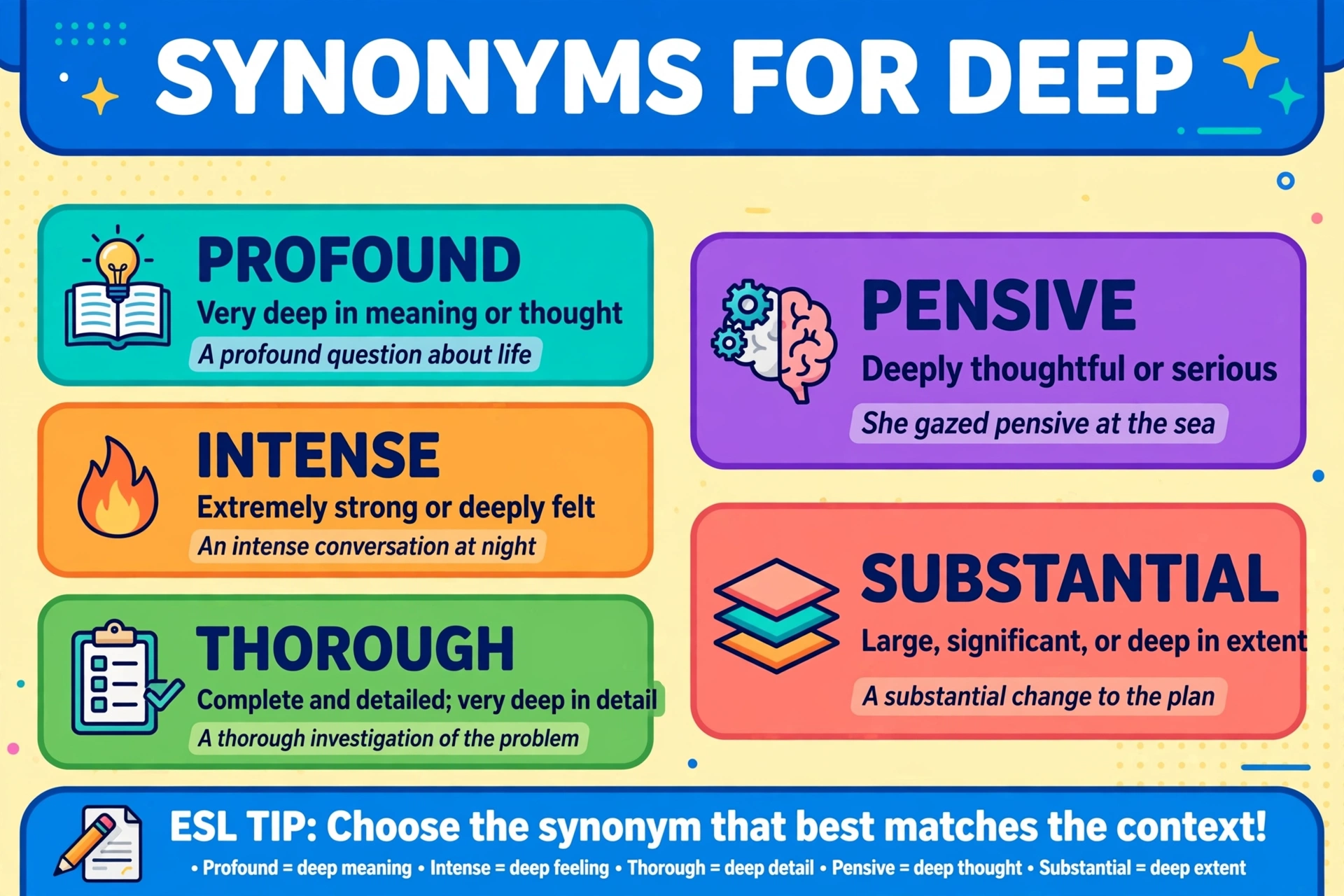
Profound
Meaning: Showing great intellectual depth or serious meaning.
Example: Her essay on friendship contained one truly profound insight.
Example: The documentary raised profound questions about the future of our planet.
Meaningful
Meaning: Full of significance, value, or purpose.
Example: They shared a meaningful conversation about their future plans.
Example: Winning the science fair was a meaningful moment for the whole class.
Intense
Meaning: Extremely strong in feeling, force, or degree.
Example: The final minutes of the match were incredibly intense.
Example: She felt an intense pressure to finish the project on time.
Thorough
Meaning: Complete and careful, covering every detail.
Example: The mechanic gave the car a thorough inspection before the trip.
Example: After a thorough review, the committee approved the proposal.
Thoughtful
Meaning: Showing careful thinking or consideration for others.
Example: He wrote a thoughtful reply to every message he received.
Example: It was thoughtful of her to bring soup to her sick neighbor.
At a Glance
| Word | Use it when… |
|---|---|
| Profound | Ideas with real intellectual weight |
| Meaningful | Moments and relationships that matter |
| Intense | Strong emotions and powerful experiences |
| Thorough | Work and research done completely |
| Thoughtful | Considerate words and careful reflection |
How to Use These Words
Match the synonym to the type of depth. Use profound for ideas and philosophy, meaningful for moments and relationships, and intense for emotions and experiences. Choose thorough for work, research, and examinations, and thoughtful for considerate actions and reflections. A related writing tip: when describing the past in depth, make sure you are using “historical” correctly — see historic vs historical — since the two adjectives are often confused.
A quick tone check helps too. “Profound” and “thorough” sound formal and serious — perfect for essays and reports. “Meaningful” and “thoughtful” are warm and personal — ideal for letters, speeches, and conversation. “Intense” is dramatic and energetic, so it fits stories and reviews but can feel too strong in a formal email. Matching the tone to the situation is what separates good vocabulary from great vocabulary.
Common Mistakes to Avoid
- Using “profound” for trivial things: “Profound” promises real intellectual weight. Calling a pizza “profound” is not funny in writing — it just looks like a vocabulary mistake. Save it for ideas that genuinely deserve the label.
- Confusing “intense” with “intensive”: “Intense” describes strong feeling or force (“an intense rivalry”); “intensive” describes concentrated effort (“an intensive course”). They are cousins, not twins.
- “Thorough” vs. “through”: These are different words. “Thorough” (with two o’s and an h) means complete and careful; “through” means from one side to the other. Mixing them up is one of the most common spelling errors in student essays.
- “Thoughtful” does not mean “full of thoughts”: A thoughtful person is considerate and careful in thinking — not someone whose mind is simply busy. “He is thoughtful” is a compliment about character, not a comment about daydreaming.
Quick Practice
Choose the best word for each sentence: profound, meaningful, intense, thorough, thoughtful.
- The coach gave a _____ speech that left the whole team in tears.
- After a _____ cleaning, the old apartment looked brand new.
- The novel’s ending carried a _____ message about forgiveness.
- It was _____ of him to remember her birthday every year.
Answer key: 1. intense — strong emotional force. 2. thorough — complete and careful work. 3. profound — deep intellectual meaning. 4. thoughtful — considerate behavior.
Related Words Worth Learning
- Synonyms for Intelligent — deep thinking and intelligence go hand in hand.
- Synonyms for Fascinating — deep subjects are often fascinating ones.
- Synonyms for Inspire — profound words inspire deep change.
FAQs
What is the strongest synonym for “deep”?
“Profound” is generally considered the strongest and most formal synonym. It suggests intellectual or philosophical depth rather than physical depth. Reserve it for ideas with real weight; using it for trivial things weakens its power.
Can “intense” replace “deep”?
Sometimes. “Intense” works when “deep” describes strong feelings or force, as in “deep emotion” becoming “intense emotion.” It does not work for physical depth like “a deep well.” A good test: if you mean strong feeling, ‘intense’ works; if you mean physical depth, it does not.
What is the difference between “profound” and “meaningful”?
“Profound” emphasizes intellectual depth and wisdom, while “meaningful” emphasizes personal significance and value. A profound book changes how you think; a meaningful gift shows someone cares. Many writers keep both in their toolkit and choose based on whether the emphasis is wisdom or value.
Is “thorough” a synonym for “deep”?
Yes, in the sense of completeness. “Deep research” and “thorough research” both suggest work that covers a subject fully without missing details. For example, ‘thorough cleaning’ and ‘deep cleaning’ describe the same job done completely.
What is the opposite of “thoughtful”?
“Thoughtless” is the direct opposite — it means not considering others or acting without care: “It was thoughtless of him to cancel at the last minute.” The contrast is useful to remember: “thoughtful” people consider feelings; “thoughtless” people ignore them. Notice the spelling keeps the “t” before the “h” — another reason to learn it carefully.
Can “profound” describe a person?
Yes, but carefully. A “profound thinker” is someone whose ideas have great depth and wisdom. Calling someone “a profound man” works in formal or literary writing, but in everyday conversation “deep thinker” or simply “wise” sounds more natural. Reserve “profound” for people only when their ideas — not just their personality — carry real weight.
Conclusion
“Deep” will always be useful, but it should not do all the work alone. Profound for wisdom, meaningful for significance, intense for feeling, thorough for completeness, and thoughtful for consideration — five precise words that give your English real depth. Use them in essays, emails, and conversations, and your ideas will land with far more power.
Depth is a quality of thought, and precise words are how you show it. Return to these five whenever ‘deep’ feels flat, and watch your ideas gain new weight.

James Reed is a writer and English language enthusiast with a passion for making vocabulary simple and fun. He writes about words, meanings, and everyday English to help learners speak and write with confidence.