“Destroy” is a blunt instrument of a word — it flattens everything from a sandcastle to a skyscraper into the same verb. But a cracked phone screen, a demolished building, and a ruined reputation are very different events, and your reader deserves to feel the difference.
The secret is intensity. English gives you a whole scale of destruction words, from mild damage to total annihilation. Here are five essential alternatives, each with a clear meaning and a practical example.
Writers love big, forceful verbs — but force without precision is just noise. Whether you are describing a storm, a broken gadget, or a failed plan, the right word tells your reader how bad the damage really was.
Think of these five words as a volume dial for destruction. At the low end sits “damage” — harm you can repair. Turn it up and you reach “ruin,” then “shatter,” then “demolish,” and finally “devastate” at maximum. Learning to set the dial correctly is one of the fastest ways to make your descriptive writing feel professional and trustworthy.
Damage
Meaning: To harm something so it works less well or looks worse, without completely ruining it.
Example: The hailstorm damaged the roof of our house.
Example: Years of sun exposure had damaged the paint on the old car.
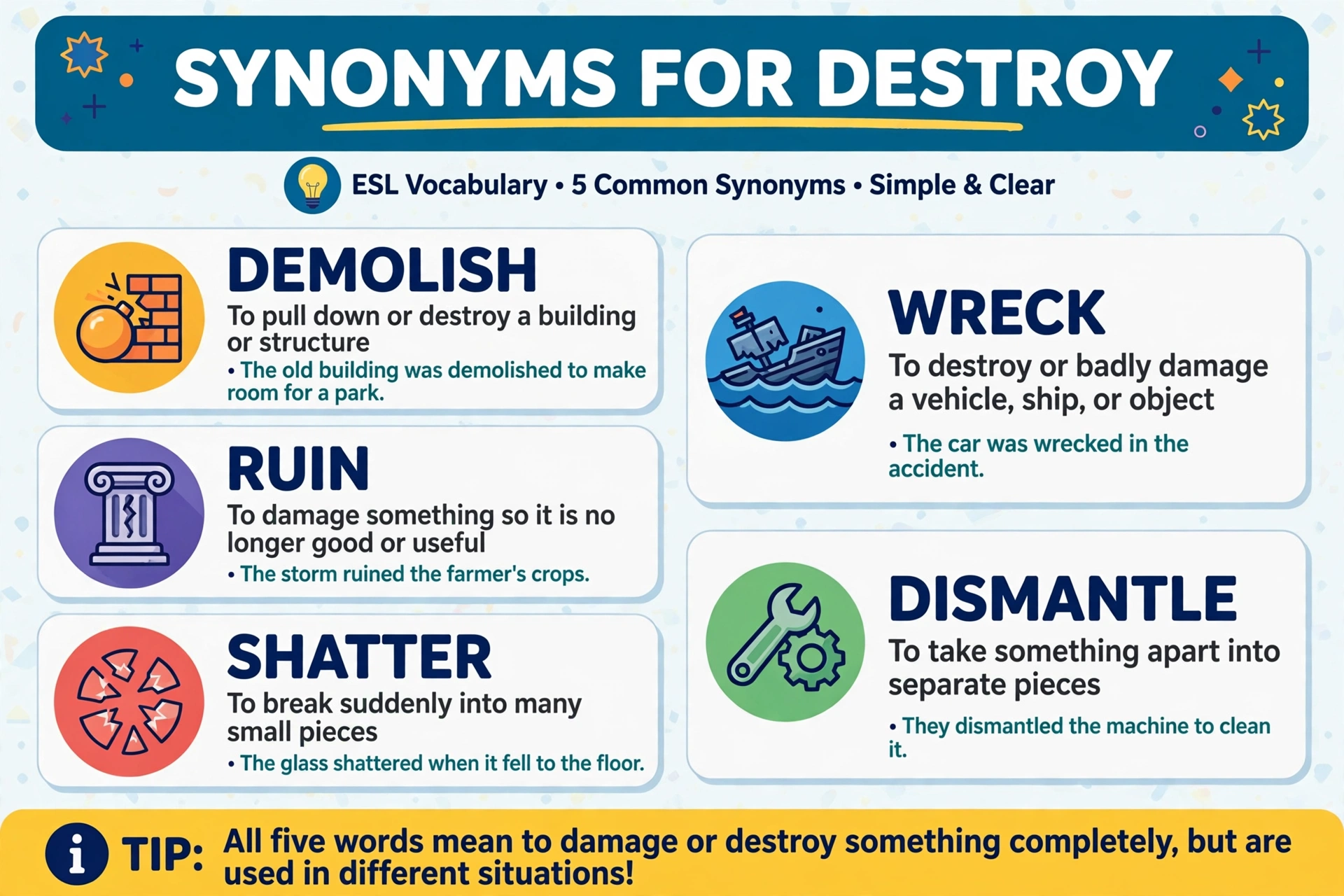
Ruin
Meaning: To spoil something so badly that it can no longer be used or enjoyed.
Example: The sudden rain ruined our outdoor wedding plans.
Example: One careless rumor almost ruined the young actor’s career.
Demolish
Meaning: To tear down a building or structure completely and deliberately.
Example: The city will demolish the old stadium next year.
Example: Workers demolished the abandoned warehouse to make room for a park.
Shatter
Meaning: To break something suddenly into many small pieces.
Example: The glass shattered when it hit the stone floor.
Example: The loud explosion shattered windows across the entire street.
Devastate
Meaning: To cause severe damage or overwhelming shock to a place or person.
Example: The flood devastated entire villages along the river.
Example: The sudden loss devastated the family, and they needed months to recover.
At a Glance
| Word | Use it when… |
|---|---|
| Damage | Partial harm; the thing can be repaired |
| Ruin | Spoiling something beyond normal use |
| Demolish | Deliberately tearing down a structure |
| Shatter | Sudden breaking into many pieces |
| Devastate | Large-scale, shocking ruin |
How to Use These Words
Think in levels. Damage is partial harm, ruin is spoiling beyond use, shatter is sudden breaking, demolish is deliberate tearing down, and devastate is large-scale ruin. A useful grammar companion: when something breaks open suddenly, English uses “burst” — and its forms confuse many learners, so check bursted or burst to get them right.
Also notice which words take objects and which stand alone. “Damage,” “ruin,” “demolish,” and “devastate” are transitive — they need something to act on: you damage a car, ruin a plan, demolish a building, devastate a town. “Shatter” can be both: “He shattered the glass” (transitive) and “The glass shattered” (intransitive). This flexibility makes “shatter” especially useful in fast-paced storytelling.
Common Mistakes to Avoid
- “Demolish” for small things: You demolish buildings and stadiums — not phones or toys. For small objects, use “destroy,” “smash,” or “break.” Saying “he demolished his phone” sounds like a comedy sketch, not a description.
- “Devastate” without real scale: “Devastate” promises disaster-level damage. A bad haircut did not “devastate” your morning — it ruined it. Reserve “devastate” for floods, wars, and genuine emotional shocks.
- “Ruin” as a verb for people: You can ruin a plan, an evening, or a reputation — but saying “he ruined him” is unnatural. For harming a person, use “destroyed his career” or “hurt him” instead.
- Forgetting the noun forms: Each verb has a useful noun: damage, ruin (“in ruins”), demolition, and devastation. “Shatter” has no common noun form — a frequent learner question, so now you know.
Quick Practice
Choose the best word for each sentence: damage, ruin, demolish, shatter, devastate.
- The old shopping mall will be _____ to build new apartments.
- Be careful — dropping your phone can _____ the screen.
- The earthquake _____ whole neighborhoods in a single minute.
- Leaving the cake in the rain will completely _____ it.
Answer key: 1. demolished — deliberately tearing down a structure. 2. shatter (or damage) — sudden breaking; “damage” also fits for partial harm. 3. devastated — large-scale, shocking ruin. 4. ruin — spoiling something beyond enjoyment.
Related Words Worth Learning
- Synonyms for Destruction — the noun form: words for the act and result of destroying.
- Synonyms for Dramatic — devastation is often described in dramatic terms.
FAQs
What is the mildest synonym for “destroy”?
“Damage” is the mildest — it means harm without total ruin. A damaged phone still works; a destroyed phone does not. It is also the most versatile, working for objects, plans, health, and even relationships.
What is the difference between “demolish” and “destroy”?
“Demolish” specifically means tearing down a structure, usually a building, and often deliberately. “Destroy” is general and can apply to anything, from objects to plans to reputations. You demolish buildings; you destroy almost anything else — including buildings, when you want the general term.
Is “devastate” stronger than “destroy”?
They overlap, but “devastate” adds emotional weight — it suggests shock, grief, or large-scale impact. News reports favor “devastate” for disasters because readers feel the human cost. Because of that emotional charge, it appears most in journalism and storytelling rather than technical writing.
Can “ruin” be used for non-physical things?
Absolutely. “Ruin” works beautifully for abstract things: a ruined career, a ruined evening, a ruined appetite. It means something good was spoiled, not necessarily smashed. This flexibility makes ‘ruin’ one of the most useful words on this list for creative writing.
What is the past tense of “shatter”?
“Shattered” — a regular past tense: “The window shattered during the storm.” Unlike tricky verbs such as “burst” (whose past is also “burst”), “shatter” follows the normal -ed pattern, which makes it learner-friendly. The past participle is the same: “The shattered glass covered the floor.”
Which word should I use in a news headline?
It depends on the scale. “Damage” suits minor incidents (“Storm damages roofs”), “destroy” works as the general choice, and “devastate” is reserved for major disasters with human impact. Headline writers love “devastate” because it carries emotion — but using it for small events is exactly the kind of exaggeration that makes readers stop trusting a publication.
Conclusion
Destruction comes in degrees, and now your vocabulary does too. Damage for partial harm, ruin for spoiling, shatter for sudden breaking, demolish for tearing down, and devastate for overwhelming ruin — five words that replace one blunt verb with real precision. Choose the level that fits, and your writing will hit exactly as hard as you intend.
Big verbs carry big responsibility. Use this scale of destruction wisely, and your readers will trust every scene you set — from a cracked screen to a fallen city.

James Reed is a writer and English language enthusiast with a passion for making vocabulary simple and fun. He writes about words, meanings, and everyday English to help learners speak and write with confidence.