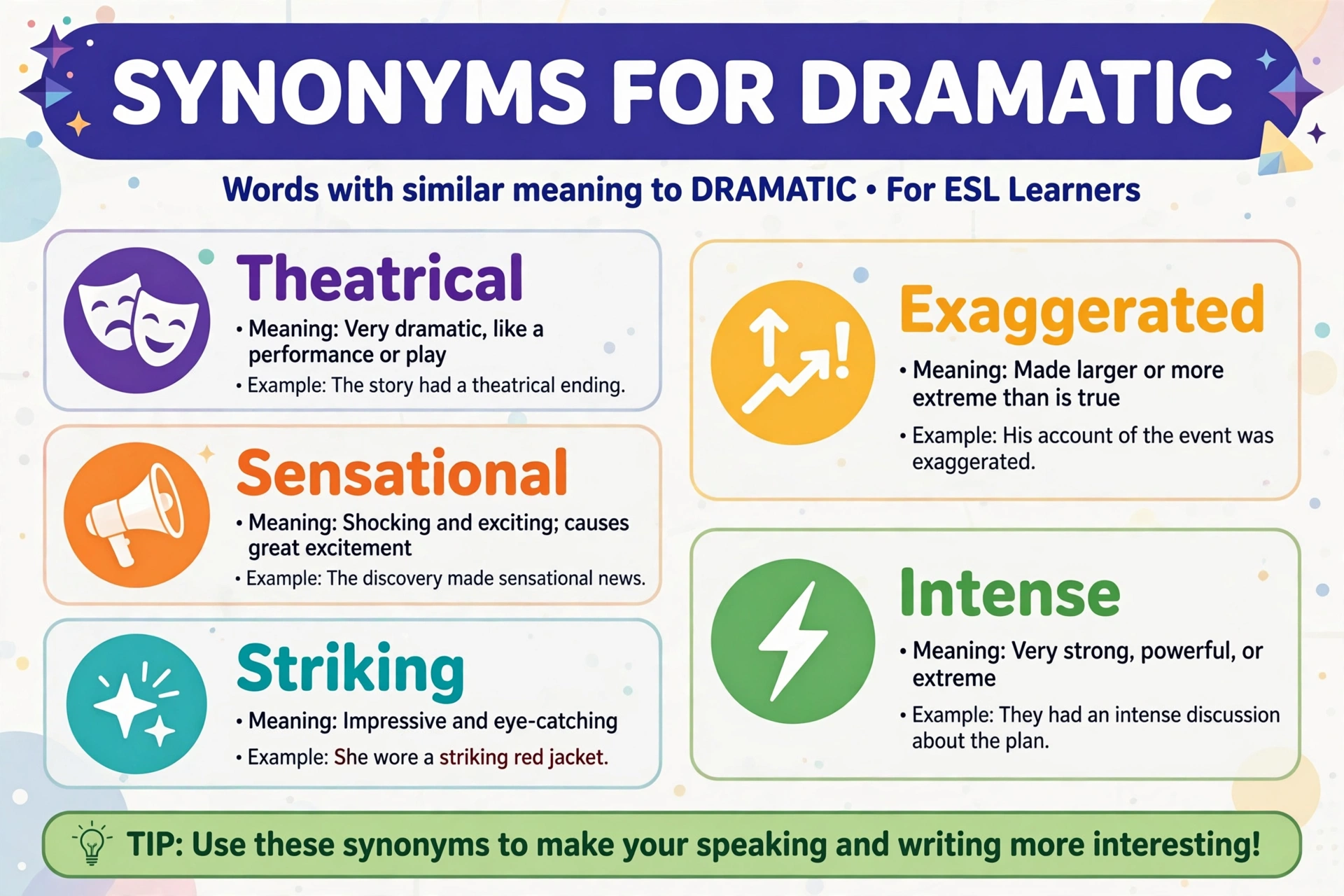
“Dramatic” is a show-stealer of a word — it can mean theatrical, sudden, striking, or emotional, sometimes all at once. That range makes it popular, but it also makes it vague. When everything is “dramatic,” your reader cannot tell whether you mean a stunning view or a heated argument.
The fix is to name the exact effect: does it grab attention, stir emotion, or signal sudden change? Here are five powerful alternatives with clear meanings and practical examples.
Stories, speeches, and even sports commentary live on drama. But skilled writers know that naming the exact effect — surprise, beauty, intensity — moves an audience far more than one all-purpose adjective.
There is also a practical reason to learn these words: “dramatic” is a favorite of lazy headlines and vague essays. Writers who reach for “striking,” “spectacular,” or “remarkable” instead instantly sound more specific and more credible. Precision is persuasive — and these five words are some of the most persuasive adjectives in English.
Striking
Meaning: Immediately noticeable and impressive; catching the eye or mind.
Example: The building’s striking design won several awards.
Example: There is a striking difference between the two teams’ playing styles.
Remarkable
Meaning: Worth noticing because it is unusual or excellent.
Example: She made a remarkable recovery after the surgery.
Example: It is remarkable how quickly the small town rebuilt after the flood.
Spectacular
Meaning: Visually impressive and breathtaking to see.
Example: The fireworks display over the harbor was spectacular.
Example: We watched a spectacular sunset from the top of the hill.
Intense
Meaning: Extremely strong in feeling, action, or effect.
Example: The debate grew intense in the final round.
Example: The competition for the scholarship was incredibly intense this year.
Powerful
Meaning: Having a strong effect on people or situations.
Example: His closing speech was powerful enough to change minds.
Example: The charity’s powerful video inspired thousands of new donations.
At a Glance
| Word | Use it when… |
|---|---|
| Striking | Grabbing attention instantly |
| Remarkable | Unusual or excellent; earning admiration |
| Spectacular | Visually breathtaking |
| Intense | Emotionally or physically extreme |
| Powerful | Having strong influence or effect |
How to Use These Words
Aim at the effect you want. Striking grabs attention instantly, remarkable earns admiration, spectacular dazzles the eyes, intense raises the emotional temperature, and powerful moves people to act. A fun related pair: “dramatic” often describes theatrical behavior — and the words for a theatre performer versus a soldier are famously confused, so see trouper or trooper to keep them straight.
Watch the grammar too. “Striking” and “remarkable” usually come before the noun (“a striking resemblance,” “a remarkable achievement”) but also work after linking verbs (“the view was spectacular”). “Intense” pairs with feelings, efforts, and moments (“intense joy,” “intense negotiations”). “Powerful” is the most flexible — it modifies speeches, engines, images, and even medicine (“a powerful painkiller”).
Common Mistakes to Avoid
- “Dramatic” for small changes: A 2% price rise is not “dramatic” — it is “slight.” Save “dramatic” and its synonyms for changes and effects that genuinely deserve the spotlight. Exaggeration is the fastest way to lose a reader’s trust.
- “Spectacular” for non-visual things: “Spectacular” is about what you see. A “spectacular failure” works as a metaphor, but “a spectacular argument” sounds odd — arguments are heard, not seen. For non-visual drama, choose “intense” or “dramatic” itself.
- “Intense” as a compliment for people: Calling a person “intense” usually means they are overwhelming or too serious — not a compliment. “She is an intense person” suggests she is hard to be around. For praise, use “passionate” or “dedicated” instead.
- “Powerful” vs. “powerless”: They look like a neat pair, but “powerless” means helpless (“felt powerless to help”), which is much stronger than simply “not powerful.” Do not use “powerless” as a casual opposite — it carries real emotional weight.
Quick Practice
Choose the best word for each sentence: striking, remarkable, spectacular, intense, powerful.
- The view from the mountaintop was absolutely _____.
- Doctors called the patient’s recovery _____ — nobody expected it.
- The final five minutes of the match were _____; the crowd could barely breathe.
- Her _____ opening statement convinced the jury within minutes.
Answer key: 1. spectacular — visually breathtaking. 2. remarkable — unusual and admirable. 3. intense — emotionally extreme. 4. powerful — strong influence and effect.
Related Words Worth Learning
- Synonyms for Fascinating — dramatic moments are often fascinating ones.
- Synonyms for Deep — the most dramatic stories carry deep emotion.
- Synonyms for Inspire — dramatic speeches are meant to inspire.
FAQs
What is the best synonym for “dramatic” in writing?
“Striking” is the most versatile — it works for appearances, events, and ideas. For emotional scenes, “intense” fits better; for visual ones, “spectacular.” Its flexibility is its strength — it works for visuals, events, performances, and even statistics.
What is the difference between “dramatic” and “theatrical”?
“Dramatic” is broad: sudden, striking, or emotional. “Theatrical” is narrower — it specifically means like acting in a play, often with a hint of exaggeration. Calling a reaction ‘theatrical’ gently suggests it was exaggerated; ‘dramatic’ makes no such judgment.
Can “dramatic” describe positive things?
Yes. “A dramatic improvement” or “a dramatic rescue” are positive. The word describes the scale of change or effect, not whether it is good or bad. This neutrality is why marketers love it — ‘dramatic results’ sounds exciting without promising anything specific.
Is “powerful” too strong to replace “dramatic”?
Not when the meaning is impact. “A dramatic speech” and “a powerful speech” both suggest the words moved the audience — “powerful” simply stresses the effect rather than the showiness. Choose ‘powerful’ when you want to emphasize influence and ‘dramatic’ when you want to emphasize spectacle.
What is the adverb form of “dramatic”?
“Dramatically” — as in “Sales improved dramatically after the launch.” It is a favorite in business and news writing because it turns any change into a story. But the same warning applies: use it only for genuinely large changes. “Prices rose dramatically by 1%” will make careful readers smile for the wrong reason.
Can “dramatic” describe a person?
Yes, but it usually criticizes. A “dramatic person” is someone who overreacts and turns small events into big scenes — rarely a compliment. If you mean someone expressive and lively, say “vivid” or “expressive.” Reserve “dramatic” for people only when you genuinely mean theatrical behavior.
Conclusion
Drama deserves direction. Striking for instant impact, remarkable for admiration, spectacular for visual wonder, intense for heated emotion, and powerful for real influence — five words that give “dramatic” the precision it lacks. Cast the right word for each scene, and your English will never play to an empty house.
Great drama is built word by word. With these five alternatives, every scene you write — or describe — will land with exactly the impact you intend.

James Reed is a writer and English language enthusiast with a passion for making vocabulary simple and fun. He writes about words, meanings, and everyday English to help learners speak and write with confidence.