Everyone knows the sting of disappointment — the exam score that fell short, the plan that collapsed, the news nobody wanted. “Disappointed” describes that feeling well, but it is a general word for a very specific pain.
The right synonym tells your reader exactly what kind of letdown you mean: mild or crushing, angry or sad, brief or lasting. Here are five expressive alternatives with clear meanings and practical examples.
Disappointment is part of life — and part of honest writing. Whether you are reviewing a product, describing a story character, or simply telling a friend how your day went, the exact word makes your feelings believable.
Getting this vocabulary right also helps you in real conversations. English speakers often soften disappointment with gentle words (“a bit disappointed”) or sharpen it when they are genuinely upset. The five synonyms below range from mild to strong, from casual to formal — giving you the full emotional toolkit for every situation.
Upset
Meaning: Feeling sad, worried, or emotionally disturbed by something.
Example: She was upset when her flight got cancelled at the last minute.
Example: The news of the factory closing upset the entire community.
Frustrated
Meaning: Feeling annoyed because things are not going the way you want.
Example: He felt frustrated after hours of work with no result.
Example: The players grew frustrated as the referee ignored every foul.
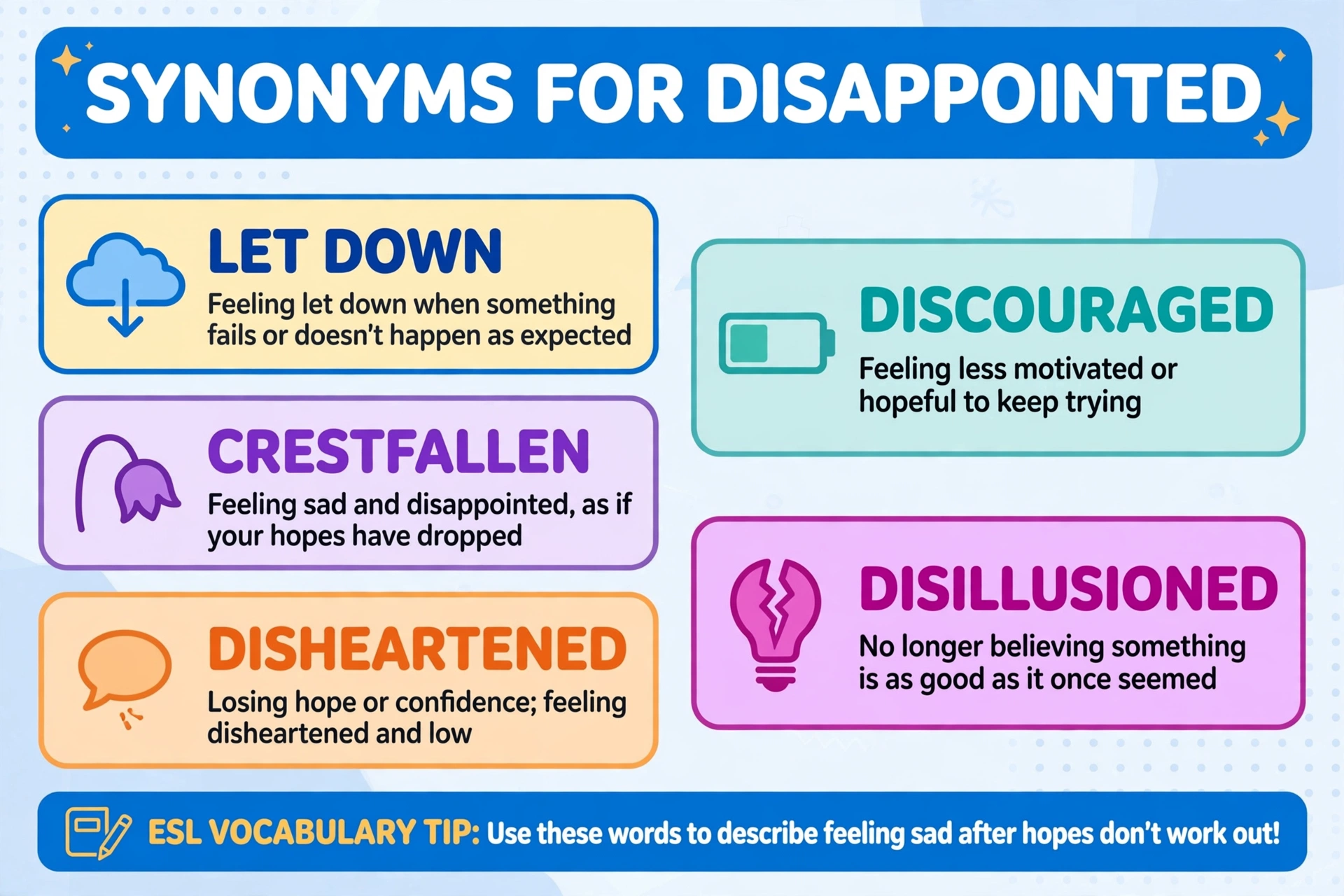
Discouraged
Meaning: Having lost confidence or enthusiasm after a setback.
Example: She felt discouraged when her application was rejected again.
Example: Low exam scores can leave even bright students feeling discouraged.
Disheartened
Meaning: Feeling sad and losing hope after an unpleasant experience.
Example: The players looked disheartened after the unexpected defeat.
Example: The volunteers felt disheartened when donations dropped for the third month.
Dissatisfied
Meaning: Not pleased or content with something; feeling it was not good enough.
Example: Customers were dissatisfied with the slow delivery service.
Example: The survey showed that most guests were dissatisfied with the hotel’s Wi-Fi.
At a Glance
| Word | Use it when… |
|---|---|
| Upset | General sadness or worry; everyday use |
| Frustrated | Annoyance when efforts are blocked |
| Discouraged | Fading confidence after setbacks |
| Disheartened | Sadness mixed with losing hope |
| Dissatisfied | Cool, formal unhappiness with quality |
How to Use These Words
Scale the emotion. Upset is the everyday, general choice; frustrated adds irritation; discouraged and disheartened describe fading hope; dissatisfied is cooler and more formal, ideal for reviews and feedback. One related spelling worth knowing: when disappointment comes from defeat, writers often confuse “losing” and “loosing” — see loosing or losing to never mix them up.
Also note the grammar each word prefers. You are upset about or upset by something, frustrated with or frustrated by a situation, discouraged by a setback, disheartened by bad news, and dissatisfied with a product or service. Learning each word together with its favorite preposition — as one chunk — is the fastest way to use them naturally.
Common Mistakes to Avoid
- “Disappointed” for everything: Repeating “disappointed” in every sentence of an essay or review makes your writing feel flat. Rotate through these five synonyms — examiners specifically reward this kind of lexical variety.
- “Frustrated” when you mean sad: “Frustrated” means annoyed and blocked, not quietly sad. If a movie made you cry, you were “upset” or “moved” — not “frustrated.” Keep the irritation inside “frustrated.”
- “Dissatisfied” in casual chat: Telling a friend “I am dissatisfied with this pizza” sounds like a restaurant inspector, not a friend. In conversation, say “I am not happy with this pizza” or “this pizza is disappointing” — save “dissatisfied” for reviews and formal feedback.
- “Discouraged” vs. “disheartened”: They are close, but “discouraged” suggests losing motivation to continue (“discouraged from applying”), while “disheartened” suggests losing emotional hope (“disheartened by the news”). One kills action; the other wounds feeling.
Quick Practice
Choose the best word for each sentence: upset, frustrated, discouraged, disheartened, dissatisfied.
- After waiting two hours for a taxi, the tourists were clearly _____.
- The restaurant manager apologized because several diners were _____ with their meals.
- She felt _____ when her best friend forgot her birthday.
- The team looked _____ after losing the championship in the final minute.
Answer key: 1. frustrated — annoyed by a blocked situation. 2. dissatisfied — formal unhappiness with quality. 3. upset — general emotional hurt. 4. disheartened — sadness mixed with lost hope.
Related Words Worth Learning
- Synonyms for Vulnerable — disappointment often leaves us feeling vulnerable.
- Synonyms for Resilience — resilience is how we recover from disappointment.
- Synonyms for Determination — determination keeps you going after a letdown.
FAQs
What is a stronger word for “disappointed”?
“Disheartened” and “crushed” are stronger. “Disheartened” suggests losing hope, while “crushed” describes an overwhelming, devastating letdown. ‘Crushed’ is informal and emotional; save it for personal writing rather than formal reports.
What is the difference between “upset” and “disappointed”?
“Upset” is broader — it covers sadness, worry, and agitation from any cause. “Disappointed” is specific: sadness because something did not meet your expectations. You can be upset about bad weather, but you are only disappointed if you had expected sunshine.
Is “dissatisfied” formal?
Yes, “dissatisfied” is more formal and is commonly used in business, reviews, and official feedback. In casual conversation, “unhappy with” or “upset about” sounds more natural. Companies take ‘dissatisfied customers’ seriously precisely because the word sounds measured and deliberate.
Can “frustrated” mean disappointed?
Partly. “Frustrated” means annoyed that efforts are blocked, which often accompanies disappointment. But frustration emphasizes irritation, while disappointment emphasizes sadness — they describe different feelings. Many people feel both at once — for instance, frustrated by the delay and disappointed by the outcome.
How do you politely express disappointment in an email?
Soften the language. Instead of “I am disappointed with your service,” write “I was a little disappointed with the delivery time” or “Unfortunately, the product did not meet my expectations.” Adding “a little” or “unfortunately” keeps the tone professional. In business English, “dissatisfied” works well too: “We were dissatisfied with the response time” is firm but polite.
What is the noun form of “disappointed”?
“Disappointment” — as in “The cancelled concert was a huge disappointment.” The adjective “disappointing” describes the cause: “a disappointing result.” So the pattern is: a disappointing event leads to a feeling of disappointment, and the person feels disappointed. Three forms, one family — learn them together.
Conclusion
Disappointment deserves better than one tired word. Upset for everyday letdowns, frustrated for blocked efforts, discouraged and disheartened for fading hope, and dissatisfied for formal complaints — five words that let you express exactly how you feel. Name the feeling precisely, and your English becomes as honest as it is expressive.
Honest emotions, precisely named, are the heart of good English. These five words help you say exactly how you feel — no more, no less.

James Reed is a writer and English language enthusiast with a passion for making vocabulary simple and fun. He writes about words, meanings, and everyday English to help learners speak and write with confidence.