Eager describes the feeling of wanting something badly and being impatient to begin — the student eager to answer, the traveler eager to explore. It is a warm, positive word, but using it in every sentence makes your English sound flat. Worse, its close cousins (keen, willing, anxious) each carry a slightly different tone, and mixing them up can change what your sentence implies.
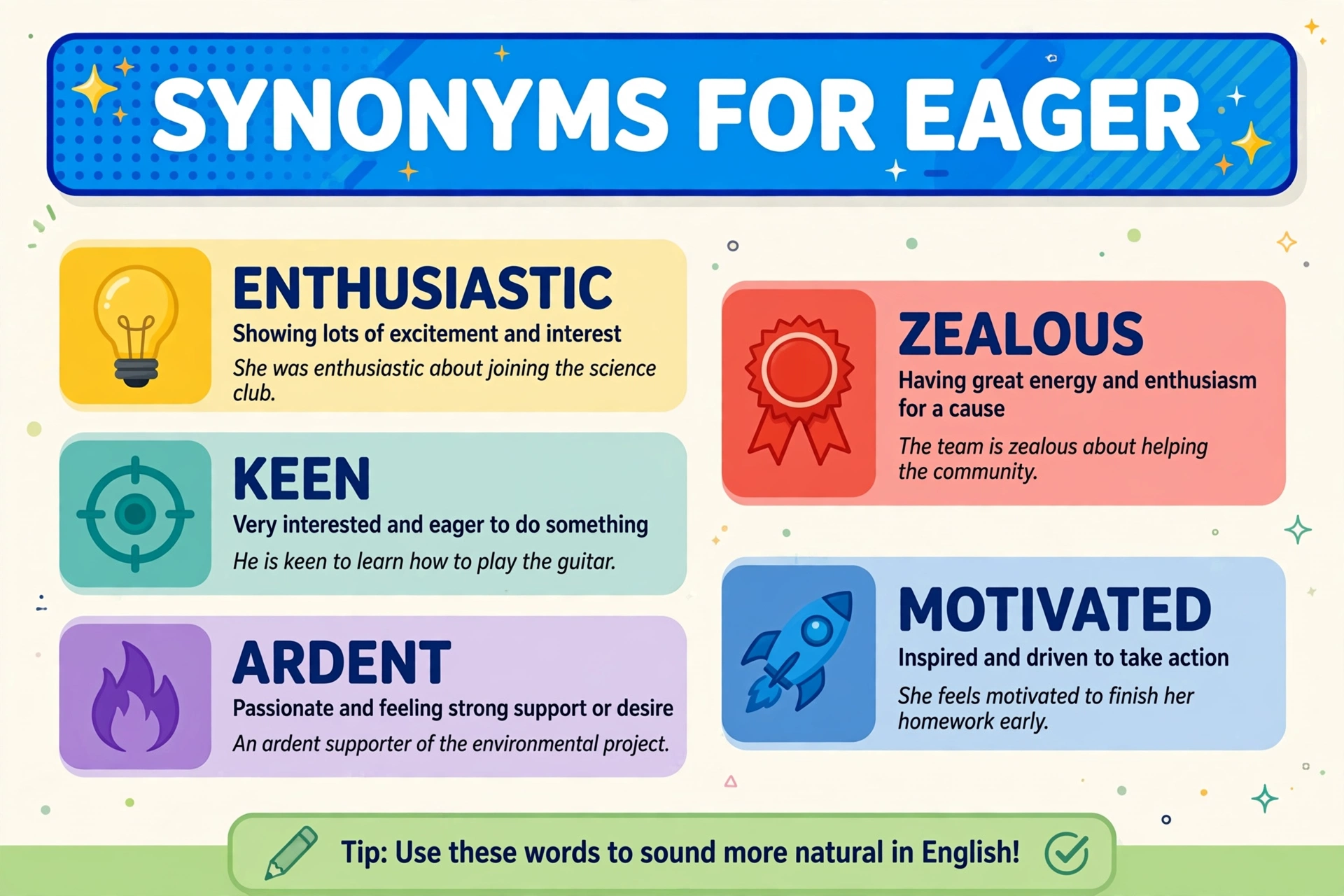
Learning the right alternatives helps you sound precise instead of repetitive. The five words below all overlap with eager, but each one shines in a different situation — interest, excitement, readiness, or drive.
Mastering these small distinctions pays off fast: in exams, examiners reward precise word choice, and at work, the right tone in an email can change how your message is received. Five words, learned well, can upgrade hundreds of sentences.
In this guide you will find each word’s exact shade of meaning, two natural examples per word, and practical tips for choosing between them. Read the meanings first, then test yourself with the practice section — that combination of learning and doing is what moves words from your notebook into your active vocabulary.
Keen
Meaning: Showing strong interest and readiness; genuinely enthusiastic about taking part in something.
Example: The keen students arrived early to get front-row seats.
Example: She is a keen gardener who spends every spare hour among her roses.
Enthusiastic
Meaning: Filled with excitement and positive energy about a person, idea, or activity.
Example: She gave an enthusiastic welcome to the new neighbors.
Example: The enthusiastic crowd kept cheering long after the concert ended.
Excited
Meaning: Feeling happy anticipation; looking forward to something with lively energy.
Example: The children were excited about the school trip.
Example: They were excited to finally meet their new baby cousin.
Willing
Meaning: Ready to do something without being forced; glad to agree or to help.
Example: He was willing to stay late to finish the report.
Example: Our neighbors were willing to lend us their ladder for the weekend.
Motivated
Meaning: Having a strong inner reason or drive to act and push toward a goal.
Example: The motivated runner trained every morning before work.
Example: A motivated student sets clear goals and reviews them every week.
How to Use These Words
Choose by nuance. Keen stresses interest (common in British English). Enthusiastic and excited stress emotion — use them when feelings run high. Willing is quieter: it signals readiness without pressure, perfect for offers of help. Motivated points at goals and ambition, so it fits workplaces and study plans. Picking the right one shows control over tone, not just vocabulary size.
There is also a question of direction. Keen, excited, and enthusiastic describe how you feel about something — the emotion points outward toward the activity. Willing describes your response to a request — the feeling points toward helping someone else. Motivated is the most inward-looking of the five: it names the engine inside you, the personal reason that keeps you moving even when no one is watching. Matching the direction of the feeling to your sentence keeps your meaning exact.
Word Shades at a Glance
| Word | Reach for it when you mean… |
|---|---|
| Keen | strong interest, especially in British English |
| Enthusiastic | warm, positive feelings about something |
| Excited | happy anticipation before an event |
| Willing | quiet readiness to help, no pressure |
| Motivated | inner drive toward a clear goal |
Common Mistakes to Avoid
- Writing “anxious to start” when you mean eager. Anxious hints at worry, so readers may think you are nervous rather than keen. Save “anxious” for genuine unease.
- Stacking “very” onto eager. Eager already means strong desire, so “very eager” adds almost nothing. For variety, switch to “keen” or “enthusiastic” instead of intensifying.
- Giving eagerness to things. People feel eager; objects and plans cannot. Write “an eager team,” not “an eager schedule” — the schedule is “tight” or “ambitious,” never eager.
- Saying “eager for” with a person as the object. You are eager for a thing or an event (“eager for the weekend”), but eager to do an action (“eager to help”). Mixing the two — “eager to the weekend” — is a common slip worth watching.
Related Words Worth Learning
Quick Practice
Rewrite each sentence with a sharper word from this guide:
- “She was eager to join the debate team.”
- “The volunteers were eager to help after the flood.”
- “He is eager to get promoted this year.”
Answer key: 1. keen (strong interest) or enthusiastic (warm excitement); 2. willing (quiet readiness, no pressure); 3. motivated (driven by a goal). Doing this drill with your own sentences cements each shade far better than rereading definitions.
FAQs
Is “eager” a positive or a negative word?
Usually positive — it suggests healthy enthusiasm. It only turns negative in phrases like “too eager,” which can hint at desperation or impatience.
What is the difference between eager and keen?
Keen emphasizes interest (“keen on music”), while eager emphasizes impatience to act (“eager to start”). They overlap but are not identical.
Can “eager” sound rude?
On its own, no. But calling someone “over-eager” suggests they are trying too hard, so use intensifiers carefully.
Eager vs anxious — are they the same?
Not quite. Anxious often carries worry (“anxious about the results”), while eager carries desire (“eager for the results”). In formal writing, keep them apart.
Eager vs willing — which is stronger?
Eager is stronger and more emotional — it suggests real desire. Willing is calmer and simply means you will do it without complaint. “Eager to help” sounds enthusiastic; “willing to help” sounds polite.
Can “excited” be used in formal writing?
Yes, but with care. “Excited” is slightly informal and emotional, so in a formal report you might prefer “enthusiastic” or “keen.” In emails and presentations, “excited” is perfectly natural.
Conclusion
Eager is a good word, but keen, enthusiastic, excited, willing, and motivated let you aim with precision. The next time you catch yourself writing “eager” for the third time in one paragraph, swap in the alternative that matches your exact tone — your readers will feel the difference even if they cannot name it.
Bookmark this page and return to it the next time you write a cover letter, a college essay, or an important email. The word you choose — keen, enthusiastic, excited, willing, or motivated — tells your reader something about you before they even finish the sentence. Make it the right something.

James Reed is a writer and English language enthusiast with a passion for making vocabulary simple and fun. He writes about words, meanings, and everyday English to help learners speak and write with confidence.