Establish is one of those verbs that quietly does a lot of heavy lifting in English. We use it when a company is founded, when trust is built, when rules are set, or when a routine finally becomes a habit. But because it covers so many situations, repeating it in every sentence can make your writing sound flat.
The good news is that English gives you sharper alternatives. Learning synonyms for establish lets you pick the word that fits the moment — whether you are starting something brand new, putting a structure in place, or making an idea official. Below are five of the most useful ones, each with a clear meaning and an example you can copy into your own sentences.
In this guide, you will learn five precise alternatives, each matched to a different stage of starting and growing something. With two examples per word, plus sections on common mistakes and a quick practice exercise, you will finish with a vocabulary toolkit you can use the same day — in emails, essays, and conversations.
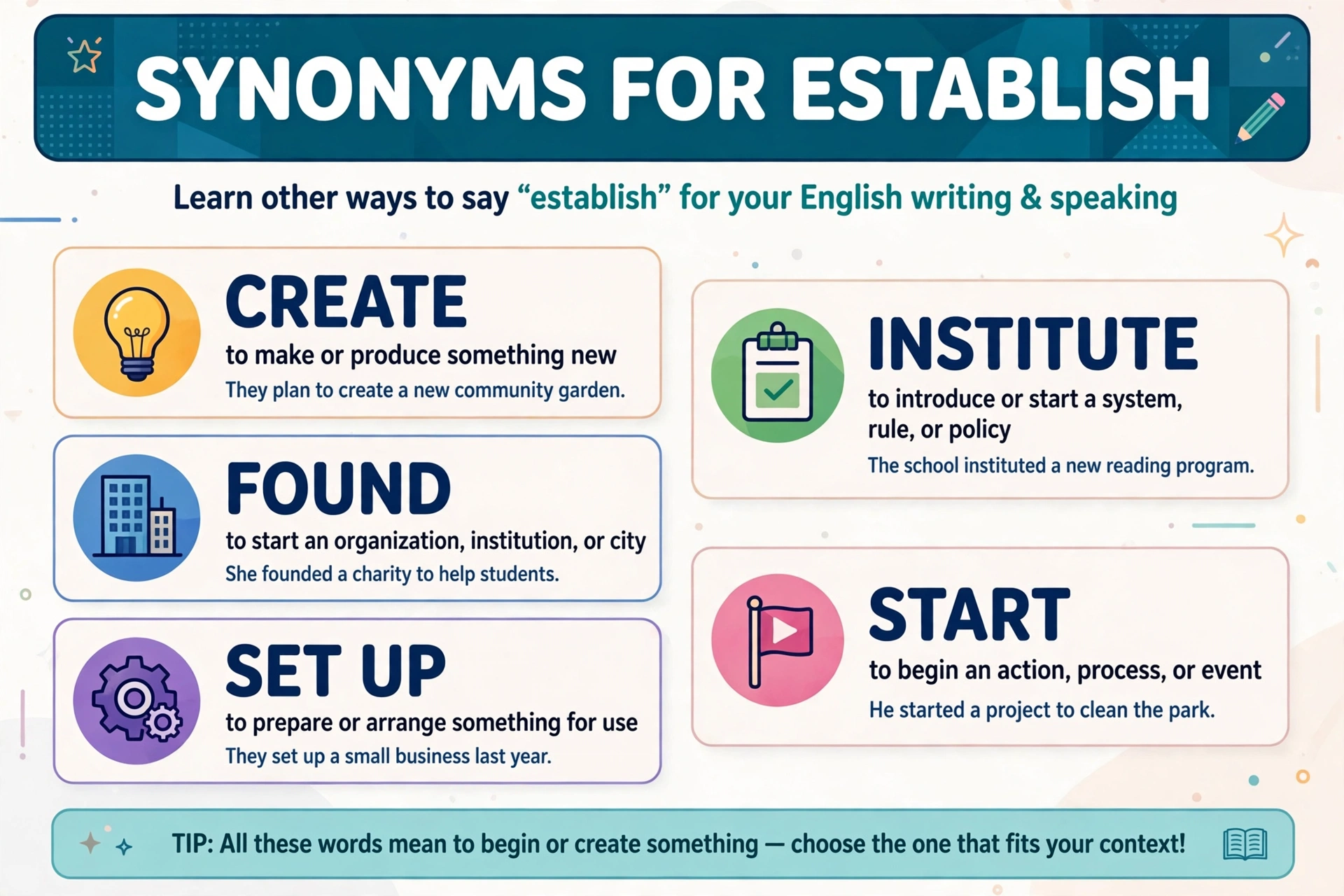
Create
Meaning: To bring something completely new into existence.
Example: After months of planning, she decided to create her own online store.
Example: The artist created a mural that covered the entire side of the building.
Build
Meaning: To develop something gradually, step by step, until it becomes strong.
Example: Good managers build trust with their teams one honest conversation at a time.
Example: They are building a new school on the edge of town.
Found
Meaning: To start an organization, company, or institution from the very beginning.
Example: The two friends founded a small bakery that later grew into a national chain.
Example: She founded a charity that provides books to rural schools.
Launch
Meaning: To introduce something to the public for the first time, often with energy and attention.
Example: The startup will launch its new app at a live event next month.
Example: The company plans to launch three new products before December.
Develop
Meaning: To grow or improve something over time until it reaches its full form.
Example: He spent years developing a training program for new teachers.
Example: Scientists are developing a vaccine that works against several variants.
How to Use These Words
The trick is matching the word to the stage of the process. Use found and create when something is being born — a company, a movement, an idea. Use launch when it goes public and needs momentum. Use build and develop when the work is gradual: reputations, skills, and relationships are built and developed, not launched. A quick test: if you can picture a ribbon-cutting ceremony, “launch” fits; if you picture slow, steady effort, choose “build” or “develop.”
There is also a formality scale. Found and establish sit at the formal end — boardrooms, history books, legal documents. Create and build are neutral and work almost anywhere. Launch carries marketing energy; it sounds exciting but can feel over-commercial in serious writing. Develop is the quiet professional — steady, neutral, and trusted in reports. Match the word’s formality to your audience, and your writing will always land at the right pitch.
Common Mistakes to Avoid
- Using “found” for the past of “find.” This is the classic trap: “found” is both the past of “find” (“I found my keys”) and the verb meaning “to start an organization.” Readers tell them apart by context, but mixing them in one paragraph confuses everyone — keep the two meanings in separate sentences.
- Launching what should be built. You launch products and campaigns; you build trust, skills, and reputations. Writing “we will launch a new company culture” sounds like culture is a product release — say “build” instead.
- Forgetting that “establish” needs an object. “Establish” is transitive: you establish something — a rule, a business, a routine. “We established last year” is incomplete; “we established the program last year” is correct.
Related Words Worth Learning
- Synonyms for Determination — the drive that keeps new ventures alive
- Synonyms for Resilience — bouncing back when a new start gets rocky
- Synonyms for Efficient — building systems that work smoothly
Quick Practice
Choose create, build, found, launch, or develop for each sentence:
- “The two brothers ___ a software company in their garage.”
- “It takes years to ___ a good reputation in any industry.”
- “The restaurant will ___ its new summer menu next Friday.”
Answer key: 1. founded (starting an organization from zero); 2. build (gradual, step-by-step growth); 3. launch (introducing something to the public). Write one sentence of your own with each of the remaining two words to finish the set.
FAQs
What is the best synonym for establish in business writing?
It depends on the stage. “Found” works for starting a company, “launch” for releasing a product, and “develop” for growing a market. Pick the one that matches what is actually happening.
Can I use “create” instead of “establish”?
Often, yes — especially for ideas, brands, and projects. But “establish” carries a sense of permanence and authority that “create” does not always have. You create a logo; you establish a reputation.
What is the difference between “found” and “launch”?
“Found” means starting something from zero, like a company or charity. “Launch” means presenting it to the world, which can happen long after founding. A startup is founded once but may launch many products.
Is “establish” a formal word?
Yes, it leans formal. In casual conversation, “start,” “set up,” or “build” usually sound more natural. Save “establish” for reports, applications, and official documents.
Establish vs set up — which is more formal?
Establish is more formal and suggests permanence and authority. Set up is casual and everyday: you set up a meeting, but you establish a company or a system.
Can “establish” be used for routines?
Yes — “to establish a routine” or “to establish a habit” is standard and natural. It suggests the routine is now firmly in place, not just tried once.
Conclusion
Establish covers a wide range of “starting and strengthening” situations, but the right synonym makes your meaning sharper. Create something new, found an organization, launch it to the world, then build and develop it over time. Practice these five words in your next email or essay, and your English will sound more precise and confident.
Start noticing which stage your sentence describes — birth, launch, or slow growth — and let that stage choose your word. That one habit will make “establish” and its five partners feel less like vocabulary to memorize and more like tools you reach for without thinking.

Thomas Allen is a language writer and editor who loves exploring the subtle differences between words. He creates clear, practical guides that help readers understand English better — one word pair at a time.