Essential means something you cannot do without — water is essential for life, trust is essential for friendship. It is a strong, clear word, which is exactly why writers wear it out. When every other sentence calls something “essential,” the word loses its punch, and readers stop feeling the urgency it is supposed to carry.
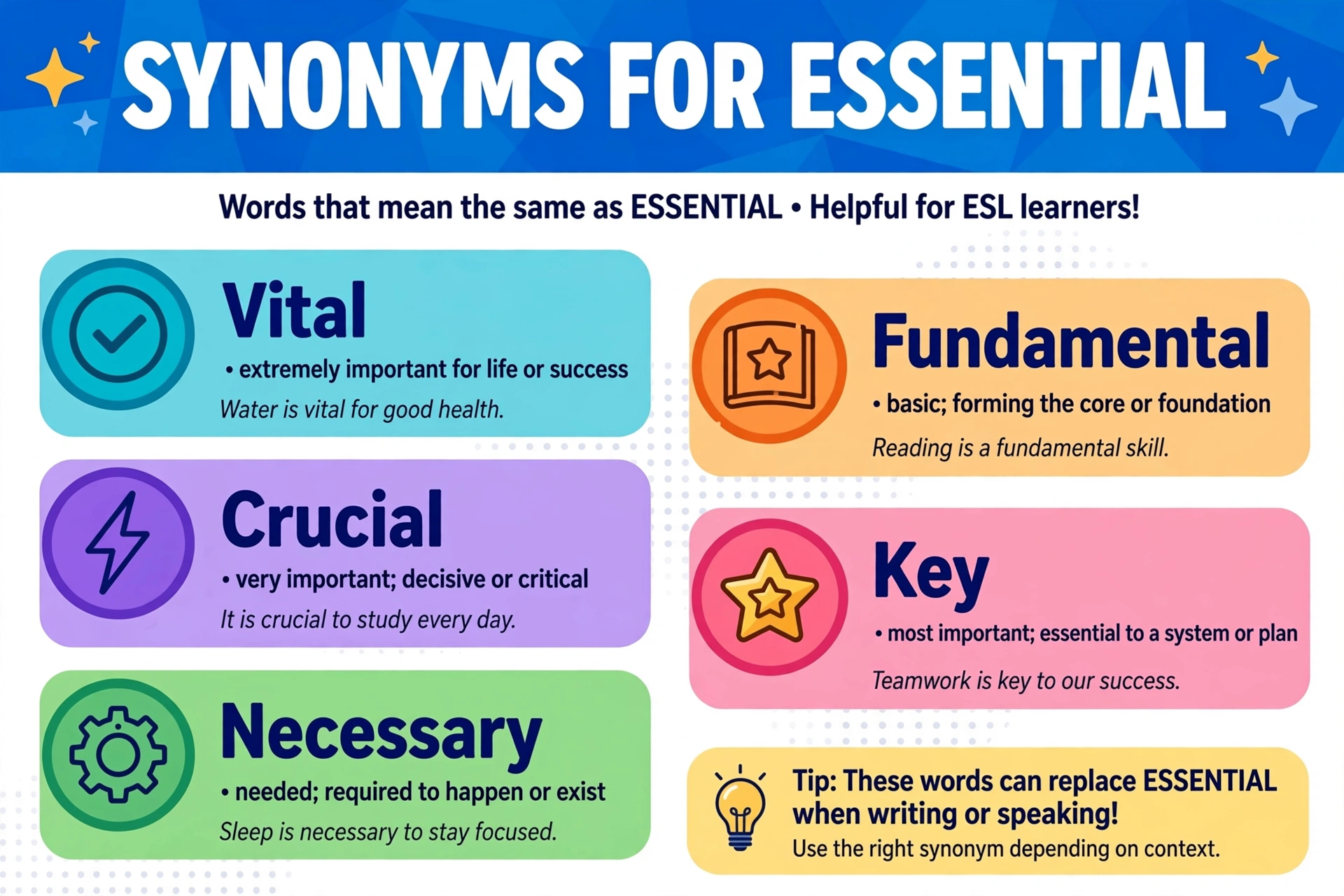
The fix is not a fancier word but a more exact one. Is the thing merely required, or is survival at stake? Is it the turning point of the whole matter, or just generally valuable? The five synonyms below answer those questions, from neutral to intense.
Think of these five as a volume dial, not five equal options. Turn it low with “necessary” for routine requirements, and crank it to “vital” only when something truly cannot be lost. Writers who control intensity keep their readers’ trust.
In the sections below, each word gets a precise meaning, two natural examples, and its place on the intensity ladder. Read them in order — necessary, important, key, crucial, vital — and you will feel the volume rising with each step.
Necessary
Meaning: Required for a purpose; needed in order for something to happen or succeed.
Example: A valid passport is necessary for international travel.
Example: It is necessary to back up your files before updating the software.
Vital
Meaning: Extremely important, often for survival, health, or success; a step above merely necessary.
Example: Clean drinking water is vital for every community.
Example: Quick action by the nurses proved vital to the patient’s recovery.
Crucial
Meaning: Decisive in effect; so important that the final outcome depends on it.
Example: The final interview was crucial for landing the job.
Example: Her support during that difficult year was crucial to his success.
Important
Meaning: Having great value, meaning, or significance; deserving serious attention.
Example: It is important to listen carefully before you speak.
Example: Regular exercise is important for both body and mind.
Key
Meaning: The most central or decisive element; the part on which success turns.
Example: Honest communication is the key factor in any strong friendship.
Example: The key moment of the match came just before halftime.
How to Use These Words
Climb the ladder of intensity on purpose. Necessary is neutral and safe for rules and requirements. Important is the all-rounder for general value. Key points at the central element. Crucial signals a turning point where everything hinges on one thing. Vital is the strongest — reserve it for survival-level stakes, and it will never sound hollow.
Grammar gives you extra clues. Necessary and important usually take “for” or “to” (“necessary for travel,” “important to listen”). Key loves nouns (“key factor,” “key player”). Crucial and vital often stand before the noun or after “is” (“a crucial decision,” “water is vital”). Getting these little patterns right makes your English sound natural, not translated.
Word Shades at a Glance
| Word | Reach for it when you mean… |
|---|---|
| Necessary | a neutral, no-drama requirement |
| Important | general value worth attention |
| Key | the central element everything turns on |
| Crucial | the turning point a result hinges on |
| Vital | stakes as high as survival or success |
Common Mistakes to Avoid
- Calling everything essential. When a document labels ten things “essential,” readers believe none of them. Downgrade lesser items to “important” or “useful” so the truly critical ones stand out.
- Writing “very essential” or “most essential.” Essential is absolute — something either cannot be done without or it can. If you need a stronger word, you actually need “vital” or “critical.”
- Confusing “essential” with “essentially.” Essentially means “basically” (“essentially, we agree”), which is far weaker. The adverb softens; the adjective strengthens. Do not swap them.
- Using “key” without a noun. “Communication is key” works as a fixed phrase, but in general “key” needs something to point at — “a key factor,” “the key reason.” A bare “it is key” can sound unfinished in formal writing.
Related Words Worth Learning
Quick Practice
Rank these from weakest to strongest: important, vital, necessary, crucial, key. (One sensible order: necessary → important → key → crucial → vital.) Now rewrite “Sleep is essential for health” twice — once softer, once stronger. Softer: “Sleep is important for health.” Stronger: “Sleep is vital for health.” Feeling the dial move is the whole skill.
FAQs
What is the difference between essential and necessary?
Essential is stronger: it means you cannot do without the thing. Necessary means it is needed for a result, but the tone is milder and more matter-of-fact.
Vital vs crucial — which is stronger?
They are close, but different. Vital suggests survival or success depends on it; crucial suggests the outcome of a specific situation hinges on it. “Vital supplies” vs “a crucial decision.”
Is “key” formal or informal?
Both. It works in boardrooms (“key metrics”) and casual speech (“the key thing is…”), which makes it one of the most versatile words on this list.
Can “essential” be used as a noun?
Yes — “essentials” (plural) means the basic necessities: “Pack only the essentials for the trip.”
Necessary vs needed — is there a difference?
“Needed” is the casual, everyday form (“I needed help”), while “necessary” is more formal and rule-like (“a permit is necessary”). In formal writing, prefer “necessary.”
What is the noun form of “crucial”?
There isn’t a common one — English speakers say “the crucial point” or “the crux of the matter.” “Cruciality” exists but sounds unnatural; avoid it.
Conclusion
Essential earns its strength by being used sparingly. When you need the same idea twice, reach down the intensity ladder instead: necessary for requirements, important for value, key for the central point, crucial for turning points, and vital for what truly cannot be lost. Your writing will sound stronger — and “essential” will hit harder when you save it for what matters most.
Keep the ladder in mind the next time you write: necessary, important, key, crucial, vital. Start low and climb only when the stakes truly rise. That restraint is what gives strong words their strength — and it is what will make your writing stand out from everyone who calls everything essential.

Thomas Allen is a language writer and editor who loves exploring the subtle differences between words. He creates clear, practical guides that help readers understand English better — one word pair at a time.