“Look” is one of the most repeated verbs in English. “Look at this,” “look at the sky,” “look at the results” — the sentences are correct, but the repetition drains the life from writing. Stronger writers choose the exact kind of looking they mean.
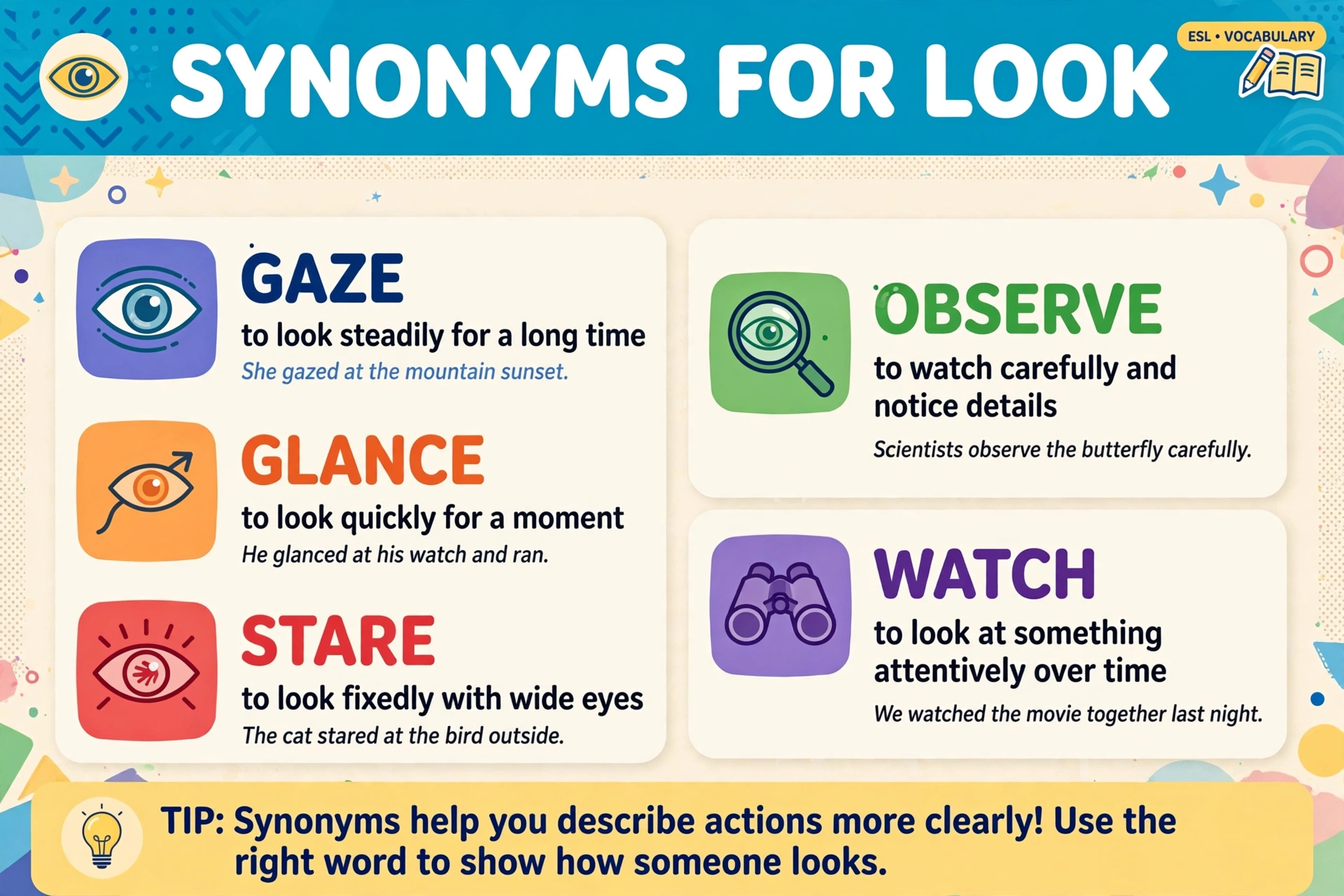
That precision is the whole game. A glance is quick, a gaze is long and thoughtful, observe is careful and detailed, watch stretches over time, and notice means your eyes caught something important. Each word paints a different picture. Small choices like these shape how professional your writing sounds — much like the distinctions in our chose vs choose guide, where one letter changes the meaning.
Writers often default to “look” because it is the first verb they learned for the eyes. But English rewards those who go further: novelists rarely write “he looked” when “he gazed” or “he stared” would do. Training yourself to pause and choose is a small habit with a large payoff in descriptive power.
The same habit helps in speaking, not just writing. In a job interview, saying “I observed a pattern in the sales data” sounds far more professional than “I looked at the numbers.” In storytelling, “she gazed at the horizon” creates a mood that “she looked outside” never could. The verb you choose quietly tells your listener how seriously to take the moment.
Glance
Meaning: To look at something very quickly, often without stopping.
Example: She glanced at her watch and hurried to the station.
Another example: He glanced around the room, searching for a familiar face.
Gaze
Meaning: To look steadily for a long time, usually with interest or wonder.
Example: They gazed at the stars from the rooftop all night.
Another example: The child gazed in wonder at the aquarium’s glowing fish.
Observe
Meaning: To look carefully and pay close attention to details.
Example: The scientist observed the birds through binoculars.
Another example: Doctors observed the patient closely overnight.
Watch
Meaning: To look at something continuously over a period of time.
Example: We watched the sunset together from the hill.
Another example: Millions watched the final match on television.
Notice
Meaning: To become aware of something by seeing it, often unexpectedly.
Example: I noticed a small crack in the phone screen.
Another example: She noticed that her keys were missing from the table.
Quick Comparison
| Word | Kind of looking | Best for |
|---|---|---|
| Glance | Very quick | Everyday moments |
| Gaze | Long, steady | Wonder, romance, nature |
| Observe | Careful, detailed | Science, reports |
| Watch | Over time | Events, performances |
| Notice | Sudden awareness | Details, discoveries |
How to Use These Words
Think about duration and attention. For a split second, use “glance.” For a long, dreamy look, “gaze” is perfect in stories and descriptions. In academic or professional writing, “observe” is the gold standard for careful looking, while “watch” fits events that unfold over time, like matches or performances. Use “notice” when the point is that something caught your eye. Matching the verb to the moment is a quiet skill that marks experienced writers — the same care our adapt vs adopt guide recommends for easily confused words. Try this: describe a scene from your day using three different looking-verbs. “I glanced at the clock, gazed out the window, and noticed a bird.” One paragraph, three precise verbs, zero repetition.
Speed is the fastest way to choose. If the look lasted a second, it was a glance. If it lasted minutes, it was a gaze or a watch. If attention was the point, it was an observe. And if the look surprised you, it was a notice. Time plus attention picks the verb.
Common Mistakes to Avoid
- “Look,” “see,” “watch” confusion. You see something (your eyes receive it), you look at it (on purpose), and you watch it (over time). “Did you see the game?” is different from “did you watch the game?”
- “Gaze” in business reports. Gaze is dreamy and romantic — perfect for novels, wrong for quarterly reports. Use “observe” at work.
- “Stare” as a synonym. Staring is rude and intense; gazing is soft. Never swap them in polite writing.
- “Notice” for deliberate study. Notice means the thing caught your eye by surprise. For careful examination, “observe” is correct.
Quick Practice
Choose the best verb for each sentence: glance, gaze, observe, watch, notice
- The detective ___ the suspect’s hands for any sign of nervousness.
- She ___ at the menu and ordered her usual dish.
- We ___ the clouds drift slowly across the evening sky.
- He ___ a strange light moving among the trees.
Answer key: 1. observed 2. glanced 3. watched 4. noticed
Related Words Worth Learning
Words to Use With Care
Do not confuse “look,” “see,” and “watch.” You “see” something (it happens to your eyes), you “look at” it on purpose, and you “watch” it over time. Also, “gaze” is romantic and dreamy — beautiful in stories, but strange in a business report where “observe” belongs.
FAQs
What is the most formal synonym for “look”?
“Observe” is the most formal and professional. It fits academic papers, reports, and business writing perfectly.
What is the difference between “gaze” and “stare”?
“Gaze” is soft and often admiring, while “stare” can feel rude or intense. You gaze at stars; you should not stare at strangers.
Can “watch” and “look” be used interchangeably?
Not quite. “Watch” implies looking over time at something moving or changing, like a film. “Look” is a single, shorter action.
Which synonym fits “look quickly”?
“Glance” is the best choice for a quick look. “Peek” also works when the look is brief or secretive.
What is the difference between “look” and “see”?
“Look” is deliberate (you choose to point your eyes), while “see” is passive (your eyes receive something). You look at a painting; you see a bird fly past the window.
Is “gaze” always romantic?
Not always, but it is always long and steady with feeling — wonder, love, sadness, or thought. For neutral long looks, “watch” or “observe” is safer.
Conclusion
“Look” will always be useful, but these five words give your sentences new eyes: glance for speed, gaze for wonder, observe for care, watch for duration, and notice for discovery. The right verb tells your reader not just that someone looked, but how and why. Start swapping them into your writing and watch your descriptions come alive. Eyes are how we experience the world — give them verbs worthy of the job.

Thomas Allen is a language writer and editor who loves exploring the subtle differences between words. He creates clear, practical guides that help readers understand English better — one word pair at a time.