Everyone has more tasks than time: homework, emails, meetings, errands. To “prioritize” means to decide what matters most and do it first. It is the secret skill behind every organized student, professional, and successful project.
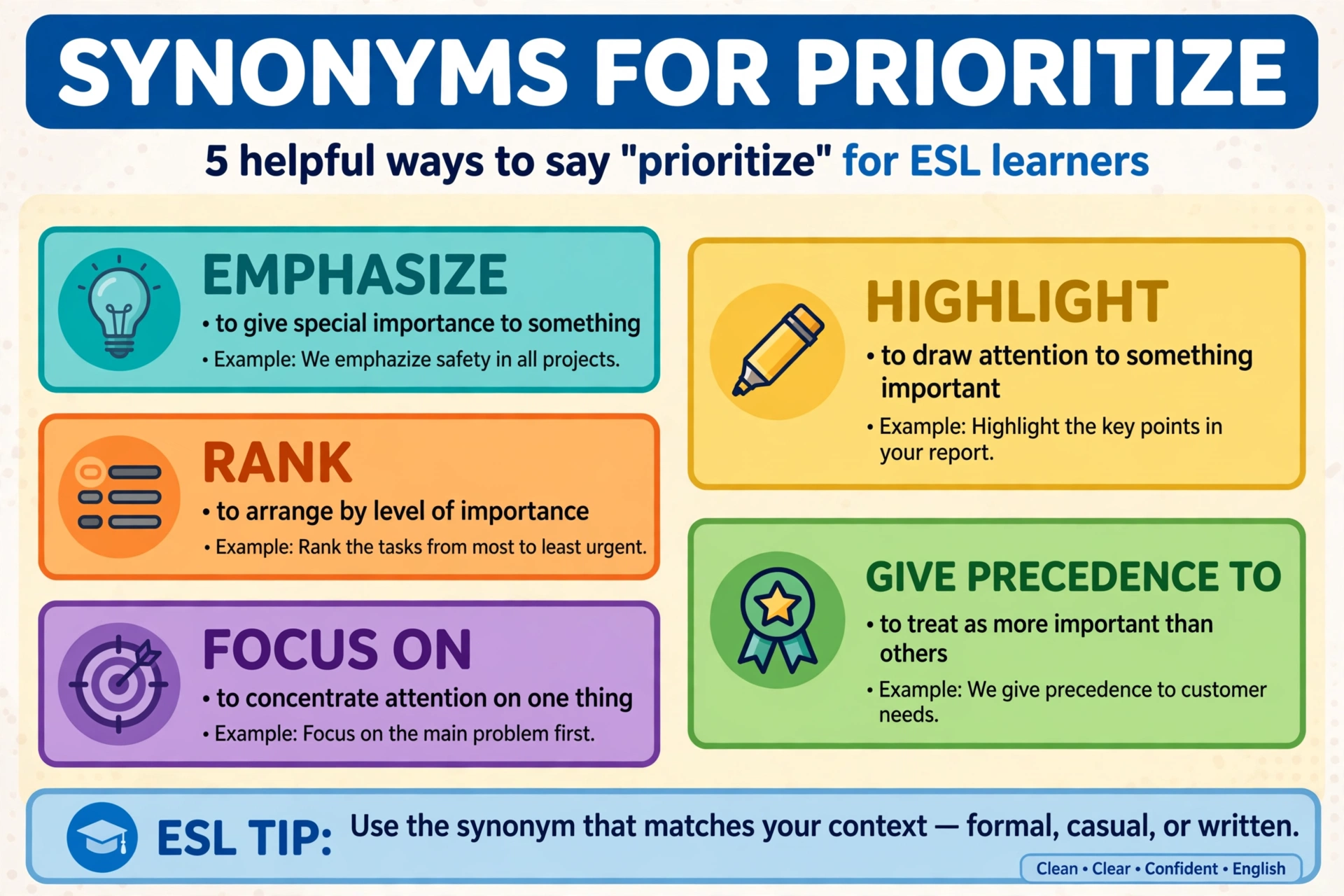
But “prioritize” gets repeated a lot in business and academic writing. The five synonyms below give you fresher ways to express the same idea — from giving full attention to arranging tasks in order — so your writing sounds sharper and more varied.
The word comes from business books and productivity blogs, which is why it can sound stiff in everyday talk. Nobody says “let me prioritize my lunch” at home — they say “lunch first.” But in essays, applications, and workplace emails, “prioritize” and its synonyms signal clear thinking. “She prioritized her studies” tells a teacher or employer that this person can manage what matters.
Interestingly, “prioritize” itself is a young word — it only became common in the 1970s, born in management literature. Before that, people simply said “put first” or “give priority to.” Knowing this helps you relax about it: the word is a tool, not a law. In a formal report, “prioritize” fits perfectly; in a text to a friend, “focus on” is the natural human choice. Good vocabulary is not about using the fanciest word — it is about matching the word to the room you are in.
Focus
Meaning: To give your full attention and energy to one thing.
Example: She decided to focus on her final exams and ignore social media for a month.
Another example: The coach told the players to focus on defense this week.
Emphasize
Meaning: To show clearly that something is especially important.
Example: The manager emphasized safety above speed in the new warehouse rules.
Another example: The report emphasizes the urgent need for better rural roads.
Rank
Meaning: To place things in order from most to least important.
Example: Let us rank these tasks by deadline so we know where to start.
Another example: The judges will rank the entries from best to worst.
Organize
Meaning: To arrange tasks, time, or things in a clear and sensible order.
Example: He organized his study schedule around his part-time job.
Another example: She organized the files neatly by date and topic.
Arrange
Meaning: To put things into a planned order or system.
Example: She arranged her goals for the year from easiest to hardest.
Another example: They arranged the chairs in a wide circle for the discussion.
How to Use These Words
“Focus” and “emphasize” describe where your attention goes; “rank,” “organize,” and “arrange” describe how you order your tasks. In a sentence like “We need to ___ our work,” any of the last three fit, while “focus on our work” needs the preposition “on.”
In writing, pair these verbs with strong objects: “focus on your health,” “rank tasks by urgency,” “organize your week.” Vague objects waste the verb’s power — “organize things” says almost nothing, while “organize your revision schedule” paints a picture. Also note the grammar: “emphasize” takes a direct object (“emphasize quality”), while “focus” needs “on” (“focus on quality”). Small grammar details like that change everything in English — just as one letter changes the meaning in chose vs choose and adapt vs adopt.
One more layer: think about who is acting. “Focus” and “emphasize” usually describe what a person does with their attention — you focus, a speaker emphasizes. “Rank,” “organize,” and “arrange” describe what you do to tasks themselves — you rank the tasks, organize the schedule, arrange the priorities. Keeping the actor and the object straight will make your sentences feel natural instead of forced.
Common Mistakes to Avoid
- Forgetting “on” after “focus.” It is always “focus on” something: “focus on your health.” Writing “focus your health” is one of the most common errors learners make.
- Confusing “prioritize” with “organize.” Organizing arranges things neatly; prioritizing decides what comes first. A tidy desk can still belong to someone with terrible priorities.
- Using “prioritize” in casual chat. “Let’s prioritize the movie” sounds stiff at home. With friends, say “let’s pick the movie first” or “movie first.”
- Using “emphasize” without an object. “Emphasize” needs something to emphasize: “emphasize quality,” “emphasize safety.” A bare “we must emphasize” leaves the reader asking “emphasize what?”
Quick Practice
Choose the best word for each sentence: focus, emphasize, rank, organize, arrange.
- Please ___ on the road while you are driving.
- Let’s ___ these ideas from the cheapest to the costliest.
- The teacher ___ reading the questions carefully before answering.
Answer key: 1. focus — 2. rank — 3. emphasized
Related Words Worth Learning
FAQs
What is the simplest synonym for “prioritize”?
“Focus” is the simplest and most common: “Focus on your health first.” Everyone understands it, and it works in both speech and writing. It also pairs naturally with “on” plus any noun — health, studies, family — which makes it the most flexible option in this list.
Is “prioritize” formal?
It is standard in business and academic writing but can sound stiff in casual talk. “Focus on” or “put first” sounds more natural in everyday conversation. If you want a middle ground that works everywhere, from text messages to board meetings, “focus on” is the safest choice.
What is the difference between “organize” and “prioritize”?
“Organize” means arranging things neatly; “prioritize” means deciding what comes first. You can organize a messy desk without prioritizing anything, but prioritizing always involves ranking by importance.
Can “rank” be used for people?
Yes, but carefully. “She ranked the applicants” is fine in hiring. Ranking friends by importance, though, would sound rude — context matters.
What is the noun form of “prioritize”?
“Priority” — as in “Health is my top priority.” The plural “priorities” is extremely common in both speech and writing: “We need to set our priorities for the quarter.” Note the spelling change: the verb ends in “-ize” but the noun drops it.
What is the opposite of “prioritize”?
“Deprioritize” — to move something lower on the list: “We deprioritized the redesign until next year.” In casual speech, people say “put it on the back burner,” an idiom from cooking that means to give something less attention for now.
Conclusion
Prioritizing is deciding what deserves your time first, and now you have five strong ways to say it. “Focus” and “emphasize” direct attention; “rank,” “organize,” and “arrange” bring order to chaos. Sprinkle these into your essays, emails, and plans, and you will sound more organized — because your words will be.
Here is a challenge: tonight, write tomorrow’s top three tasks and rank them with one of these verbs in a full sentence — “I will focus on…” or “I will rank… by deadline.” Doing it in words, not just thoughts, is itself an act of prioritizing.

James Reed is a writer and English language enthusiast with a passion for making vocabulary simple and fun. He writes about words, meanings, and everyday English to help learners speak and write with confidence.