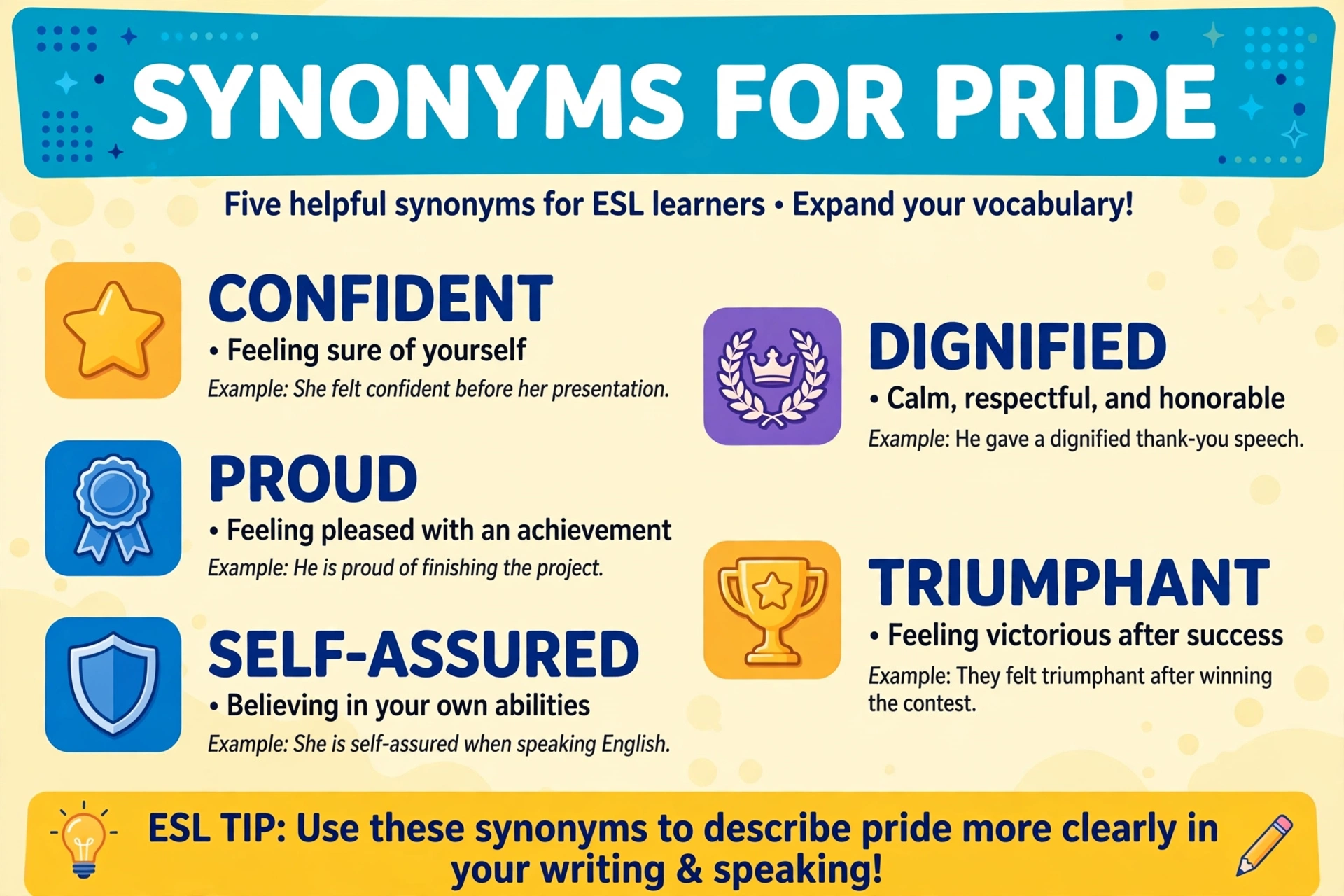
“Pride” is an emotional word with two faces. On one side, it is the warm satisfaction you feel after hard work — pride in your family, your country, your achievements. On the other side, it can mean an unhealthy sense of superiority. Because the word swings between positive and negative, choosing a precise synonym matters.
The five words below focus on the positive side of pride: the dignity, honor, and quiet satisfaction that come from doing something well. Each one highlights a slightly different shade of that feeling.
Writers love “pride” because it feels strong, but strength without precision can misfire. Telling a colleague you feel “pride” in a finished project is warm; telling them you feel “pride” after correcting their mistake sounds arrogant. The synonyms below keep you on the warm side, giving each positive shade of the feeling its own name.
This matters beyond essays. In job interviews, “I take pride in my work” sounds confident and grounded — but “I am full of pride” can sound boastful to the same listener. In speeches, leaders reach for “dignity” and “honor” because those words lift the audience instead of the speaker. Learning which shade to use, and when, is emotional intelligence expressed through vocabulary — and it is a skill that serves you in every language, not just English.
Satisfaction
Meaning: The pleasant feeling you get when something turns out well or a goal is reached.
Example: She felt deep satisfaction after finishing her first marathon.
Another example: Completing the difficult puzzle gave the children a quiet sense of satisfaction.
Dignity
Meaning: A calm, honorable way of carrying yourself, especially in difficult moments.
Example: Even after losing the match, he accepted the result with dignity.
Another example: She handled the unfair criticism with remarkable dignity.
Honor
Meaning: Great respect connected to an achievement, position, or good character.
Example: It was an honor to be chosen as the team’s captain this season.
Another example: Winning the scholarship was a great honor for the whole family.
Self-respect
Meaning: A healthy sense of your own worth that guides how you act and let others treat you.
Example: He kept his self-respect by refusing to cheat, even under pressure.
Another example: Keeping your self-respect sometimes means walking away from a bad deal.
Confidence
Meaning: A steady belief in your own abilities and judgment.
Example: Months of practice gave her the confidence to speak on stage.
Another example: Her confidence grew with every successful presentation she delivered.
How to Use These Words
Use “satisfaction” for the feeling after a completed task, “dignity” for graceful behavior under pressure, “honor” for respect tied to achievement, “self-respect” for how you value yourself, and “confidence” for belief in your abilities. Notice how each word stays on pride’s positive side — for the negative side (thinking you are better than everyone), words like “arrogance” fit instead. Getting the tone right is everything in English vocabulary; the same care applies to confusing pairs, as moral vs morale and chose vs choose show.
One more distinction worth learning: “pride” describes the feeling, while “honor” often describes what others give you. You feel pride; you receive an honor. “Dignity,” meanwhile, is about how you behave rather than how you feel. Keeping feeling, recognition, and behavior apart will keep your word choices clean.
A practical way to practice: take one achievement from your own life and describe it three ways — once with “satisfaction” (the feeling), once with “honor” (the recognition), and once with “dignity” (how you carried yourself through it). You will feel how each word frames the same event differently. That framing power is exactly why skilled writers rarely settle for plain “pride.”
Common Mistakes to Avoid
- Letting positive pride slide into arrogance. “I am proud of my team” is warm; “I am better than everyone” is arrogance. Check your tone before you speak — the line is thinner than it looks.
- Mixing up who gives and who feels. You feel pride; others give you honor. “It was a pride to meet you” is wrong — say “It was an honor to meet you.”
- Using “dignity” for a feeling. Dignity is about behavior, not emotion. “She felt dignity” sounds odd; “she behaved with dignity” is correct.
- Confusing the prepositions. It is “pride in” (“pride in her work”) and “proud of” (“proud of her work”) — never “pride of” in this sense. Small preposition errors are the most common slip with this word family.
Quick Practice
Choose the best word for each sentence: satisfaction, dignity, honor, self-respect, confidence.
- He felt quiet ___ when the garden he planted finally bloomed.
- It is an ___ to represent your country at the games.
- She accepted the unfair decision with remarkable ___.
Answer key: 1. satisfaction — 2. honor — 3. dignity
Related Words Worth Learning
FAQs
Is pride always a positive feeling?
No. Pride can be healthy (satisfaction in honest work) or harmful (looking down on others). Synonyms like “dignity” and “honor” carry the positive sense; “arrogance” and “vanity” carry the negative one. Context is everything: the same achievement can be described with humble “satisfaction” or boastful “vanity.”
What is the difference between “pride” and “confidence”?
Confidence is belief in your ability to do something. Pride is the feeling you get after you have done it well. Confidence looks forward; pride often looks back.
Which synonym fits “national pride”?
“Dignity” and “honor” both work: “a sense of national dignity” or “national honor.” “Satisfaction” is too personal for this use.
Can “honor” replace “pride” in every sentence?
No. “Honor” emphasizes respect and recognition, while “pride” emphasizes the inner feeling. “She takes pride in her garden” becomes “Her garden is her honor” only in very poetic writing.
What is the difference between “pride” and “vanity”?
Pride can be healthy — satisfaction in real achievement. Vanity is excessive concern with how you appear to others: admiring your reflection, fishing for compliments, needing constant praise. A proud craftsman shows you his work; a vain one shows you himself.
What does “swallow your pride” mean?
It means doing something despite embarrassment — usually admitting you were wrong or asking for help when you would rather not. “He swallowed his pride and apologized” paints a vivid picture: pride is treated like something bitter you force down for a good reason.
Conclusion
Pride at its best is dignity, honor, satisfaction, self-respect, and confidence — the quiet reward of effort and character. These five synonyms let you express that positive feeling with precision instead of leaning on one overused word.
Try this: write one sentence about something you accomplished this year, using “satisfaction,” “dignity,” or “honor” instead of “pride.” Notice how each version tells a slightly different story. That is the power of a precise vocabulary — use it in essays, speeches, and daily conversation, and your English will carry more warmth and exactness.

James Reed is a writer and English language enthusiast with a passion for making vocabulary simple and fun. He writes about words, meanings, and everyday English to help learners speak and write with confidence.