The word “clear” is one of the busiest words in English. It can mean easy to understand, obvious, transparent, free from doubt, or bright and unclouded. Because it does so many jobs, repeating it makes your writing sound dull — and sometimes unclear about which meaning you intend.
Imagine describing a window, an explanation, and the sky in the same paragraph. If you call all three “clear,” your reader has to work out which meaning you mean each time. Swapping in “transparent” for the window, “plain” for the explanation, and “cloudless” for the sky removes all doubt instantly. That is the power of precise synonyms.
Learning precise synonyms for clear helps you say exactly what you mean. Whether you want to describe a transparent window, an obvious answer, or a plain explanation, the right word makes your message sharper. Students, professionals, and bloggers all benefit from this upgrade.
There is another benefit that learners often miss: precise words reduce misunderstandings. In a work email, “the instructions are clear” is polite but vague, while “the instructions are plain and simple” tells the reader exactly what to expect. In an essay, “it is obvious that” carries confidence, while “it is evident from the data that” sounds careful and evidence-based. Each synonym sets a slightly different tone, and choosing well is a mark of a skilled writer.
In this guide, you will learn five powerful synonyms for clear, each with a clear meaning and natural example sentences.
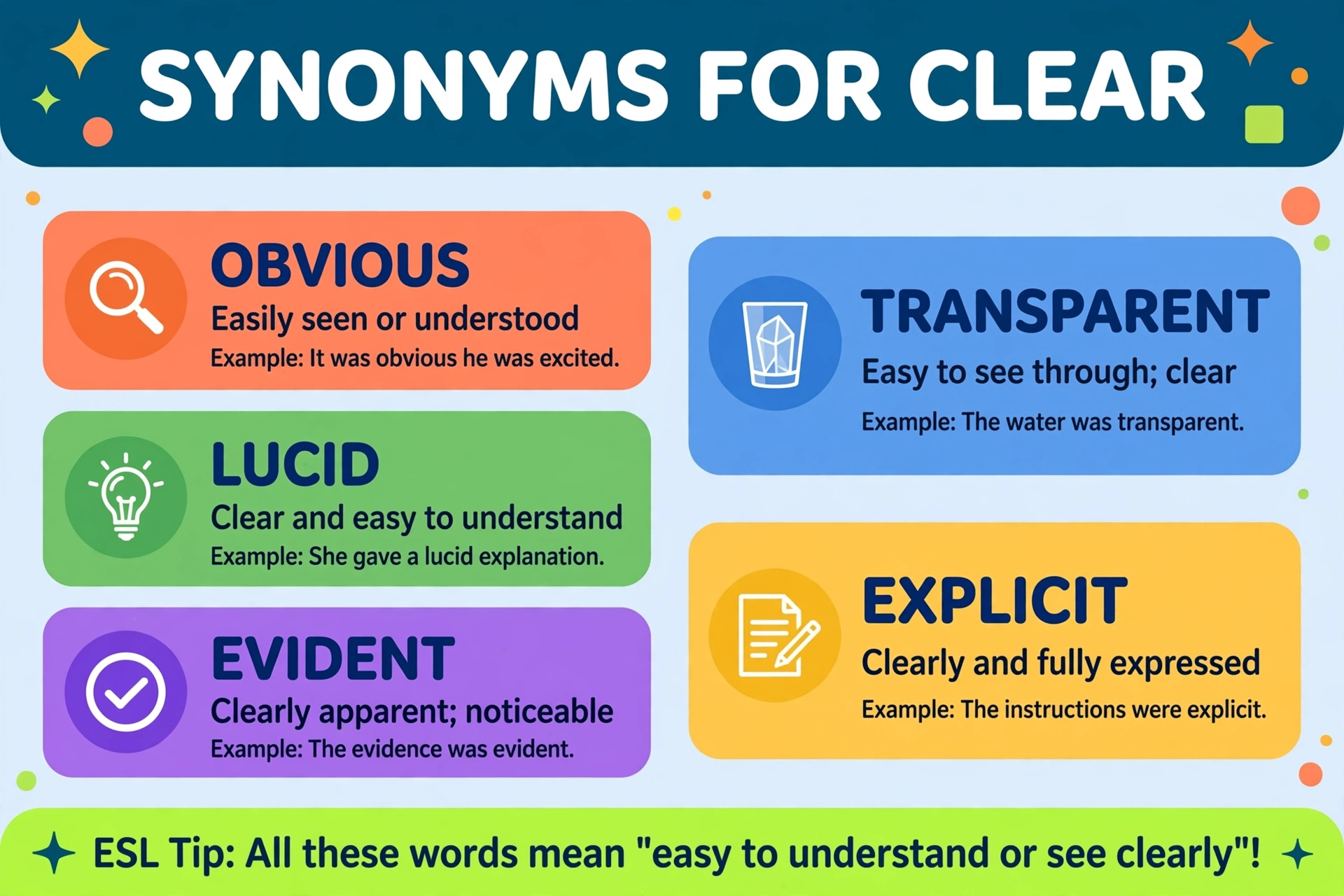
Obvious
Meaning: Very easy to see, notice, or understand; impossible to miss.
Example: It was obvious from her smile that she had good news.
Example: The mistake in the report was obvious to everyone in the room.
Example: It was obvious that the team needed more time to finish the task.
Transparent
Meaning: Allowing light to pass through so things can be seen, or honest and easy to understand with nothing hidden.
Example: The company promised to be transparent about its prices.
Example: They replaced the old windows with transparent glass panels.
Example: She gave a transparent answer and admitted she did not know the details.
Distinct
Meaning: Clearly different or separate from other things, easy to recognize.
Example: There are two distinct flavors in this dish: sweet and sour.
Example: Each bird has a distinct call that sets it apart from others.
Example: The twins have distinct personalities — one is shy, the other is outgoing.
Plain
Meaning: Simple and easy to understand, without decoration or confusion.
Example: Please explain it in plain words so everyone can follow.
Example: The instructions were written in plain language for beginners.
Example: He gave a plain, honest answer instead of hiding behind excuses.
Evident
Meaning: Clearly true or easy to see from the facts available.
Example: It was evident that he had not slept well the night before.
Example: Her talent was evident from the very first performance.
Example: The damage to the car was evident even before the mechanic looked underneath.
Quick Comparison Table
| Synonym | Best Used For |
|---|---|
| Obvious | Things impossible to miss |
| Transparent | See-through objects or honest behavior |
| Distinct | Things clearly separate from others |
| Plain | Simple, easy explanations |
| Evident | Truths clear from the facts |
How to Use These Words
Match the synonym to your meaning. Use obvious for things impossible to miss, transparent for glass-like clarity or honesty, distinct for things clearly separate, plain for simple explanations, and evident when facts make something clear. A useful habit: before writing “clear,” pause and ask which sense you mean — visual, mental, or moral. Small spelling slips can also cloud otherwise clear writing — trouper vs trooper shows how a single letter changes everything. Choosing precise words keeps your message sharp.
Watch out for register as well. Evident and distinct belong to formal, careful writing — perfect for essays and reports. Obvious and plain feel natural in everyday speech and casual writing. Transparent sits in the middle: it is at home in business writing (“transparent pricing”) and in physical descriptions (“transparent plastic”). Matching the word’s formality to your context is the difference between writing that sounds right and writing that sounds slightly off.
Common Mistakes to Avoid
- Using “transparent” for people in a casual way. “He is transparent” usually means he is honest and open — but in casual speech it can sound odd or too corporate. In everyday talk, “open” or “honest” is often more natural.
- Confusing “distinct” with “distinctive.” They are cousins, not twins. “Distinct” means clearly separate; “distinctive” means special and easy to recognize. A “distinctive logo” is memorable; a “distinct flavor” is separate from other flavors.
- Saying “plain obvious.” Learners sometimes stack synonyms for emphasis — “it is plain obvious” — but native speakers never do this. Pick one strong word and let it do the work.
- Using “evident” without evidence. “Evident” points to facts you can see. If nothing supports your claim yet, “obvious” or “clear” is safer than “evident,” which promises proof.
Quick Practice
Choose the best word from the list: obvious, transparent, distinct, plain, evident.
- The instructions were written in ___ language that even a child could follow.
- It was ___ from the empty plates that everyone had enjoyed the meal.
- The shop uses ___ bags so customers can see what is inside.
- The two paintings have a ___ style — you would never confuse them.
Answer key: 1. plain 2. evident 3. transparent 4. distinct
Related Words Worth Learning
- Synonyms for Communication — sharing ideas clearly with others
- Synonyms for Concept — ideas explained simply
- Synonyms for Importance — what matters most
FAQs
What is the most common synonym for clear?
“Obvious” is the most common when “clear” means easy to understand. For the see-through meaning, “transparent” is the standard choice.
Is “evident” formal?
Yes, “evident” is slightly formal and works well in essays, reports, and professional writing. In casual speech, “clear” or “obvious” sounds more natural.
What is the difference between distinct and clear?
“Distinct” emphasizes being separate or different from other things, while “clear” emphasizes being easy to understand. A sound can be distinct without being clear.
Can “plain” sound rude?
It can if used about a person (“a plain woman” means unattractive). But “plain words” or “plain explanation” simply means simple and clear — perfectly polite.
What is the difference between transparent and clear?
“Transparent” is stronger and more specific. A “clear window” might just be clean, but a “transparent window” lets you see straight through it. In writing about honesty, “transparent” means hiding nothing at all.
Can “distinct” describe memories?
Yes. A “distinct memory” is one that stands out clearly from other memories — sharp and easy to recall. It works because the memory feels separate from the blur of everyday events.
Conclusion
“Clear” is useful, but it is overused. With obvious, transparent, distinct, plain, and evident in your toolkit, you can express every shade of clarity with precision. Try swapping one of these into your next email or essay and notice how much sharper your writing feels.

Thomas Allen is a language writer and editor who loves exploring the subtle differences between words. He creates clear, practical guides that help readers understand English better — one word pair at a time.