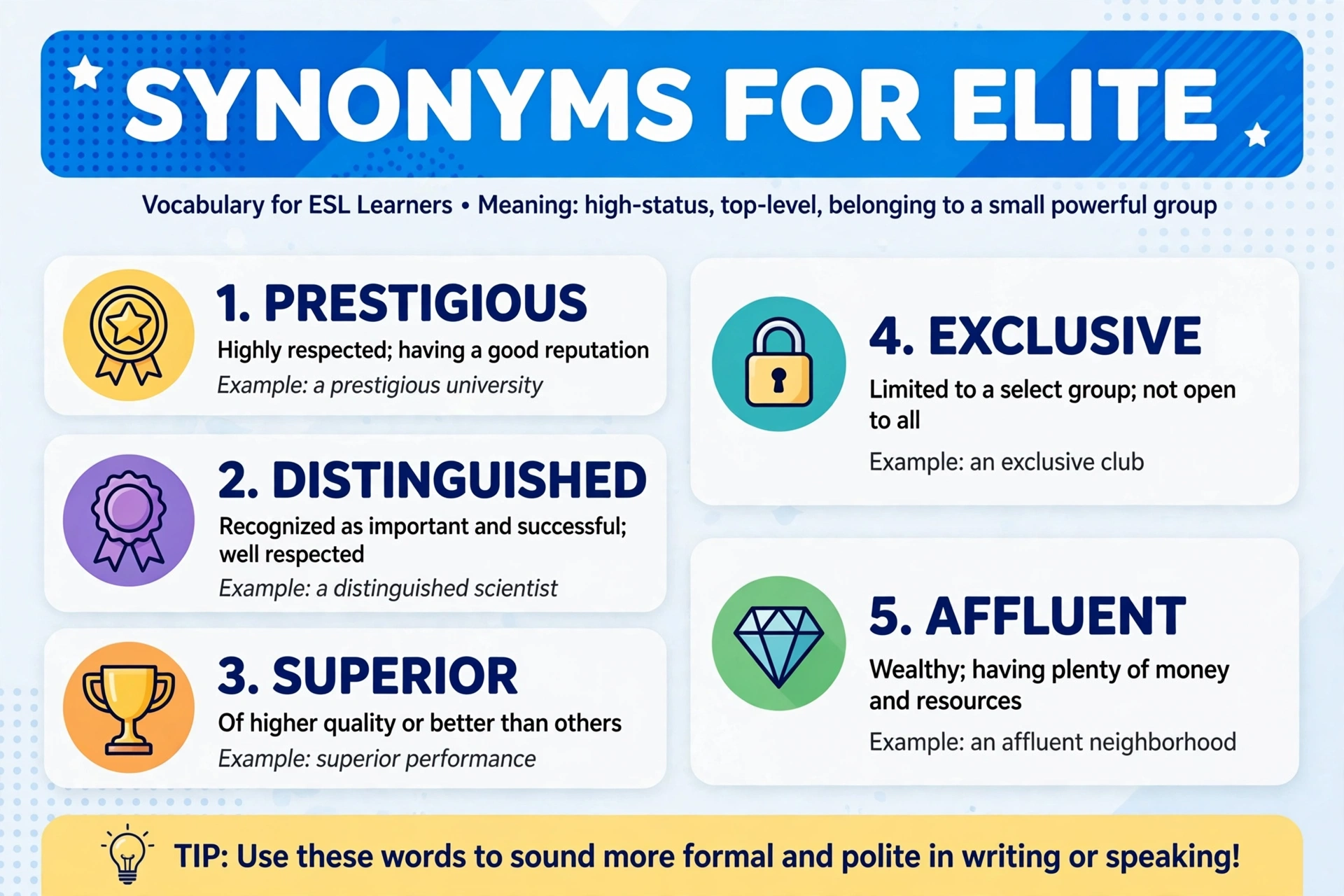
Elite means belonging to the very best of a group — the top students, the finest athletes, the most skilled professionals. It is a powerful word, but it is also easy to overuse, and in some contexts it can sound snobbish. Whether you are describing a product, a school, or a person’s skill, having sharper alternatives lets you praise without repeating yourself or striking the wrong note.
The five words below all express top-level quality, but each fits a different angle: pure quality, visible achievement, respected status, paid tier, or restricted access.
These distinctions matter in real life. A job application praising your “outstanding” results sounds credible, while calling yourself “elite” can sound arrogant. Choosing well is not just vocabulary — it is judgment.
Below you will find five precise alternatives, each with two examples and clear guidance on tone. Pay special attention to the usage notes — with words of praise, how a word sounds to the reader matters as much as what it means.
Superior
Meaning: Higher in quality, rank, or ability than others; better by a clear margin.
Example: This superior fabric lasts twice as long as the cheaper one.
Example: The superior camera on the new phone takes sharper photos in low light.
Outstanding
Meaning: Clearly better than the rest; so excellent that it stands out and gets noticed.
Example: Her outstanding grades earned her a full scholarship.
Example: His outstanding service during the crisis earned him a national medal.
Prestigious
Meaning: Commanding great respect because of high status, history, or achievement.
Example: He won a prestigious award for his cancer research.
Example: She was invited to speak at a prestigious conference in Geneva.
Premium
Meaning: Of top quality, usually costing more than the standard option; the best tier on offer.
Example: The airline serves premium meals in business class.
Example: They upgraded to premium seats for the long flight to Tokyo.
Exclusive
Meaning: Reserved for a small, select group; not open or available to everyone.
Example: The exclusive club accepts only twenty members a year.
Example: The reporter’s exclusive interview with the president made headlines worldwide.
How to Use These Words
Aim at the right target. For pure quality, use superior or premium. For achievement that deserves applause, outstanding or prestigious fits. When the point is limited access rather than quality itself, exclusive is the honest word. Note the tone too: “elite” can sound admiring or arrogant depending on context, while “outstanding” is almost always warm.
Context also decides. In marketing copy, premium and exclusive are workhorses — they justify a higher price or create desire. In academic or professional praise, outstanding and prestigious carry more weight because they point to recognized achievement rather than price. Superior is the most neutral of the five and works almost anywhere you are comparing quality directly. When in doubt, ask yourself: am I praising quality, achievement, status, price, or access? The answer picks the word.
Word Shades at a Glance
| Word | Reach for it when you mean… |
|---|---|
| Superior | better quality than the rivals |
| Outstanding | achievement that deserves applause |
| Prestigious | status that commands deep respect |
| Premium | a paid top tier above standard |
| Exclusive | access limited to a select few |
Common Mistakes to Avoid
- Calling anything expensive “elite.” A high price alone does not make something the best. “Premium” is the honest word for a costly top tier; save “elite” for proven superiority.
- Labeling yourself elite. “I am an elite designer” sounds arrogant in a bio or cover letter. Let clients or awards give you the title — or use “experienced” and “award-winning,” which carry proof.
- Treating “exclusive” as praise for quality. An exclusive club is simply hard to enter; it is only elite if its members are genuinely the best. Access and excellence are different claims.
- Using “superior” about people to their face. “Our superior product” is fine in a brochure, but telling a colleague your work is “superior” to theirs sounds insulting. For people, “outstanding” praises without comparing so bluntly.
Related Words Worth Learning
Quick Practice
Choose the best word for each sentence:
- “This is a ___ university with a 200-year history.”
- “They sell ___ coffee beans at twice the normal price.”
- “Only members can enter this ___ airport lounge.”
Answer key: 1. prestigious (respected status); 2. premium (paid top tier); 3. exclusive (limited access). Testing yourself this way turns passive reading into usable vocabulary.
FAQs
Is “elite” only used for people?
No. Products, schools, military units, and even neighborhoods are described as elite when they sit at the top of their category.
What is the difference between elite and exclusive?
Elite describes being the best; exclusive describes restricted access. An exclusive restaurant may or may not be elite — it simply limits who can enter.
Can “elite” sound negative?
Yes, in the wrong context. “Elite” can imply snobbery or unfair privilege, especially in discussions about wealth or power. “Outstanding” is a safer compliment.
Premium vs elite — which should I use for products?
Use premium for a paid top tier (premium subscription, premium fuel). Use elite when comparing against all competitors as the best overall.
What is the opposite of elite?
Ordinary, average, or mediocre are common opposites, depending on tone. “Ordinary” is neutral, “average” is statistical, and “mediocre” is mildly critical.
Is “elite” countable?
Yes — you can say “an elite,” though it usually appears as an adjective (“elite athletes”) or in the plural noun form “the elite,” meaning the top group as a whole.
Conclusion
Elite will always have its place, but superior, outstanding, prestigious, premium, and exclusive give you finer control. Match the word to what you actually mean — quality, achievement, status, price tier, or access — and your praise will land exactly as intended. Keep this guide bookmarked, and the next time “elite” feels too blunt, you will know exactly which sharper word to reach for.
The next time you are tempted to call something elite, pause and ask which kind of excellence you mean. That single question — quality, achievement, status, tier, or access — will hand you the sharper word every time, and sharper words are what make praise believable.

Thomas Allen is a language writer and editor who loves exploring the subtle differences between words. He creates clear, practical guides that help readers understand English better — one word pair at a time.