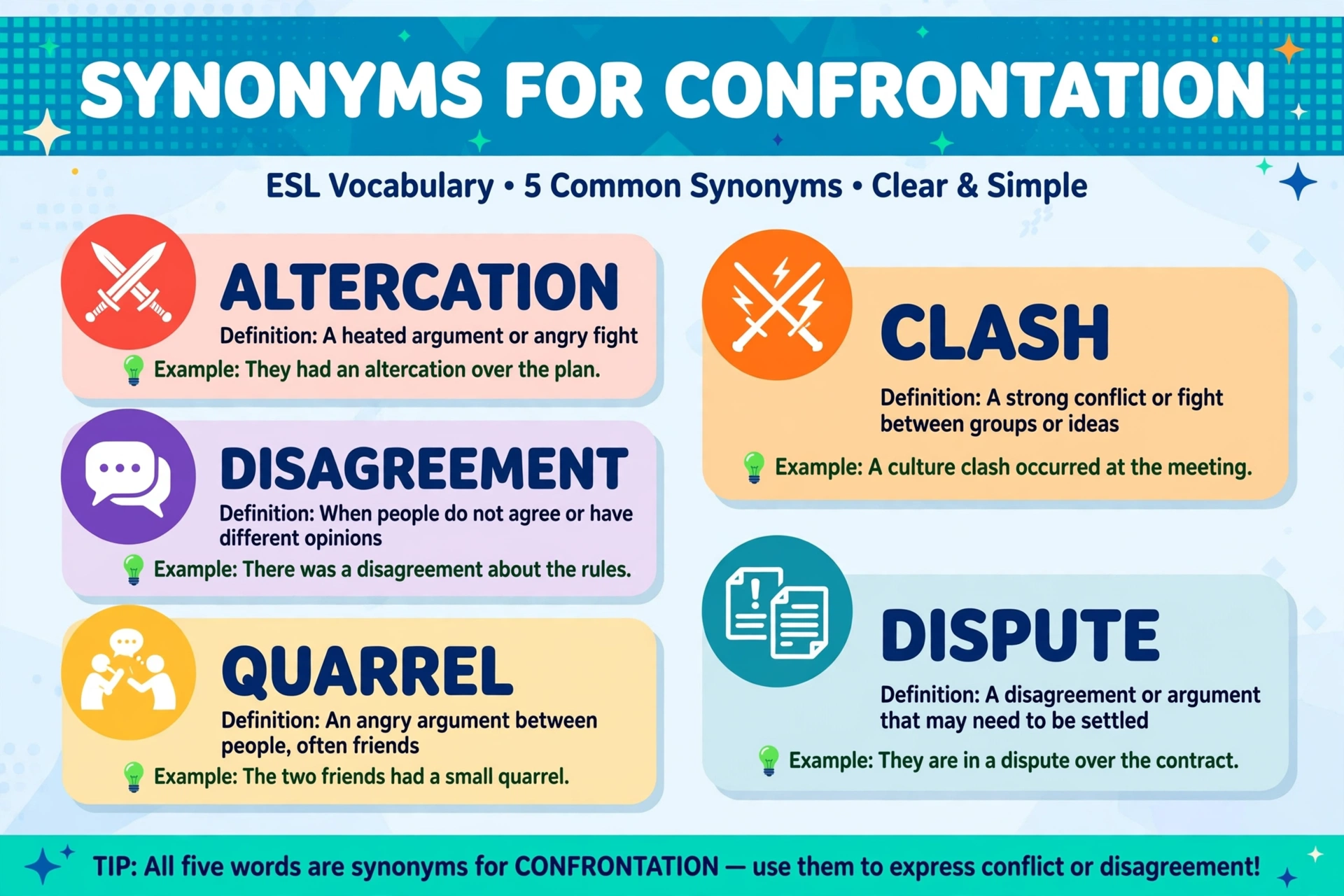
A confrontation is a direct clash between people or groups — an argument, a fight, or a tense face-to-face meeting. The word appears in news reports, stories, and discussions about conflict. But it is a heavy word, and using it for every disagreement makes your writing sound dramatic and repetitive.
Writers of news and fiction face this problem daily. If every disagreement in a novel is a “confrontation,” the word loses its punch exactly when the story needs it most. Saving “confrontation” for the truly tense moments — and using “clash,” “encounter,” or “face-off” elsewhere — keeps readers on edge.
Sharper synonyms for confrontation help you match the intensity of the moment. A “conflict” can be mild or serious, a “clash” is sudden and sharp, a “showdown” is the final decisive meeting, and an “encounter” can be neutral. Choosing the right word shows control over your language.
Intensity is the key idea behind all five words. Think of them as a temperature scale: an “encounter” can be cool and neutral, a “conflict” runs warm, a “clash” flashes hot and fast, a “face-off” simmers with tension, and a “showdown” boils over into the final decisive moment. Journalists and storytellers use this scale instinctively — and once you learn it, your own descriptions of arguments and rivalries will feel far more dramatic and precise.
In this guide, you will learn five powerful synonyms for confrontation, each with a clear meaning and natural example sentences.
Conflict
Meaning: A serious disagreement or fight between people, groups, or ideas.
Example: The conflict between the two teams lasted for several weeks.
Example: Good leaders know how to resolve conflict before it grows.
Example: The conflict over water rights divided the two villages for years.
Clash
Meaning: A sudden, sharp disagreement or fight, often loud and brief.
Example: A clash broke out between fans after the final whistle.
Example: Their clash of opinions made the meeting uncomfortable for everyone.
Example: The clash between the two drivers ended with both cars in the ditch.
Showdown
Meaning: A final, decisive meeting or fight that settles a long disagreement.
Example: The election became a showdown between two strong candidates.
Example: Tonight’s match is a showdown for the championship title.
Example: The courtroom showdown between the two lawyers lasted three days.
Encounter
Meaning: A meeting with someone, sometimes unexpected; can be friendly or hostile.
Example: His encounter with the stray dog left him shaken.
Example: Her first encounter with snow was pure joy.
Example: The hiker’s unexpected encounter with a bear ended without harm.
Face-off
Meaning: A direct, tense meeting between opponents, each refusing to back down.
Example: The debate turned into a face-off between the two rivals.
Example: The playoff game promises a thrilling face-off of top scorers.
Example: The salary negotiation became a tense face-off between the union and management.
Quick Comparison Table
| Synonym | Best Used For |
|---|---|
| Conflict | Serious, ongoing disagreements |
| Clash | Sudden, sharp fights |
| Showdown | Final, decisive meetings |
| Encounter | Neutral or unexpected meetings |
| Face-off | Tense standoffs between opponents |
How to Use These Words
Match the word to the heat of the moment. Use conflict for serious ongoing disagreements, clash for sudden sharp fights, showdown for decisive final meetings, encounter for neutral or unexpected meetings, and face-off for tense standoffs. Remember that “encounter” is the odd one out — it can be friendly, so check your tone before using it for hostile scenes. Many clashes begin with a misunderstood reason — stating it correctly with since vs because keeps explanations clean. The right word captures the exact temperature of the moment.
Grammar habits matter here too. Conflict often pairs with verbs like “resolve,” “avoid,” or “escalate” — “they resolved the conflict peacefully.” Clash is frequently used with “break out” — “a clash broke out.” Showdown usually follows “a” or “the” and leads to a result — “the showdown decided the winner.” Encounter commonly appears with “unexpected” or “chance.” Face-off often follows “a tense” or “a thrilling.” Learning these pairings makes your writing sound natural rather than translated.
Common Mistakes to Avoid
- Calling every argument a “confrontation.” Small disagreements do not deserve this heavy word. Save it for genuinely tense, direct clashes — overusing it drains its power.
- Using “showdown” in formal reports. A showdown belongs in sports pages and stories, not in a board report. For formal writing, “decisive meeting” or “final negotiation” is safer.
- Forgetting that “encounter” can be friendly. Writing “a violent encounter with an old friend” confuses readers, because the word itself is neutral. Pair it with the right adjectives to set the tone.
- Writing “clash” for slow, quiet disagreements. A clash is sudden and loud by nature. A months-long cold disagreement between colleagues is a conflict, not a clash.
Quick Practice
Choose the best word from the list: conflict, clash, showdown, encounter, face-off.
- The final debate was a ___ between the two leading candidates.
- A ___ between rival supporters broke out outside the stadium.
- Her first ___ with the ocean left her amazed and happy.
- The long ___ between the brothers finally ended at the family dinner.
Answer key: 1. showdown (face-off also works) 2. clash 3. encounter 4. conflict
Related Words Worth Learning
- Synonyms for Vulnerable — when people feel exposed
- Synonyms for Resilience — recovering after conflict
- Synonyms for Determination — standing your ground
FAQs
Is “confrontation” always violent?
No. It can describe any direct, tense disagreement, including a calm but firm meeting where someone is challenged.
What is the difference between conflict and clash?
“Conflict” is broader and can last a long time; “clash” is usually sudden, brief, and sharp.
Is “showdown” informal?
Slightly. It comes from Western movies and works well in journalism and storytelling, but formal reports may prefer “decisive meeting.”
Can “encounter” be positive?
Yes. Unlike the others, “encounter” is neutral — it can describe meeting a friend, an animal, or a new experience.
What is the difference between a fight and a confrontation?
A fight usually involves physical violence, while a confrontation can be purely verbal — a tense argument or a firm face-to-face challenge counts as a confrontation.
Is “face-off” one word or two?
It is usually written with a hyphen — “face-off” — as a noun. Without the hyphen (“face off”) it becomes a verb phrase: “The two teams will face off tonight.”
Conclusion
Not every disagreement is a confrontation. Conflict, clash, showdown, encounter, and face-off let you describe tension with exactly the right intensity. Master these words and your descriptions of disagreements will feel vivid, accurate, and controlled.

James Reed is a writer and English language enthusiast with a passion for making vocabulary simple and fun. He writes about words, meanings, and everyday English to help learners speak and write with confidence.