To connect means to join things together or to form a relationship between people, ideas, or objects. We connect phones to chargers, connect with old friends, and connect ideas in essays. It is one of the most useful verbs in English — and one of the most repeated.
Listen to a day of conversation and you will hear “connect” everywhere: connecting flights, connecting on social media, connecting the dots. Each use means something slightly different, yet we use the same word. Choosing “link,” “attach,” or “unite” instead instantly tells your listener which kind of joining you mean.
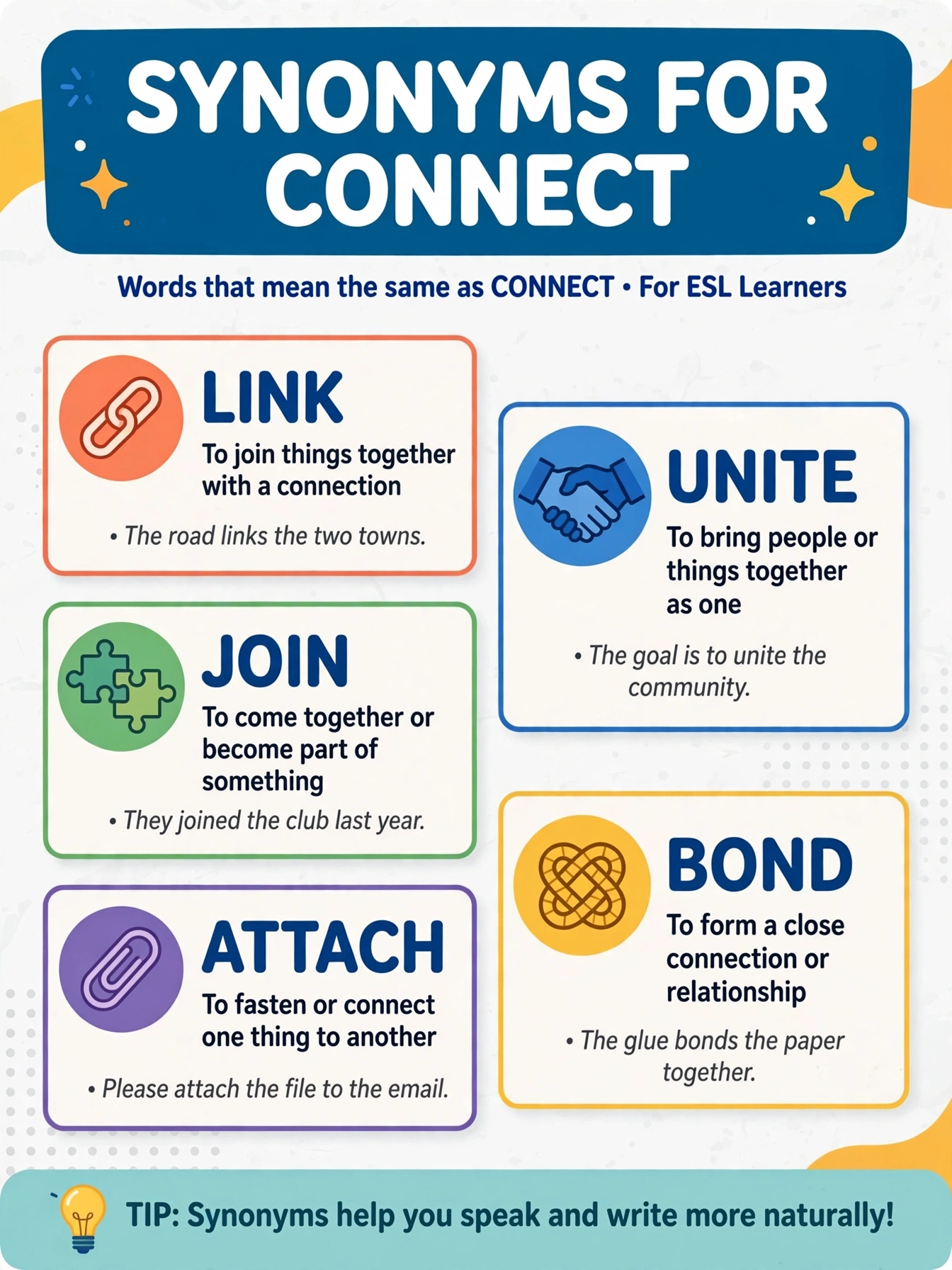
Better synonyms for connect make your meaning exact. You “link” ideas, “join” groups, “attach” files, “unite” people, and “associate” one thing with another. Each synonym fits a different situation, and using them well makes your English sound fluent and natural.
This precision pays off in everyday life. On a job application, “I joined the marketing team” tells a clear story of belonging, while “I connected with the marketing team” sounds vague. In an essay, “this chapter links poverty to poor health” sounds analytical and strong. Even in small talk, “we really united around the project” carries warmth that “we connected on the project” lacks. Small verb choices like these quietly shape how confident and capable you sound.
In this guide, you will learn five powerful synonyms for connect, each with a clear meaning and natural example sentences.
Link
Meaning: To join two or more things so they relate to each other.
Example: The article links healthy eating to better sleep.
Example: Police linked the suspect to three different crime scenes.
Example: Click the underlined words to follow the link to the next page.
Join
Meaning: To become part of a group, or to fasten things together.
Example: She decided to join the school debate club this year.
Example: The two wooden pieces join neatly without any nails.
Example: Thousands of fans joined the celebration in the city square.
Attach
Meaning: To fasten or connect one thing to another, physically or digitally.
Example: Please attach your photo to the application form.
Example: He attached the trailer to the back of his truck.
Example: She attached a note to the gift so he would know who sent it.
Unite
Meaning: To bring people or groups together for a shared purpose.
Example: The festival united the whole neighborhood in celebration.
Example: A common goal can unite even the fiercest rivals.
Example: The national anthem united the crowd before the final match.
Associate
Meaning: To connect one thing with another in your mind; to relate ideas together.
Example: Most people associate the smell of rain with calm feelings.
Example: The brand is strongly associated with quality and trust.
Example: People often associate that song with summer holidays.
Quick Comparison Table
| Synonym | Best Used For |
|---|---|
| Link | Joining ideas or related things |
| Join | Becoming part of a group |
| Attach | Fastening things, including files |
| Unite | Bringing people together |
| Associate | Mental connections between ideas |
How to Use These Words
Choose by what is being joined. Use link for ideas and relationships, join for groups or physical joining, attach for fastening things (including files), unite for bringing people together, and associate for mental connections. Note the prepositions: you link A to B, join a group, attach something to something, unite people around a cause, and associate one thing with another. Connecting ideas clearly also means linking cause and effect properly — since vs because keeps those links correct. The right verb makes every connection clear.
Watch for the physical-versus-abstract split. Attach is almost always physical or digital — you attach a file, a trailer, a note. Associate is almost always mental — you associate ideas, feelings, or memories. Link and join cross both worlds: you can link two websites or two ideas, join two boards or a club. Unite stays firmly in the human world; saying “the storm united the two roofs” would sound comical. Keeping each verb in its natural world is what makes your English sound native.
Common Mistakes to Avoid
- Writing “attach with” instead of “attach to.” The correct preposition is “to” — “attach the file to the email.” “Attach with” is a common learner error that sounds off immediately.
- Using “join” for online meetings. Native speakers “join a meeting” but “connect to a call.” Saying “I will connect the meeting” mixes the two and confuses listeners.
- Saying “unite” for objects. Unite is for people, groups, and efforts — not things. “The glue united the pieces” is wrong; use “joined” or “bonded” for objects.
- Confusing “associate” with “assistant.” The spellings look related but the meanings are not. An associate is a partner or colleague; to associate is to mentally connect ideas. Double-check before writing either.
Quick Practice
Choose the best word from the list: link, join, attach, unite, associate.
- Please ___ your CV to the application before sending it.
- The charity event will ___ the whole community for a good cause.
- Many people ___ the color red with danger and warning signs.
- He decided to ___ the local football team this season.
Answer key: 1. attach 2. unite 3. associate 4. join
Related Words Worth Learning
- Synonyms for Communication — connecting through words
- Synonyms for Flexible — adapting to new connections
- Synonyms for Importance — what connects most to you
FAQs
Is “link” only for the internet?
No. “Link” works for any connection: linking ideas, linking events, or linking people. The internet sense is just one use.
What is the difference between join and connect?
“Join” often means becoming part of something (join a club) or fastening physically. “Connect” is broader and covers relationships, ideas, and devices.
Can “unite” be used for things, not people?
Yes, though it is most common for people and groups: “The two companies united their efforts.”
Is “associate” formal?
Somewhat. It is standard in academic and professional writing, especially for mental connections between ideas.
What is the difference between connect and link?
They are close, but “link” suggests a clear, direct relationship between two specific things, while “connect” is broader. “The study links sleep to memory” sounds more precise than “connects sleep to memory.”
Can “join” mean to take part in a conversation?
Yes. “Join the conversation” or “join in the discussion” are very natural — it means becoming part of the talking, not just listening.
Conclusion
Connections are everywhere — now your vocabulary can keep up. Link, join, attach, unite, and associate each join things in their own way. Practice them in daily speech and writing, and your English will feel more connected and more precise.

James Reed is a writer and English language enthusiast with a passion for making vocabulary simple and fun. He writes about words, meanings, and everyday English to help learners speak and write with confidence.