Relax is the word we all reach for after a long day — but it is doing too many jobs at once. It can mean resting your body, calming your mind, releasing tension, or simply taking a break. When one word covers all of that, your sentences start sounding the same.
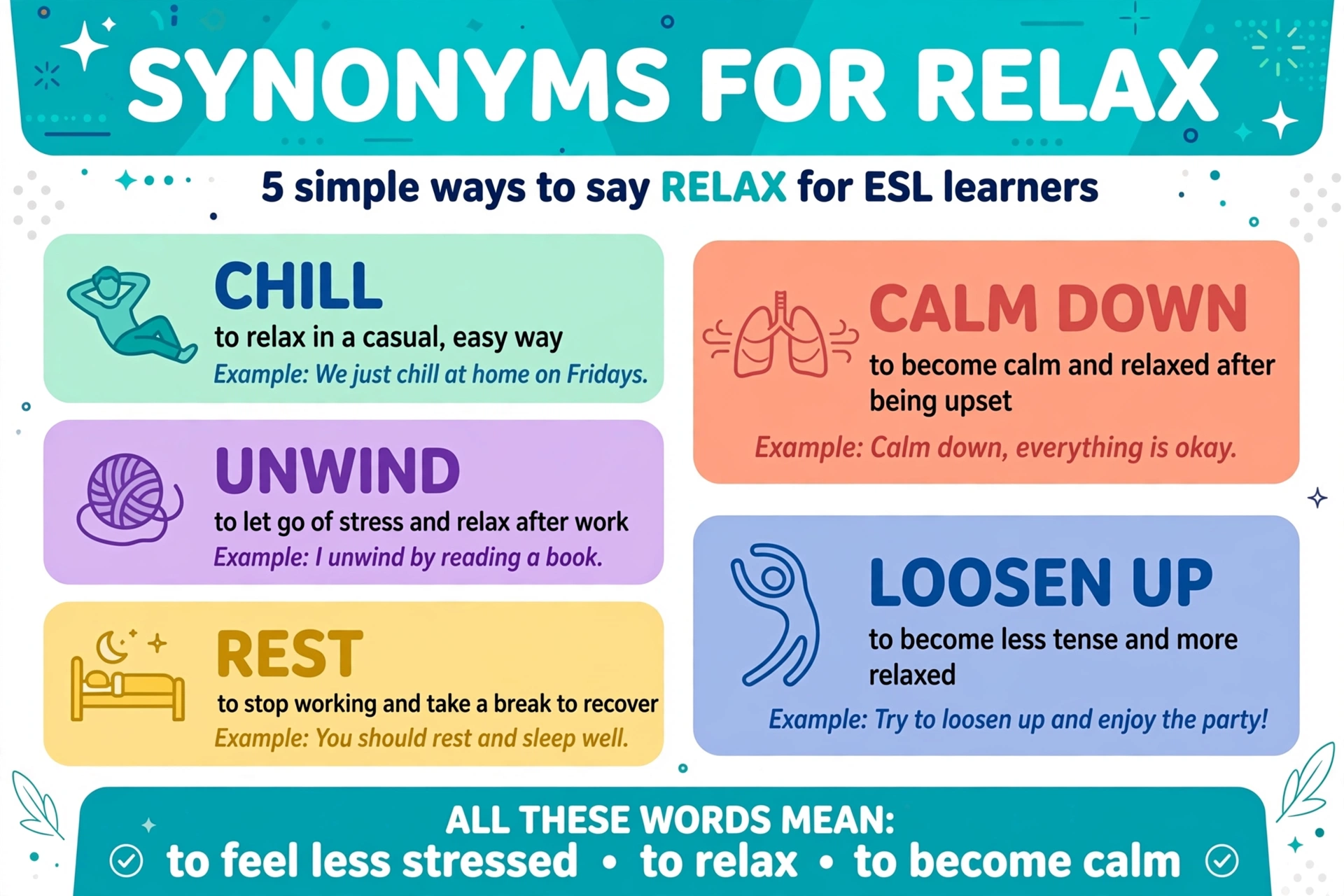
The right synonym depends on what kind of relaxing you mean: physical rest, mental relief, or emotional calm. Here are five of the most useful synonyms for relax, each with a clear meaning and an example.
Doctors and researchers keep telling us that real rest is not laziness — it is maintenance. Short breaks rebuild focus, good sleep repairs the body, and genuine downtime lowers stress hormones. But “just relax” is vague advice; the science works better when you name the kind of rest you need. A tired body needs rest, a wired mind needs to unwind, and drained energy needs to recharge. Matching the word to the need is the first step toward actually recovering.
The grammar is worth a quick note too, because learners mix it up constantly. “Relax” is the verb: “I need to relax.” “Relaxed” describes how you feel: “I feel relaxed.” “Relaxing” describes what creates the feeling: “a relaxing holiday.” Getting these three forms straight will clean up dozens of small errors in your writing — and the same attention to word forms helps with the five synonyms below.
Unwind
Meaning: To release stress and tension after a period of effort or pressure.
Example: After the difficult exam week, she unwound with long evening walks.
Another example: He likes to unwind by listening to old songs on quiet nights.
Rest
Meaning: To stop activity and allow your body or mind to recover.
Example: The doctor told him to rest for two days before returning to training.
Another example: After the long flight, they rested at the hotel for the whole day.
Recharge
Meaning: To restore your energy, like refilling a battery, so you feel fresh again.
Example: A quiet weekend at home helped her recharge before the busy month.
Another example: A short afternoon nap helped him recharge for the evening shift.
De-stress
Meaning: To actively remove or reduce stress from your life.
Example: He de-stresses by cooking elaborate meals on Sunday afternoons.
Another example: Gardening in the early morning helps her de-stress after tough weeks.
Calm Down
Meaning: To become less agitated, nervous, or emotional; to settle your feelings.
Example: She took a few deep breaths to calm down before the interview.
Another example: The coach asked the angry young player to calm down and focus.
How to Use These Words
Sort by what needs relaxing. For the body, use rest — it is the most neutral and general. For the mind after pressure, use unwind — it fits the slow release of built-up tension. For energy levels, use recharge — it suggests coming back stronger, like a battery. For stress specifically, use de-stress. For emotions running high, use calm down. And watch the tone: “chill” is fine with friends but too casual for a work email, where “unwind” or “recharge” sounds more professional.
Think of it as a toolkit with labeled drawers. “Rest” is the biggest drawer — it covers almost any break from activity. “Unwind” is the evening drawer, for after work or exams. “Recharge” is the energy drawer, for when you feel drained but must go again soon. “De-stress” is the wellness drawer, for deliberate stress removal. “Calm down” is the emergency drawer, for heated moments. Opening the right drawer shows you understand not just the words, but the situations behind them.
Common Mistakes to Avoid
- Using “calm down” for the body. “Calm down” settles emotions, not muscles. After a marathon you rest your legs; you do not “calm them down.”
- Mixing up “relaxed” and “relaxing.” “Relaxed” describes how you feel: “I feel relaxed.” “Relaxing” describes what causes it: “a relaxing holiday.” Swapping them is one of the most common learner errors.
- Writing “chill” in formal contexts. “Chill” is slang for relaxing with friends. In a work email or essay, use “unwind,” “rest,” or “recharge” instead.
- Treating “de-stress” as the rest itself. “De-stress” means removing stress — the action. The peaceful state afterward is what “relax” or “unwind” describes. Keep the action and the result apart.
Quick Practice
Choose the best word or phrase for each sentence: unwind, rest, recharge, de-stress, calm down.
- After the final match, the tired players needed a full day to ___.
- A week at the beach will ___ your batteries completely.
- Take three deep breaths and ___ before you answer.
Answer key: 1. unwind — 2. recharge — 3. calm down
Related Words Worth Learning
- Synonyms for Quiet — the peaceful settings where relaxing happens
- Synonyms for Confidence — what returns after real rest
- Synonyms for Resilience — bouncing back stronger after a break
FAQs
What is the most formal synonym for relax?
“Unwind” and “recharge” work well in professional writing. “Repose” is the most formal but sounds old-fashioned in everyday use.
Can I say “chill” in a work email?
Better not. “Chill” is informal slang for relaxing with friends. In professional contexts, use “unwind,” “rest,” or “recharge” instead.
What is the difference between “rest” and “relax”?
“Rest” specifically means stopping activity to recover — it is physical. “Relax” is broader, covering mental calm, emotional ease, and physical rest together.
Is “de-stress” a real word?
Yes — it is widely used in modern English, especially in wellness and workplace contexts. It specifically means removing stress, while “relax” is the general state you reach afterward.
What is the difference between “relaxed” and “relaxing”?
“Relaxed” describes how a person feels: “She felt relaxed after the massage.” “Relaxing” describes the thing that creates the feeling: “It was a relaxing massage.” One points at the person, the other at the cause — keep them straight and many small errors disappear.
What does “take it easy” mean?
It is an informal way of saying “relax” or “do not work too hard”: “Take it easy this weekend.” It can also mean “be gentle” — “Take it easy with the new recruit.” Friendly and common in speech, but too casual for formal writing.
Conclusion
Relax covers everything from naps to deep breathing, but precision sounds better. Unwind after pressure, rest your body, recharge your energy, de-stress your mind, and calm down your emotions. With these five words, you will always describe exactly the kind of break you mean.
This week, pay attention to what kind of rest you actually need each evening — and name it with the exact word. That tiny habit turns vocabulary from a school subject into a life skill.

James Reed is a writer and English language enthusiast with a passion for making vocabulary simple and fun. He writes about words, meanings, and everyday English to help learners speak and write with confidence.