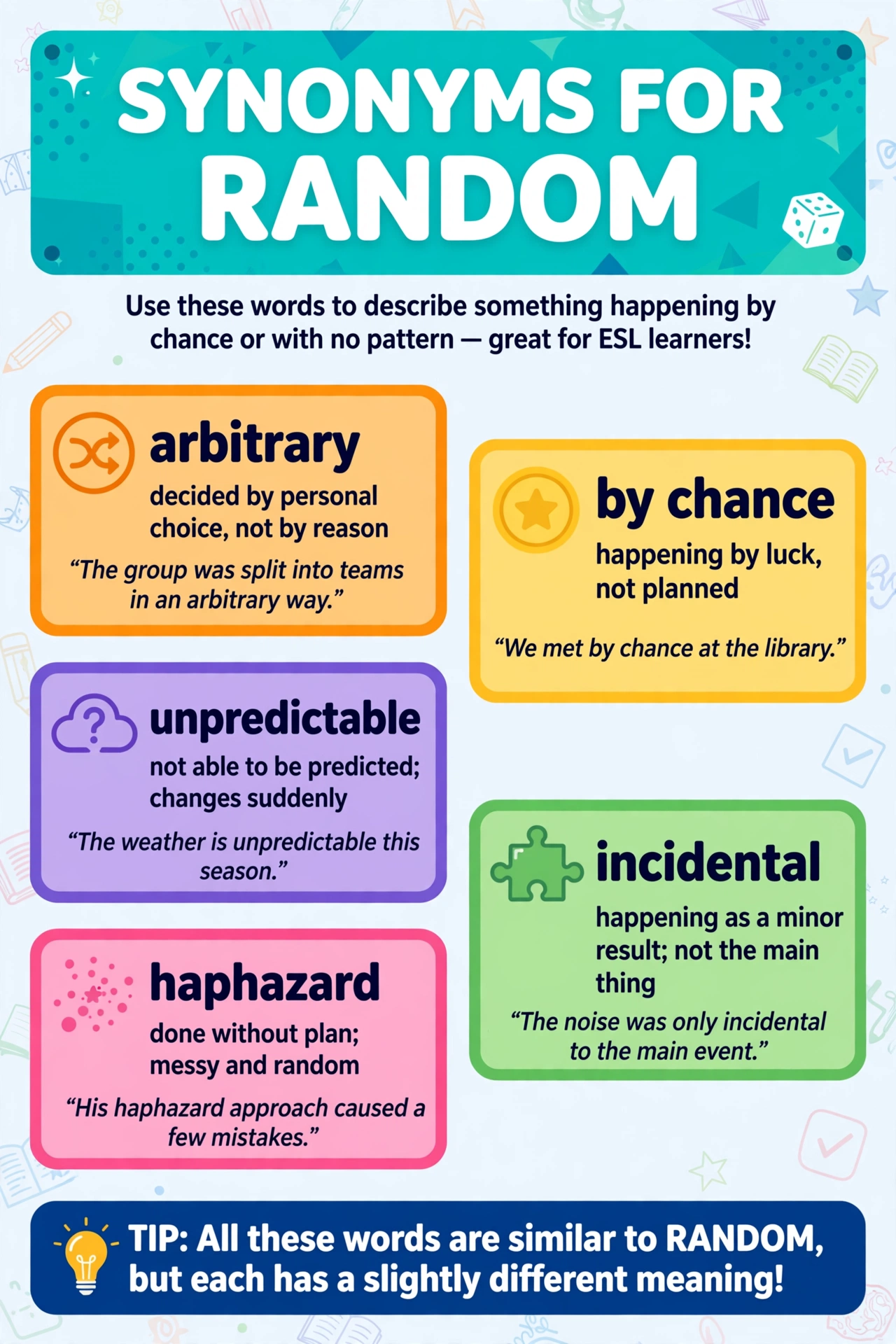
“Random” is one of those words we toss around all day: a random song, a random thought, a random stranger. It means happening without a clear plan, pattern, or reason. But because it is so casual and overused, it can make writing sound vague — especially when a more exact word exists.
The five synonyms below each capture a different kind of randomness. Some describe choices made without reason, some describe events no one could predict, and some describe delightful surprises. Pick the one that matches your situation.
It is also a word people use when they mean “I don’t know why.” Saying “it was random” often just means “I can’t explain it.” That vagueness is fine in chat with friends, but in writing it reads as lazy thinking. Replacing it forces you to decide what actually happened: was the choice unfair (“arbitrary”), the timing lucky (“accidental”), or the plan messy (“haphazard”)?
There is even a technical side to “random” worth knowing. In science and statistics, “random” has a strict meaning: every item has an equal chance of being chosen — a “random sample” in a survey, “random selection” in a lottery. Scientists work hard to make their samples truly random, because only then are the results fair. So the casual “random” of everyday chat and the precise “random” of research are almost opposites: one means “I can’t explain it,” the other means “I controlled it carefully.” Knowing both uses makes you sound smarter in both worlds.
Arbitrary
Meaning: Decided without a clear reason or fair system; based on personal whim.
Example: The winner was picked by an arbitrary draw from a box of names.
Another example: The new rules seemed arbitrary, and the players complained loudly.
Unpredictable
Meaning: Impossible to guess in advance; changing in ways no one expects.
Example: Mountain weather is unpredictable, so hikers always pack extra layers.
Another example: Her reactions to surprises are completely unpredictable.
Accidental
Meaning: Happening by chance, without being planned or intended.
Example: Their meeting at the airport was completely accidental.
Another example: He made an accidental phone call to his old boss at midnight.
Spontaneous
Meaning: Done suddenly, without planning, often in a fun or lively way.
Example: We took a spontaneous road trip to the coast last weekend.
Another example: Their spontaneous laughter filled the whole classroom.
Haphazard
Meaning: Messy and disorganized, with no clear plan behind it.
Example: His haphazard notes were scattered across three different notebooks.
Another example: The haphazard filing system wasted everyone’s time each morning.
How to Use These Words
“Arbitrary” criticizes unfair decisions; “unpredictable” describes what cannot be foreseen; “accidental” describes chance events; “spontaneous” celebrates unplanned fun; “haphazard” complains about mess. Calling a surprise party “arbitrary” would sound odd — “spontaneous” is the joyful word you want.
Tone is the hidden rule here. “Spontaneous” is warm and positive — nobody complains about a spontaneous compliment. “Haphazard” is cold and critical — a haphazard report suggests carelessness. “Arbitrary” carries a sense of injustice, which is why it appears in complaints and debates. Before you pick, ask yourself: do I want to praise, describe, or criticize? Matching tone to meaning is a core English skill, and it matters just as much with look-alike words, as adapt vs adopt and trouper vs trooper prove.
One more practical filter: ask whether a human chose it. “Arbitrary” and “haphazard” both imply someone made a decision — one unfairly, one carelessly. “Unpredictable” and “accidental” imply nobody controlled it at all — nature, luck, or chance did the work. “Spontaneous” sits in the middle: someone chose it, but freely and joyfully in the moment. This little test — who decided? — will guide you to the right word almost every time.
Common Mistakes to Avoid
- Using “arbitrary” for fun surprises. “Arbitrary” implies unfairness or lack of reason — it criticizes. A surprise party is “spontaneous,” never “arbitrary.”
- Mixing up the tones. “Spontaneous” is warm and positive; “haphazard” is cold and critical. Swapping them flips your whole message from praise to complaint.
- Writing “random” in essays. In academic writing, “random” sounds vague. Replace it with the precise word: “arbitrary” for unjustified choices, “unpredictable” for uncertain outcomes, “incidental” for side events.
- Confusing “accidental” with “spontaneous.” “Accidental” means unintended — it just happened, like a spilled drink. “Spontaneous” means unplanned but willingly done — like a midnight road trip you chose in the moment.
Quick Practice
Choose the best word for each sentence: arbitrary, unpredictable, accidental, spontaneous, haphazard.
- The choice of seats for the ceremony was purely ___ — nobody understood the system.
- Let’s plan a ___ dinner this Friday, just the two of us, no reservations.
- His desk was a ___ pile of papers, books, and old coffee cups.
Answer key: 1. arbitrary — 2. spontaneous — 3. haphazard
Related Words Worth Learning
FAQs
What is the most formal synonym for “random”?
“Arbitrary” is the most formal — common in law, academics, and business: “an arbitrary decision.” “Unpredictable” is neutral and works everywhere. In everyday speech, though, “random” itself is perfectly fine — formality only matters in writing.
Is “random” too casual for essays?
Often, yes. In academic writing, replace it with the precise word: “arbitrary” for unjustified choices, “unpredictable” for uncertain outcomes, “incidental” for side events. Your teacher will notice the upgrade immediately, because precise words signal precise thinking.
What is the difference between “accidental” and “spontaneous”?
“Accidental” means unintended — it just happened. “Spontaneous” means unplanned but willingly done — you chose it in the moment. A spilled drink is accidental; a midnight road trip is spontaneous.
Can “haphazard” describe a person?
It usually describes a person’s work or methods, not the person: “haphazard planning.” Calling a person “haphazard” directly can sound insulting, so use it carefully.
What does “random” mean in statistics?
It has a strict technical meaning: every item has an equal chance of being chosen. A “random sample” in a survey means names were picked by a fair system, like a lottery, with no human bias. Scientists insist on true randomness because only fair samples give trustworthy results.
Is “randomly” used the same way as “random”?
Yes — “randomly” is simply the adverb form: “The names were drawn randomly from a hat.” It follows the same casual-to-technical range as the adjective, so in formal writing, consider whether a more precise adverb fits your meaning.
Conclusion
“Random” is handy, but it hides more than it reveals. “Arbitrary” questions the reason, “unpredictable” admits the mystery, “accidental” shrugs at chance, “spontaneous” celebrates the moment, and “haphazard” frowns at the mess. Five words, five precise meanings — exactly what strong English writing is made of.
For one week, ban “random” from your writing and replace every instance with the exact synonym. You will be surprised how often you discover you meant something specific all along — and your readers will thank you for the clarity.

James Reed is a writer and English language enthusiast with a passion for making vocabulary simple and fun. He writes about words, meanings, and everyday English to help learners speak and write with confidence.