A challenge is a difficult task, problem, or situation that tests your skill, patience, or determination. From exams and job interviews to personal goals, challenges appear everywhere in life — and in writing. The trouble is that the word “challenges” gets repeated so often that it starts to feel flat and vague.
Think about the last essay you wrote. If every paragraph mentioned “challenges,” your reader probably stopped noticing the word by the third page. Repeated words fade into the background, while varied vocabulary keeps readers alert and interested. That is why strong writers keep a shelf of synonyms ready for the words they use most.
Learning strong synonyms for challenges solves this problem. Words like obstacles, hurdles, and setbacks each carry a slightly different shade of meaning, so you can pick the one that fits your sentence exactly. A richer vocabulary makes your essays sharper, your emails more professional, and your everyday speech more confident.
Why does variety matter so much? Examiners, teachers, and hiring managers all notice word choice, and repeated words quietly lower their opinion of your writing. A student who writes “obstacles” in one paragraph and “setbacks” in the next looks thoughtful and precise, while a student who writes “challenges” five times looks lazy. The good news is that learning just five alternatives is enough to transform your writing — and each one is easy to remember once you understand its exact shade of meaning.
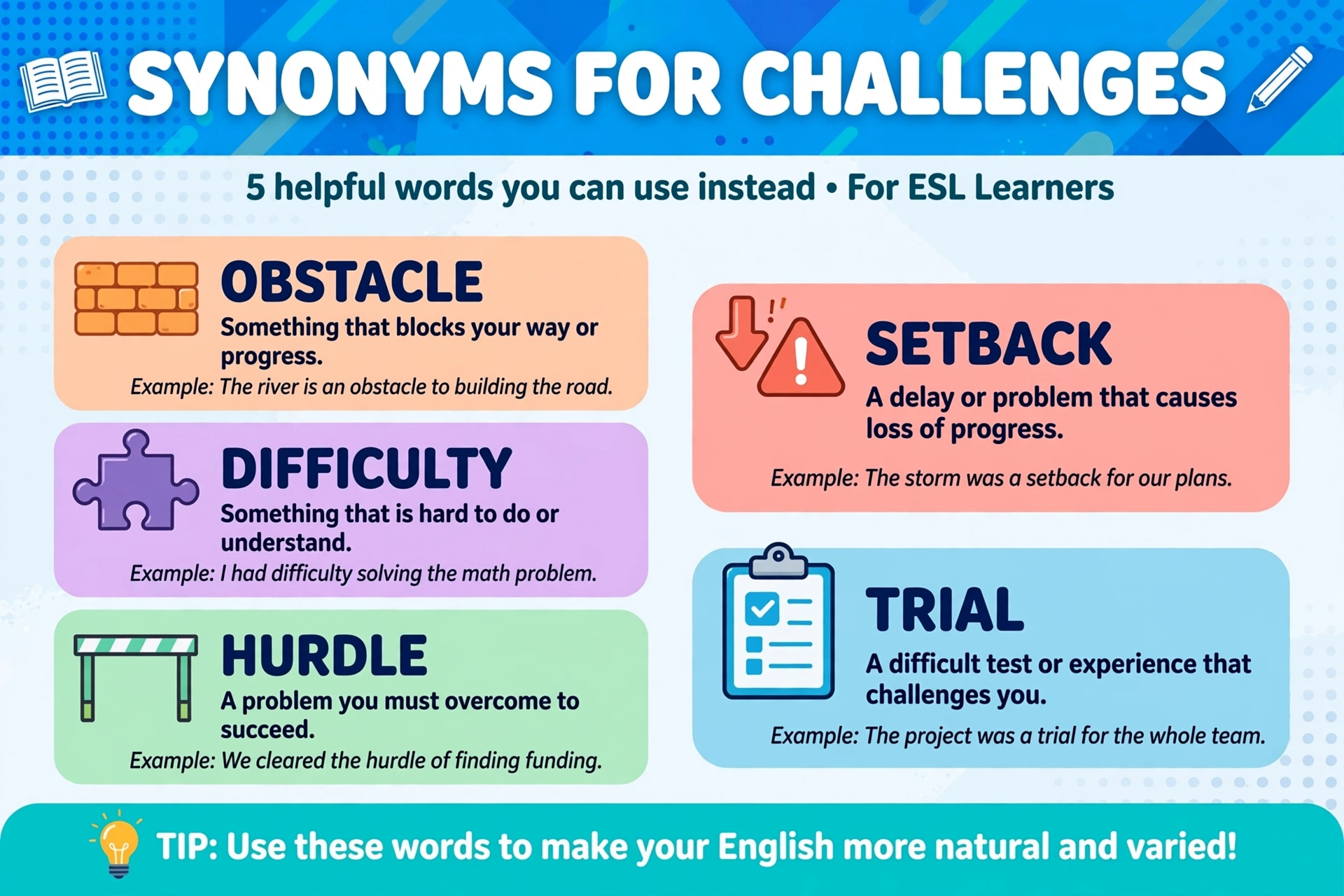
In this guide, you will learn five powerful synonyms for challenges, each with a clear meaning and natural example sentences.
Obstacles
Meaning: Something that blocks your path or stands in the way of progress.
Example: She overcame many obstacles to finish her degree on time.
Example: Lack of funding was the biggest obstacle facing the new project.
Example: Strict visa rules became an unexpected obstacle for students hoping to study abroad.
Hurdles
Meaning: Difficulties that you must get past in order to reach a goal, like jumping over barriers in a race.
Example: Starting a small business involves many hurdles, from funding to permits.
Example: He cleared every hurdle and earned the promotion he wanted.
Example: The final hurdle was the visa interview, and she passed it with confidence.
Difficulties
Meaning: General problems or hard situations that need effort to solve or manage.
Example: The team faced unexpected difficulties during the final week of the project.
Example: Moving to a new country brings difficulties, but also exciting opportunities.
Example: The young company faced serious financial difficulties in its first year but survived.
Barriers
Meaning: Things that prevent movement, communication, or progress, often put in place by rules or circumstances.
Example: Language barriers can make it hard for newcomers to find work.
Example: The company worked hard to remove barriers for employees with disabilities.
Example: High travel costs are a barrier that keeps many families from taking holidays.
Setbacks
Meaning: Events that slow you down or push your plans backward for a while.
Example: An injury caused a setback in his training, but he recovered quickly.
Example: Every career has setbacks; what matters is how you respond to them.
Example: A delayed shipment caused a brief setback, so the product launch moved to March.
Quick Comparison Table
| Synonym | Best Used For |
|---|---|
| Obstacles | Things blocking your progress |
| Hurdles | Goals that require extra effort |
| Difficulties | General problems and hard situations |
| Barriers | Restrictions, rules, or limits |
| Setbacks | Delays that push plans backward |
How to Use These Words
Choose your synonym based on the situation. Use obstacles when something blocks progress, hurdles when effort is needed to move forward, difficulties for general problems, barriers for restrictions or limits, and setbacks when progress is delayed. A quick test: if you can picture a wall in front of you, “obstacle” or “barrier” fits; if you picture a race, “hurdle” fits. Tough challenges can also shake a team’s spirit — if you want to describe that feeling precisely, learn the difference between moral vs morale. Matching the right word to the right moment makes your English sound natural and confident.
Also think about tone. In formal writing, such as essays or reports, obstacles, barriers, and setbacks sound strong and serious. Hurdles works well in business writing and speeches because it suggests effort that pays off — “we cleared the final hurdle” sounds like a victory. Difficulties is the safest, most neutral choice for everyday writing when you do not need extra color. In conversation, native speakers mix all five freely, so listening for them in podcasts and interviews is a great way to learn their natural rhythm.
Common Mistakes to Avoid
- Calling a permanent failure a “setback.” Setbacks are temporary — the word promises that progress will continue. If a project was cancelled forever, do not call it a setback; that misleads your reader.
- Using “barriers” for personal problems. Barriers usually come from systems, rules, or physical limits, not from feelings or habits. A fear of public speaking is an obstacle or a difficulty, not a barrier.
- Reaching for “difficulties” every time. It is the vaguest word on this list. When a sharper word fits — a wall-like obstacle, a race-like hurdle — choose it. Precision is what makes vocabulary impressive.
- Writing “hurdles” for things you cannot overcome. Hurdles imply you can jump over them. Do not use the word for dead ends or impossible situations; it clashes with the hopeful image the word carries.
Quick Practice
Choose the best word from the list: obstacles, hurdles, difficulties, barriers, setbacks.
- The new tax law created a major ___ for small shop owners.
- After his injury, the athlete’s comeback was slowed by several ___.
- She faced many ___ while writing her thesis, from research gaps to writer’s block.
- Passing the final interview was the last ___ before she got the job.
Answer key: 1. barrier 2. setbacks 3. obstacles (difficulties also works) 4. hurdle
Related Words Worth Learning
- Synonyms for Determination — the quality that helps you beat challenges
- Synonyms for Resilience — bouncing back after hard times
- Synonyms for Consequences — what follows your actions
FAQs
What is the best synonym for challenges in an essay?
It depends on context. “Obstacles” works for things blocking progress, “difficulties” for general problems, and “setbacks” for delays. Pick the word that matches your exact meaning rather than forcing one favorite.
Is “obstacles” stronger than “challenges”?
Slightly. “Obstacles” paints a clearer picture of something standing in your way, which makes writing more vivid than repeating “challenges.”
Can I use “hurdles” in formal writing?
Yes. “Hurdles” is widely accepted in business and academic writing, especially when describing steps that require effort to overcome.
What is the difference between barriers and obstacles?
They are close, but “barriers” often suggests restrictions or limits (like rules or walls), while “obstacles” suggests anything blocking progress, including people or events.
Can setbacks ever be positive?
In the long run, yes. A setback often teaches a lesson that prevents bigger problems later — a failed first business attempt, for example, can teach skills that make the second one succeed. The word itself stays neutral; it simply means progress paused, not progress ended.
Is “challenge” also a verb?
Yes. “To challenge someone” means to invite them to compete or to question what they said — “She challenged his opinion.” That verb meaning is completely different from the noun “challenges” discussed in this guide, so do not mix them up.
Conclusion
Challenges are a part of life, but repeating the same word does not have to be part of your writing. With obstacles, hurdles, difficulties, barriers, and setbacks in your vocabulary, you can describe hard situations with precision and style. Practice using one new synonym each day, and your English will grow stronger, clearer, and more expressive.

Thomas Allen is a language writer and editor who loves exploring the subtle differences between words. He creates clear, practical guides that help readers understand English better — one word pair at a time.