Nervous is a feeling everyone knows — the flutter in your stomach before an exam, the tightness in your chest before an interview, the restlessness of waiting for important news. The word means feeling worried, uneasy, or on edge. It is honest and relatable, which is why we reach for it so often.
But “nervous” is vague: it does not tell us whether the feeling is mild worry about tomorrow, physical tension right now, or deep fear of what might happen. English offers sharper words for each shade of this feeling. Learning them helps you describe emotions precisely, whether you are writing a story, talking about your day, or preparing for an exam. Here are five powerful synonyms for nervous, with clear meanings and examples.
Precision about feelings is useful far beyond exams. When you can name exactly what you feel, you can manage it better — “I am tense” suggests a walk or some stretching might help, while “I am worried about the results” suggests the real fix is preparation or information. Writers use this precision to make characters feel real, and speakers use it to ask for the right kind of help. The five words below are a small toolkit for emotional honesty.
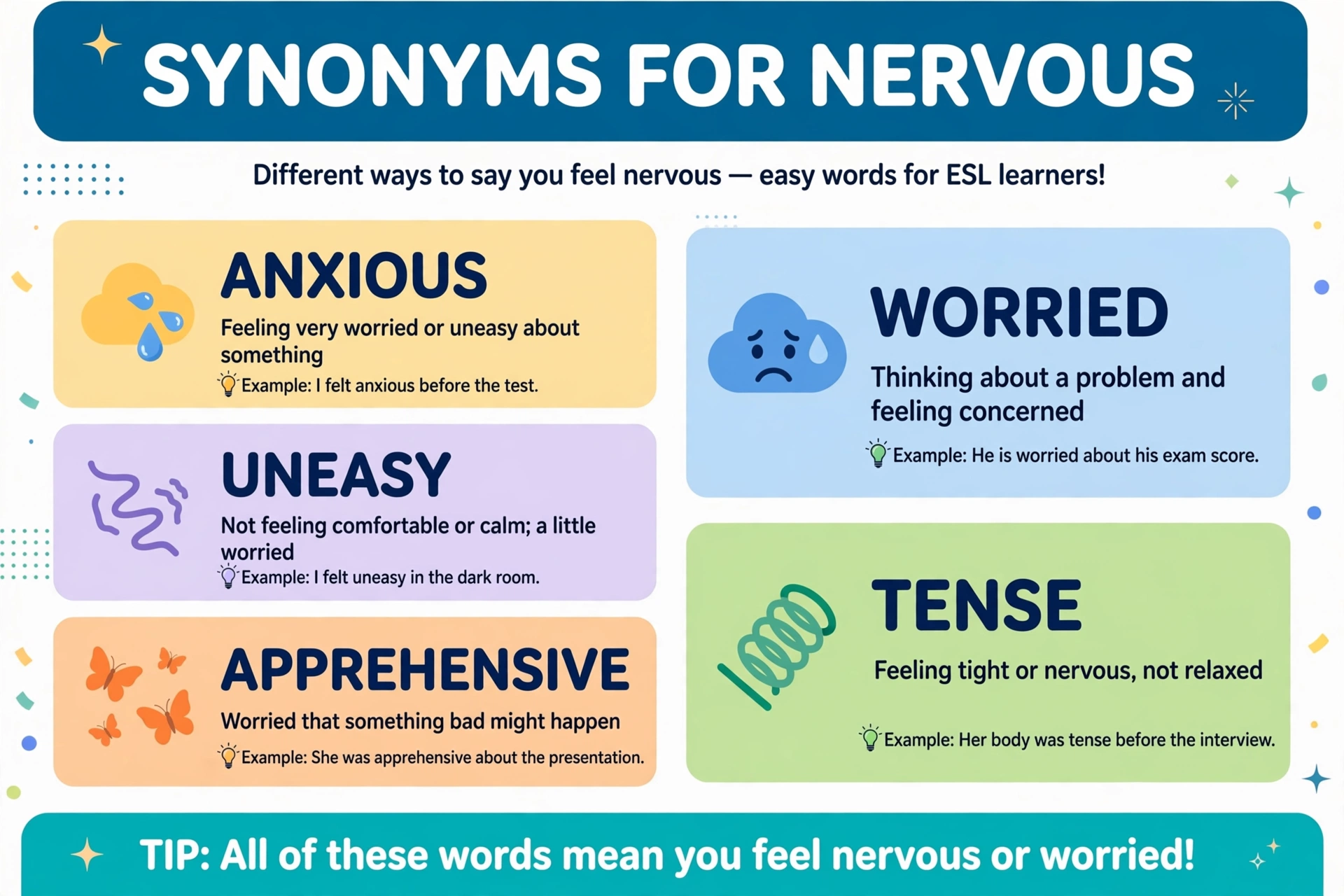
Anxious
Meaning: Feeling worried about something that might happen in the future; uneasy anticipation.
Example: She felt anxious the night before her driving test. Many students feel anxious when results are about to be announced. He grew anxious as the deadline moved closer.
Worried
Meaning: Thinking that something bad might happen and feeling troubled or bothered by the thought.
Example: His parents were worried when he came home late. She was worried about her mother’s health all week. They were worried the storm would cancel their flight.
Tense
Meaning: Feeling tight and stressed, in your body or your mind; stretched like a pulled rope.
Example: The room felt tense during the difficult negotiation. His shoulders were tense after the long argument. She gave a tense smile before answering the question.
Uneasy
Meaning: Feeling uncomfortable and not fully at peace with a situation; a vague sense that something is wrong.
Example: He felt uneasy walking through the empty street at night. There was an uneasy silence after the announcement. Something about the offer left her feeling uneasy.
Apprehensive
Meaning: Nervous about what the future might bring; expecting trouble or difficulty with dread.
Example: She was apprehensive about starting her new job. Investors grew apprehensive as the market fell. First-time parents are often apprehensive about the hospital visit.
How to Use These Words
Match the word to the intensity and type of feeling. Use “worried” and “anxious” for everyday concerns about upcoming events — an exam, a result, a phone call. “Anxious” leans slightly more formal and clinical than “worried.” Use “tense” when the stress shows up physically: tight shoulders, a stiff voice, a clenched jaw. “Uneasy” fits vague discomfort you cannot quite explain, the feeling that something is off. “Apprehensive” is the formal choice for essays and professional writing, suggesting dread of what lies ahead.
A good exercise: describe one stressful day from your life using all five words, one per moment, and notice how each changes the picture. Small word choices shape meaning everywhere — see how a single letter does it in our guide to trouper vs trooper.
Also pay attention to what follows each word. We are “worried about” something, “anxious about” or “anxious for” news, “tense during” an event, and “apprehensive about” the future. “Uneasy” often stands alone or pairs with “about.” These little partner words are part of the vocabulary — learning “apprehensive” without “about” is like learning half a word.
Common Mistakes to Avoid
- Using “anxious” only for bad feelings. In formal writing, “anxious” can also mean eagerly wanting something: “I am anxious to meet her.” In everyday speech it almost always means worried, so know your audience before using the eager sense.
- Saying “nervous breakdown” casually. The phrase describes a serious mental health crisis. Using it for ordinary stress (“this traffic gives me a nervous breakdown”) minimizes real suffering — “this traffic is stressing me out” is kinder and more accurate.
- Confusing “tense” the feeling with “tense” the grammar. English learners meet “tense” first as past, present, and future. The emotion word is spelled the same but means something entirely different — context always tells you which one is meant.
- Overusing “worried” in formal writing. “Worried” is warm and conversational, which makes it perfect for messages to friends but slightly weak in essays and reports. “Concerned” or “apprehensive” usually fit formal contexts better.
Quick Practice
Choose the best word from this article: anxious, worried, tense, uneasy, apprehensive.
- The ______ atmosphere in the courtroom made everyone whisper.
- She was ______ about her son’s first day at the new school.
- He felt ______ signing the contract without reading it twice.
- Investors are ______ that prices will fall next quarter.
Answer key: 1. tense 2. worried (anxious also fits) 3. uneasy 4. apprehensive
Now describe how you felt before your last exam or interview using three of these words, one for the night before, one for the morning, and one for the moment itself.
Related Words Worth Learning
- 5 Powerful Synonyms for Vulnerable (With Meanings & Examples)
- 5 Powerful Synonyms for Confidence (With Meanings & Examples)
- 5 Powerful Synonyms for Flexible (With Meanings & Examples)
FAQs
What is the difference between nervous and anxious?
They overlap heavily, but “anxious” usually points to worry about a future event, while “nervous” often describes the physical feeling in the moment — shaky hands, a racing heart, a dry mouth. You can be anxious for weeks about an exam but nervous only on the morning of it.
What is a formal synonym for nervous?
“Apprehensive” is the best formal choice. It works well in essays, reports, and professional emails. “Anxious” is also widely accepted in formal writing, especially in psychology and medicine.
What word is stronger than nervous?
“Petrified” and “panic-stricken” describe extreme, almost paralyzing fear — far stronger than everyday nervousness. “Distraught” suggests deep emotional upset, and “terrified” sits between nervous and petrified.
What is the opposite of nervous?
The most common opposites are “calm,” “relaxed,” and “confident.” For example, “She felt calm before the presentation” is the direct reverse of feeling nervous, and “a relaxed atmosphere” is the opposite of a tense one.
Can nervousness ever be helpful?
Yes. Mild nervousness sharpens focus and reaction time — athletes and performers often say a little nerves help them do their best. Problems start only when the feeling is so strong that it blocks clear thinking.
How can I calm my nerves before a big event?
Preparation is the best cure: rehearse, arrive early, and breathe slowly. Reframing helps too — telling yourself “I am excited” instead of “I am nervous” can genuinely change how the feeling affects your performance.
Conclusion
Nervous covers a wide emotional range, but anxious, worried, tense, uneasy, and apprehensive each paint a clearer picture. The next time you feel those butterflies, try naming the exact feeling — you will find the right word makes the emotion easier to understand, describe, and manage.

Thomas Allen is a language writer and editor who loves exploring the subtle differences between words. He creates clear, practical guides that help readers understand English better — one word pair at a time.