Normal means usual, common, or not special — a normal day, a normal routine, a normal result. It is one of the plainest words in English, and that is exactly the problem: using it everywhere makes your writing sound dull and colorless. When every paragraph contains “normal,” readers stop paying attention.
The good news is that several precise alternatives exist, each describing a slightly different kind of “usual.” One suggests a schedule, another a habit, another a pattern. Whether you are writing an essay, a report, or a simple message, the right synonym makes your meaning clearer and your style fresher. Here are five useful synonyms for normal, with meanings and examples you can start using today.
There is a quieter benefit too: precise “usual” words make you sound observant. Anyone can call a day normal, but noticing that it was “typical” shows you have seen many such days and know the pattern. A doctor who says your results are “within the normal range” is reassuring; a doctor who says they are “typical for your age group” sounds like she has compared you against real data. Small words, big difference in how competent you sound.
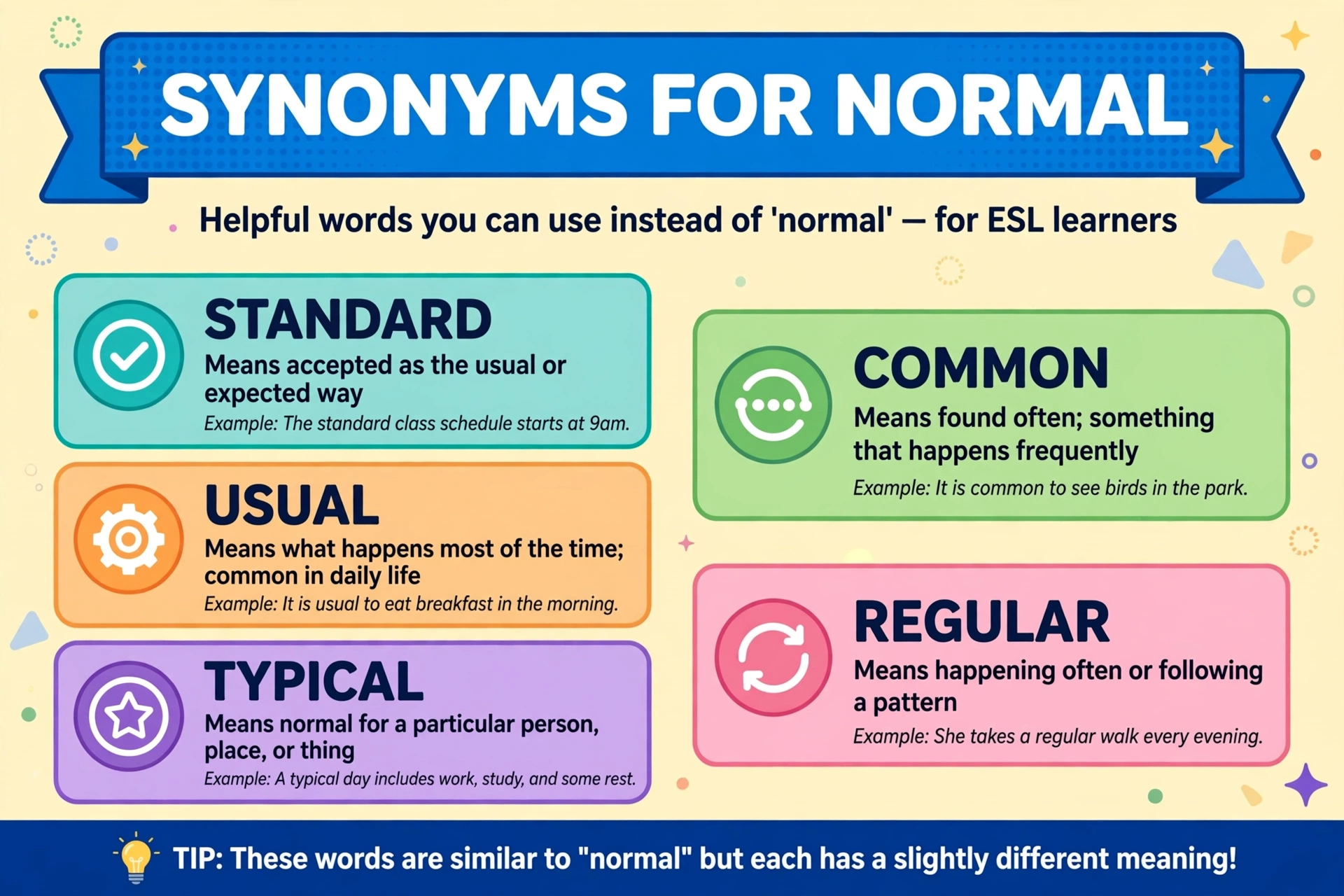
Regular
Meaning: Happening again and again, usually on a fixed schedule or pattern.
Example: He goes for a regular morning walk before work. The company holds regular training sessions every month. The dentist advised regular checkups twice a year.
Usual
Meaning: What happens or is done most of the time; the habitual or expected thing.
Example: She arrived at her usual time, just before nine. I will have the usual, please — coffee with milk. The usual crowd gathered at the cafe on Sunday.
Common
Meaning: Found in many places, or shared by many people; widespread rather than rare.
Example: This spelling mistake is very common among beginners. Colds are common during the winter months. Sparrows are a common sight in city parks.
Typical
Meaning: Showing the usual pattern or character of a particular type; a good representative example.
Example: It was a typical rainy afternoon in the city. A typical exam has fifty multiple-choice questions. Their wedding was a typical village celebration.
Ordinary
Meaning: Not special, different, or exciting; plain and unremarkable.
Example: It was just an ordinary Tuesday with nothing unusual. They live in an ordinary apartment on a quiet street. He turned out to be an ordinary man with an extraordinary hobby.
How to Use These Words
Each word answers a different question about “usual.” Use “regular” for things on a schedule — regular checkups, regular buses, regular exercise. Use “usual” for personal habits and routines — your usual seat, your usual order. Use “common” when many people share something, from common colds to common mistakes. “Typical” is perfect when something represents its type well: a typical exam question, a typical winter’s day. Save “ordinary” for things that are simply unremarkable, neither good nor bad.
Try this exercise: describe your daily routine and replace every “normal” with a sharper word. “My regular bus, my usual breakfast, a typical workday” — watch the paragraph come alive. Getting small distinctions right is a core English skill, and our guide to allways vs always shows how even one letter decides correctness.
Think about scope as well. “Usual” is personal — it describes your habits or your group’s habits. “Common” is social — it needs many people. “Typical” is categorical — it compares something against its type. “Regular” is temporal — it needs repetition over time. Asking “usual for whom? common among whom? typical of what?” will almost always point you to the right word.
Common Mistakes to Avoid
- Saying “normally” when you mean “usually.” They overlap, but “normally” suggests following a rule or standard (“the train normally leaves at six”), while “usually” is just about habit. In casual writing the difference is small, but in formal writing it matters.
- Calling people “ordinary” to their face. “Ordinary” can sting — it hints that someone is unremarkable. If you mean no harm, “typical” or “regular” gets the same meaning across without the dull edge.
- Using “common” for one person’s habits. “Common” needs many people or many cases. “It is common for him to wake early” is slightly off; “it is usual for him” or “he usually wakes early” is the natural choice.
- Writing “very normal.” “Normal” already sits in the middle of a scale, so “very normal” sounds strange — like saying “very average.” If you want emphasis, say “perfectly normal” or “completely typical” instead.
Quick Practice
Choose the best word from this article: regular, usual, common, typical, ordinary.
- Power cuts are ______ in this neighborhood during summer.
- She ordered her ______ breakfast: toast and orange juice.
- He was just an ______ employee who suddenly became a hero.
- A ______ day at the office starts with a team meeting.
Answer key: 1. common 2. usual 3. ordinary 4. typical (regular also fits)
Now write three sentences about your own week, using “regular,” “usual,” and “typical” — one word per sentence. Check that each word answers its own question: schedule, habit, or type.
Related Words Worth Learning
- 5 Powerful Synonyms for Obvious (With Meanings & Examples)
- 5 Powerful Synonyms for Place (With Meanings & Examples)
- 5 Powerful Synonyms for Plan (With Meanings & Examples)
FAQs
What is the best synonym for normal in an essay?
“Typical” and “standard” work best in essays because they sound neutral and precise. “Conventional” is another strong formal option, especially when discussing accepted methods or behaviors.
What is the difference between normal and common?
“Normal” describes what is usual for a particular situation or person, while “common” means widespread among many people or things. Something can be normal for you — your normal bedtime — but uncommon in general.
Is “ordinary” a negative word?
Not always, but it can sound slightly dull or dismissive depending on tone. “It was an ordinary meal” faintly suggests disappointment, while “a regular meal” is neutral. In praise, avoid “ordinary” entirely.
What is the opposite of normal?
Common opposites include “unusual,” “abnormal,” “extraordinary,” and “exceptional.” Use “unusual” for rare things, “abnormal” for what deviates from a standard (often medical), and “extraordinary” for what is remarkably good.
When should I use “regular” instead of “normal”?
Use “regular” when repetition or a schedule is the point: regular exercise, regular meetings, regular customers. If the sentence is about a timetable or routine, “regular” is almost always sharper than “normal.”
Is it polite to call someone’s life “ordinary”?
Usually not. Even when you mean no harm, “ordinary” can sound like a judgment that the person is unremarkable. “Typical,” “regular,” or simply describing their routine avoids the risk entirely.
Conclusion
Normal is a serviceable word, but regular, usual, common, typical, and ordinary each say something more exact. Once you start choosing between them, your descriptions become sharper and your writing more interesting — proof that even the plainest words deserve precise alternatives.

Thomas Allen is a language writer and editor who loves exploring the subtle differences between words. He creates clear, practical guides that help readers understand English better — one word pair at a time.