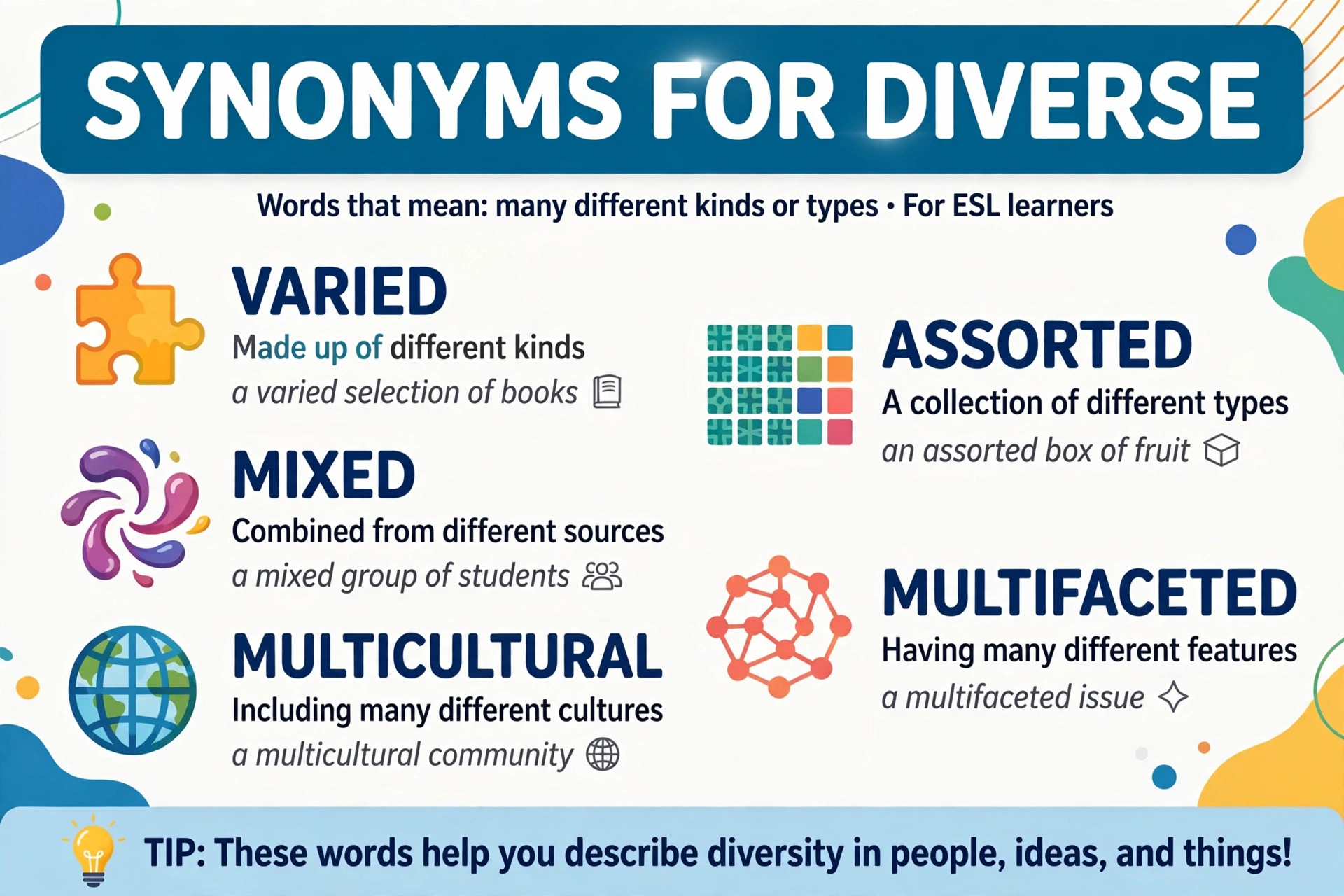
“Diverse” describes variety — of people, ideas, cultures, or things. It is a positive, modern word, but because it appears in almost every company statement and school brochure, it has started to feel automatic.
Fresh synonyms bring the variety back to life by naming what kind of difference you mean: many types, many cultures, or many styles. Here are five vivid alternatives with clear meanings and practical examples.
Modern life is wonderfully varied — our cities, our playlists, our workplaces. Describing that variety well matters, especially in professional and academic writing where ‘diverse’ appears so often it risks becoming invisible.
The good news is that English offers a whole palette of variety words, from the everyday (“different,” “mixed”) to the formal (“heterogeneous”). Learning to rotate through them is a simple habit that makes essays, reports, and presentations sound noticeably more polished — because readers unconsciously equate varied vocabulary with careful thinking.
Varied
Meaning: Including many different types; not all the same.
Example: She enjoys a varied diet with food from many countries.
Example: His varied career has included teaching, journalism, and photography.
Various
Meaning: Many different kinds of things or people.
Example: The museum displays various artifacts from ancient times.
Example: Various studies have linked daily walking to better sleep.
Mixed
Meaning: Made up of different types combined together.
Example: Our team is a mixed group of designers and engineers.
Example: The audience gave the new film a mixed reaction — some loved it, some did not.
Different
Meaning: Not the same; showing variety or contrast.
Example: The festival featured music from many different cultures.
Example: They took different routes to the stadium and arrived at the same time.
Broad
Meaning: Wide in range, covering many areas or types.
Example: He has broad knowledge of history and science.
Example: The new policy received broad support from all political parties.
At a Glance
| Word | Use it when… |
|---|---|
| Varied | Many different types; the closest everyday match |
| Various | Many kinds; neutral and flexible |
| Mixed | Different types blended together |
| Different | Simple contrast or variety |
| Broad | Wide range or broad coverage |
How to Use These Words
Pick the shade of variety you need. Varied and various are the closest everyday matches for “diverse.” Use mixed when types are blended together, different for simple contrast, and broad when emphasizing wide coverage. For culture-specific variety, words like “multicultural” or “eclectic” are even more precise — save those for when the context truly calls for them.
A useful test is asking “variety of what?” If the answer is types or kinds, “varied” and “various” are your safest bets. If the answer is a blend or mixture, choose “mixed.” If you mean wide coverage or range, “broad” is the word. And when you simply mean “not the same,” plain “different” does the job honestly — simple words are not weak words.
Common Mistakes to Avoid
- “Diversed” is not a word: Learners sometimes write “a diversed group” by analogy with “varied.” The adjective is “diverse,” the noun is “diversity,” and the verb is “diversify” — there is no “diversed.” This is one of the most common errors with this word family.
- “Various” + singular noun: “Various” always takes a plural: “various reasons,” “various people.” Writing “various reason” is a frequent mistake — if you need the singular, use “a different” or “another” instead.
- “Different” without “from”: In standard English, things are “different from” each other (“different from mine”). “Different than” appears in American speech but is frowned upon in formal writing; “different to” is a British variant. Safest choice everywhere: “different from.”
- Overusing “diverse” in formal statements: Company reports that say “diverse” in every paragraph sound like templates, not thinking. Rotating in “varied,” “broad,” and “multifaceted” makes the same point with more credibility.
Quick Practice
Choose the best word for each sentence: varied, various, mixed, different, broad.
- The conference attracted a _____ crowd, with visitors from over forty countries.
- _____ experts were invited to share their views on the new law.
- The committee reached a _____ consensus after weeks of debate.
- She ordered a _____ salad with vegetables, cheese, and nuts.
Answer key: 1. varied — many different types of people. 2. Various — many different kinds, plural noun. 3. broad — wide agreement. 4. mixed — different types blended together.
Related Words Worth Learning
- Synonyms for Flexible — diverse groups tend to be flexible thinkers.
- Synonyms for Fascinating — diverse experiences make life fascinating.
- Synonyms for Deep — diverse reading builds deep understanding.
FAQs
What is the closest synonym for “diverse”?
“Varied” is the closest everyday synonym — both mean including many different types. “Various” is nearly as close and works in most of the same sentences. When in doubt, ‘varied’ is the safest swap — it fits almost every sentence where ‘diverse’ appears.
What is the difference between “diverse” and “various”?
“Diverse” emphasizes meaningful differences within a group, often of people or cultures. “Various” simply means many different kinds, with less emphasis on the significance of the differences. A ‘diverse team’ celebrates meaningful differences; ‘various tasks’ are simply many different jobs.
Is “diverse” only used for people?
No. While “diverse” often describes groups of people, it also works for ideas, investments, diets, ecosystems, and anything else that comes in many types. Scientists describe diverse ecosystems, chefs create diverse menus, and investors hold diverse portfolios.
What is a formal alternative to “diverse”?
“Heterogeneous” is the formal, technical term, common in academic and scientific writing. “Multifaceted” also works when describing something with many different aspects. Use it in research papers when you need a technical tone, but prefer ‘diverse’ or ‘varied’ for general readers.
What is the noun form of “diverse”?
“Diversity” — as in “The city celebrates its cultural diversity.” It is a hugely important word in modern English, appearing in education, business, and public policy. Its verb is “diversify”: “The company diversified its products to reduce risk.” Learn the trio together: diverse (adjective), diversity (noun), diversify (verb).
Is “diverse” positive or neutral?
Mostly positive in modern use — it suggests richness, inclusion, and variety as strengths. That is why companies and universities use it proudly. But it can be neutral in scientific contexts (“a diverse sample”), where it simply means “containing many types.” The positive glow comes from social context, not from the dictionary definition itself.
Conclusion
Variety is worth describing with variety. Varied for everyday use, various for many kinds, mixed for blends, different for contrast, and broad for wide range — five words that keep “diverse” fresh instead of formulaic. Choose the one that fits your context, and your descriptions will feel as rich as the variety you are describing.
Variety deserves varied language. Rotate these five through your writing, and your descriptions of our wonderfully mixed world will stay fresh.

James Reed is a writer and English language enthusiast with a passion for making vocabulary simple and fun. He writes about words, meanings, and everyday English to help learners speak and write with confidence.