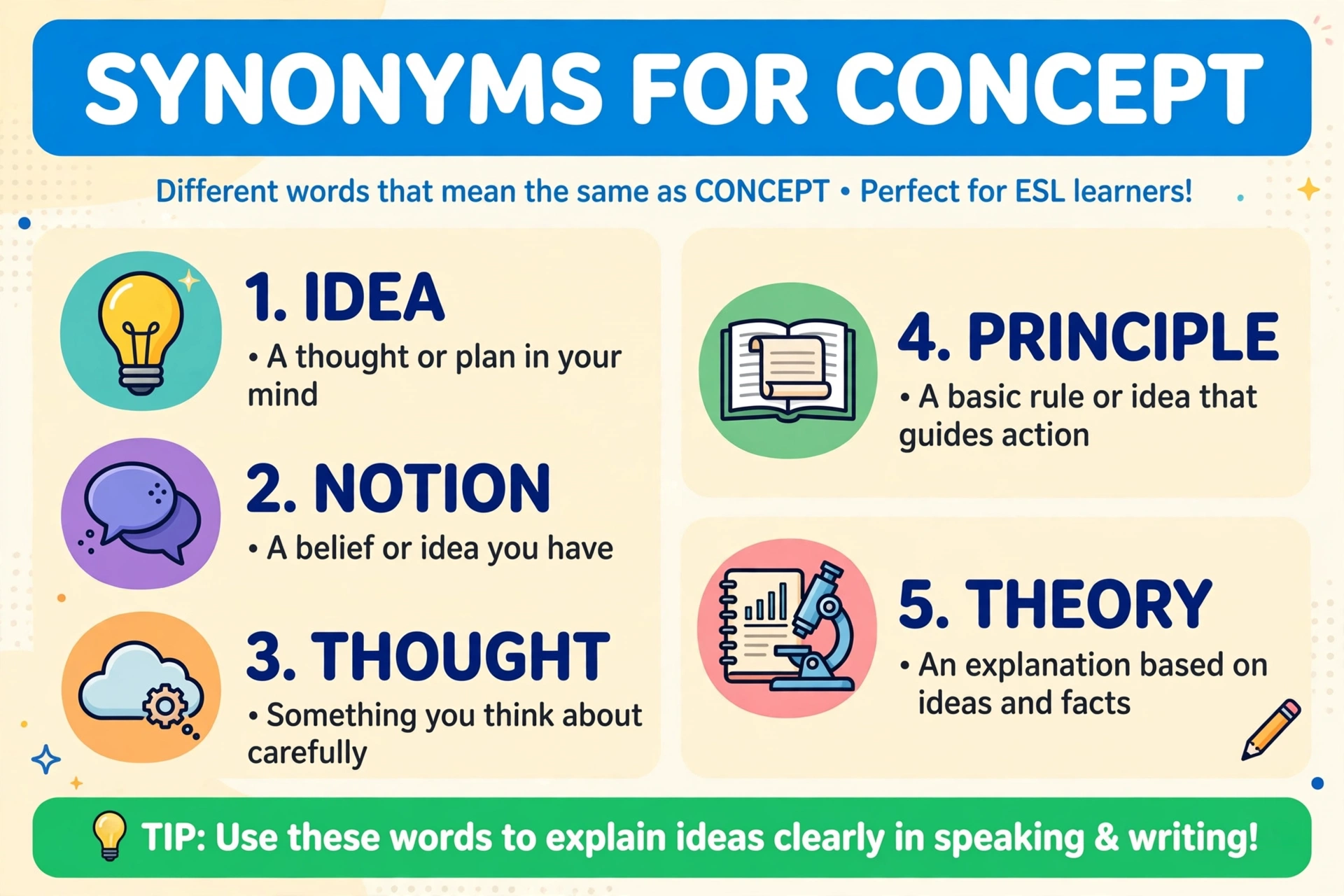
A concept is an idea or a general understanding of something — how things work, what something means, or a plan in someone’s mind. Students meet concepts in every subject, and professionals discuss them in every meeting. Because the word is so common in academic English, repeating it makes essays sound monotonous.
Open any textbook and count how many times “concept” appears on a single page — you might be surprised. Skilled academic writers break the repetition with “idea,” “notion,” and “theory,” choosing each for its exact shade. The result reads smoothly instead of sounding like a broken record.
Useful synonyms for concept add variety and nuance. An “idea” is casual, a “notion” is a personal belief, a “theory” explains how something works, and a “conception” is a deeper mental picture. Knowing which to use makes your writing sound thoughtful and precise.
These words also shape how readers judge your thinking. A student who writes “my notion of freedom” sounds personal and reflective, while “my theory of freedom” sounds like a bold academic claim — and the examiner will hold you to it. In business, “we have an idea for the new product” invites casual brainstorming, but “we have a conception of the new product” suggests a fully formed vision. The word you pick frames the idea before you even explain it, so choosing well is half the work of sounding smart.
In this guide, you will learn five powerful synonyms for concept, each with a clear meaning and natural example sentences.
Idea
Meaning: A thought or suggestion about something, often simple and everyday.
Example: She had a great idea for the school science project.
Example: His idea of a perfect weekend is camping by a lake.
Example: The startup began as a simple idea scribbled on a napkin.
Notion
Meaning: A personal belief or vague understanding about something.
Example: He had the notion that hard work always brings success.
Example: She dismissed the notion that money alone brings happiness.
Example: He clung to the outdated notion that the internet was just a passing trend.
Thought
Meaning: Something formed in the mind; an act of thinking or a resulting idea.
Example: The thought of moving abroad excited and scared her at the same time.
Example: On second thought, he decided to take the earlier train.
Example: The thought of speaking in front of hundreds of people made him nervous.
Theory
Meaning: An idea or set of ideas that explains how something works, often tested or studied.
Example: The teacher explained the theory of gravity with a simple experiment.
Example: Scientists developed a new theory about how the disease spreads.
Example: Her theory about the missing keys turned out to be completely wrong.
Conception
Meaning: The way someone understands or pictures something in their mind; a mental image of an idea.
Example: His conception of success changed after years of experience.
Example: The architect’s original conception was bolder than the final building.
Example: The novel presents a dark conception of the future.
Quick Comparison Table
| Synonym | Best Used For |
|---|---|
| Idea | Everyday thoughts and suggestions |
| Notion | Personal, sometimes vague beliefs |
| Thought | Mental reflections |
| Theory | Explanations of how things work |
| Conception | Deep mental pictures of ideas |
How to Use These Words
Choose by depth and formality. Use idea for everyday thoughts, notion for personal beliefs, thought for mental reflections, theory for explanations of how things work, and conception for deeper mental pictures. One caution: in science, “theory” means a well-tested explanation, not a casual guess — using it loosely can confuse readers. Some concepts sound alike but mean very different things — moral vs morale is a perfect example. Naming ideas precisely is the heart of clear thinking.
Notice also how these words combine with verbs. We “have” an idea, “hold” a notion, “give thought to” something, “develop” a theory, and “form” a conception. These natural pairings — called collocations — are worth learning because they make your English sound native. Saying “I did a notion” or “I made a theory” sounds wrong to native ears even though the grammar looks fine. When you learn a new word, always learn one or two verbs that go with it.
Common Mistakes to Avoid
- Calling a guess a “theory” in academic writing. In essays and exams, “theory” means a tested explanation. For an untested hunch, write “hypothesis” or “idea” — examiners will mark you down for the wrong label.
- Using “notion” for concrete plans. A notion is vague by nature. “My notion is to open a shop in March” sounds confused; a concrete plan deserves the word “idea” or “plan.”
- Overusing “thought” as a filler. Phrases like “just a thought” or “food for thought” are fine, but writing “my thoughts on this thought” turns an essay into mush. Vary your nouns.
- Writing “conception” when you mean “concept.” They overlap, but conception is the mental picture, not the idea itself. “The conception of the project” means how it was imagined, not the project idea.
Quick Practice
Choose the best word from the list: idea, notion, thought, theory, conception.
- The scientist’s ___ about black holes changed modern physics.
- She had a brilliant ___ for recycling old clothes into bags.
- He rejected the ___ that success requires giving up your values.
- The director’s original ___ of the film was very different from the final cut.
Answer key: 1. theory 2. idea 3. notion 4. conception
Related Words Worth Learning
- Synonyms for Importance — the concepts that matter most
- Synonyms for Intelligent — describing sharp thinkers
- Synonyms for Communication — sharing your ideas well
FAQs
Is “idea” too simple for academic writing?
Not always. “Idea” is fine in most contexts, but “concept,” “notion,” or “theory” sound more academic when discussing serious topics.
What is the difference between a notion and an idea?
A “notion” is usually vaguer and more personal — a feeling or belief. An “idea” can be concrete, like a plan or suggestion.
Can “theory” be used casually?
Yes. In casual speech, “theory” often just means a guess (“My theory is he forgot”). In science, it means a well-tested explanation.
Is “conception” common in daily speech?
Not very. It is more formal and literary, best for essays and serious writing.
What is the difference between thought and thinking?
“Thought” is a single mental item — one idea in your head. “Thinking” is the ongoing process — the act of using your mind over time. “I had a thought” is one flash; “I was thinking” is a longer activity.
Can “notion” be positive?
Yes. A notion is simply a personal belief — it can be wise or foolish. “He had the pleasant notion that the whole town would join the festival” is warm and positive.
Conclusion
Ideas deserve better than repetition. Idea, notion, thought, theory, and conception give you five ways to express what lives in the mind. Use them well, and your writing will sound more thoughtful, varied, and mature.

James Reed is a writer and English language enthusiast with a passion for making vocabulary simple and fun. He writes about words, meanings, and everyday English to help learners speak and write with confidence.