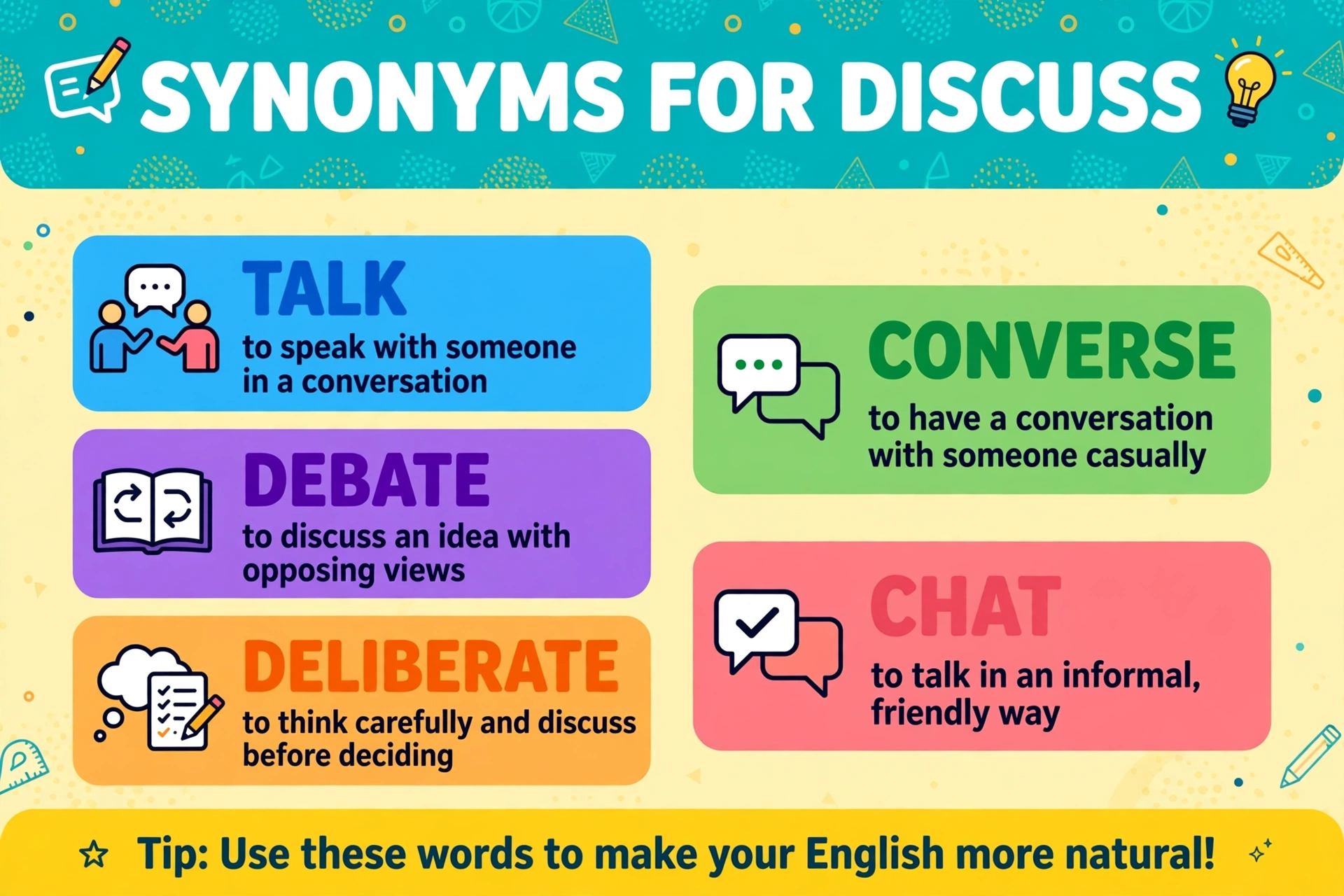
“Discuss” is a workhorse verb — meetings, essays, and classrooms all run on it. But not every discussion is the same: a friendly chat, a heated argument, and a careful analysis need different words.
The best synonym tells your reader what kind of talking is happening. Are people exchanging opinions, studying evidence, or negotiating a deal? Here are five precise alternatives with clear meanings and practical examples.
Strong communication starts with the right verb. Boardrooms, classrooms, and group chats all run on discussion, but each setting has its own rhythm. These five verbs help you match your words to the moment.
This matters because “discuss” is one of the most overused verbs in student essays — examiners see it in almost every introduction. Swapping in “explore,” “examine,” or “debate” instantly signals stronger analytical thinking. A verb that names the exact kind of talking also saves you from adding extra explanation, which keeps your sentences tight and confident.
Debate
Meaning: To discuss a topic by presenting opposing opinions or arguments.
Example: The students debated whether school uniforms should be required.
Example: The two candidates debated the economy for nearly two hours on live television.
Explore
Meaning: To discuss and examine a topic in order to understand its different sides.
Example: This chapter explores the causes of climate change.
Example: The documentary explores the lives of fishermen in three different countries.
Examine
Meaning: To look at a subject closely and discuss its details carefully.
Example: The report examines the effects of remote work on productivity.
Example: The study examines how social media affects teenage sleep patterns.
Address
Meaning: To talk about an issue directly, often with the aim of dealing with it.
Example: The manager addressed the team’s concerns in Friday’s meeting.
Example: The principal addressed the parents about the new school safety rules.
Consider
Meaning: To think about and talk through something carefully before deciding.
Example: We should consider all options before signing the contract.
Example: The committee will consider your proposal at next month’s meeting.
At a Glance
| Word | Use it when… |
|---|---|
| Debate | Presenting opposing opinions or arguments |
| Explore | Discovering the different sides of a topic |
| Examine | Analyzing details closely and carefully |
| Address | Dealing with an issue directly |
| Consider | Weighing options before deciding |
How to Use These Words
Match the verb to the purpose. Use debate when opinions clash, explore when discovering ideas, examine when analyzing details, address when confronting an issue, and consider when weighing a decision. A closely related word worth spelling right: “converse” means to talk with someone, but many writers mistakenly write “conversate” — see conversing or conversating for the correct form.
Notice the sentence patterns each verb loves. You debate a question or an issue; a book or essay explores a topic; a report examines effects, causes, or data; you address a concern, a problem, or an audience; and you consider options, proposals, or possibilities. Each verb has its favorite partners — learn them as pairs and your academic English will sound instantly more fluent.
Common Mistakes to Avoid
- “Discuss about” — the classic error: In standard English, “discuss” takes a direct object: “We discussed the plan.” Saying “we discussed about the plan” is one of the most common mistakes worldwide. (The same rule does not apply to “debate” — “they debated about taxes” is also wrong; say “they debated taxes.”)
- “Explore” for people: You explore ideas, places, and topics — not usually people. “We explored the possibilities” is correct; “we explored the manager” sounds like a medical procedure. For people, use “interviewed” or “consulted.”
- “Address” confused with a location: “Address” the verb (to speak to an issue) and “address” the noun (where you live) are spelled the same. In “She addressed the envelope,” it means she wrote on it — a third meaning. Context always tells you which one is meant, but learners should be aware of the triple life of this word.
- “Consider” without a follow-up: “Consider” needs an object or a clause — “consider the offer,” “consider leaving.” The bare “Please consider” feels unfinished in writing; always name what should be considered.
Quick Practice
Choose the best word for each sentence: debate, explore, examine, address, consider.
- The panel will _____ the advantages and disadvantages of online learning.
- In her speech, the mayor _____ the city’s growing traffic problem.
- This essay _____ the reasons behind the rise of remote work.
- Before buying a car, you should _____ fuel costs and insurance.
Answer key: 1. debate — presenting opposing views. 2. addressed — dealing with an issue directly. 3. explores — discovering the sides of a topic. 4. consider — weighing options before deciding.
Related Words Worth Learning
- Synonyms for Deep — the best discussions go deep into a topic.
- Synonyms for Intelligent — intelligent discussion needs intelligent vocabulary.
- Synonyms for Fascinating — fascinating topics deserve rich discussion.
FAQs
What is the most formal synonym for “discuss”?
“Deliberate” and “confer” are the most formal, often used in legal and official settings. Among common choices, “examine” and “address” sound professional and work well in academic writing. In a university essay, either one instantly raises the register of your writing.
What is the difference between “debate” and “discuss”?
“Discuss” is neutral — people simply talk about a topic. “Debate” specifically means presenting opposing views or arguments, so it implies disagreement or competition. A friendly ‘discussion’ can turn into a ‘debate’ the moment two strong opinions collide.
Can “explore” replace “discuss” in an essay?
Yes, and it often improves the sentence. “This essay discusses pollution” is flat; “This essay explores the causes of pollution” sounds more curious and analytical. Examiners reward this kind of precise verb choice because it shows analytical thinking.
Is “address” too formal for everyday use?
Not at all. “Address” works in both formal and everyday English: “Let me address your question” is natural in meetings, emails, and customer service. It is a favorite in business English because it sounds decisive without sounding aggressive.
What is the noun form of “debate”?
“Debate” is both a verb and a noun: “They debated the issue” / “The debate lasted two hours.” This double life is convenient — you can move between “to debate” and “a debate” without changing the word. The same is true of “address” (verb and noun), though the noun means something completely different: your home address.
Is there a stronger word than “discuss” for arguments?
“Debate” is stronger when opinions clash, and “argue” is stronger still — but “argue” suggests real conflict, even anger. The scale runs: discuss (neutral) → debate (opposing views) → argue (heated conflict). Choose the level that honestly matches the situation; exaggerating a friendly chat into an “argument” misleads your reader.
Conclusion
Talking about things is easy; talking about them precisely is a skill. Debate for opposing views, explore for discovery, examine for analysis, address for directness, and consider for careful thought — five verbs that turn every “discussion” into exactly the conversation you mean. Choose with care, and your English will always say what you intend.
Every conversation has a shape. Name it correctly with these five verbs, and your meetings, essays, and messages will all communicate with purpose.

James Reed is a writer and English language enthusiast with a passion for making vocabulary simple and fun. He writes about words, meanings, and everyday English to help learners speak and write with confidence.