To allow means to give permission for something to happen, or to make it possible. Parents allow children to stay up late, managers allow flexible hours, and good tools allow people to work faster. It is a small word that appears everywhere — in rules, requests, and everyday conversation.
The word “allow” sits quietly at the center of rules, requests, and technology. Constitutions allow rights, apps allow features, and teachers allow retakes. Because it is everywhere, it becomes invisible — and invisible words make dull writing. The five alternatives below restore precision: two for official permission, one for everyday speech, one for formal approval, and one that means making something possible rather than merely permitted.
Because it is so common, “allow” quickly becomes repetitive. The right synonym also adds precision: some alternatives sound official, others casual, and others describe making something possible rather than merely permitting it. The five below cover the full range. Note that “allow” pairs with specific prepositions (allow for, allow of is rare), so if prepositions trip you up, our guide to of or for is worth a look.
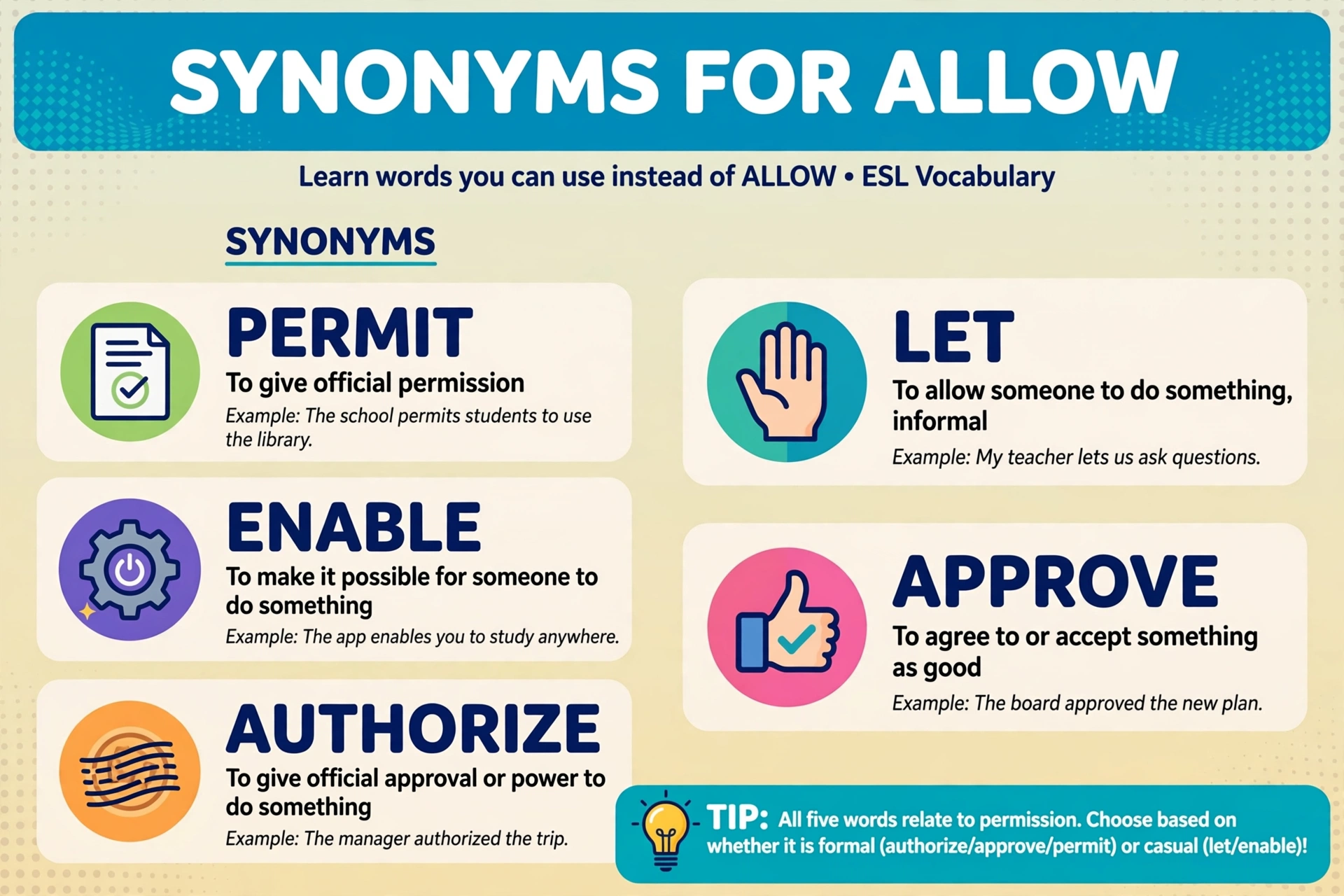
Permit
Meaning: To officially or formally give someone permission to do something.
Example: The park does not permit visitors to feed the animals.
Example 2: The license permits the restaurant to serve food outdoors.
Let
Meaning: To give permission in a casual, everyday way; the most natural choice in conversation.
Example: My parents let me choose my own bedroom color.
Example 2: Let me know if you need anything before Friday.
Authorize
Meaning: To give official approval, usually by someone with authority, for an action to take place.
Example: Only the manager can authorize refunds above fifty dollars.
Example 2: The bank authorized the large transfer after verifying his identity.
Approve
Meaning: To agree formally that something is acceptable or may go ahead.
Example: The committee approved our proposal after a short discussion.
Example 2: Her parents finally approved the trip with her friends.
Enable
Meaning: To make something possible by providing the means, tools, or conditions for it.
Example: The new ramp enables wheelchair users to enter the building easily.
Example 2: Good lighting enables students to read comfortably.
Allow at a Glance
A quick comparison to lock in the differences:
| Word | Tone | Use it when… |
|---|---|---|
| Permit | Formal | stating rules, signs, or official policy |
| Let | Casual | giving permission in everyday conversation |
| Authorize | Formal | someone with authority grants official approval |
| Approve | Formal | a decision-maker agrees a plan may go ahead |
| Enable | Neutral | describing making something possible, not just permitted |
How to Use These Words
Think in terms of formality and meaning. Let fits friends and family; permit and authorize suit rules, signs, and workplaces; approve works when a decision-maker says yes to a plan. Enable is different from all of them — it is about making possible, not just saying yes. “The software enables editing” means the software provides the ability, not merely the permission. Mixing these up is common, and the same careful attention helps with near-twins like assure vs ensure, where one letter changes the job the word does.
A practical trick: ask who is speaking and where. A parent says “I will let you go”; a sign says “smoking is not permitted“; a director writes “I authorize this expense”; a committee notes “the board approved the budget”; an engineer explains “this feature enables offline mode.” Notice how each sentence would sound wrong with a different word — “the sign says smoking is not let” is broken English. Matching the word to the speaker is the real skill, and it transfers to every formal-casual pair you will ever learn.
Grammar follows formality too. “Permit” often takes an object plus infinitive in official style (“permit visitors to enter”), while “let” takes a bare infinitive (“let them enter”) — a small difference that marks you as fluent. “Approve” usually pairs with “of” when it means personal agreement (“approve of the plan”) but takes a direct object for formal acceptance (“approve the budget”). And “enable” needs a person or thing plus infinitive: “the app enables users to save files.” Master these patterns and the words will slot into your sentences naturally.
Common Mistakes to Avoid
- “Enable” for simple permission. Your teacher did not “enable” you to leave early — she allowed or let you. Enable means providing the ability, not the permission.
- “Let” in formal writing. “The policy lets employees work remotely” sounds chatty in a company handbook — use “permits” or “allows” instead.
- Forgetting the bare infinitive after “let.” It is “let me go,” never “let me to go.” One of the most common learner errors in English.
- “Approve” vs “approve of.” “The board approved the plan” (formal acceptance) differs from “She approves of his choice” (personal agreement). The little “of” changes the meaning.
Related Words Worth Learning
- Synonyms for Ask — when rules bend a little
- Synonyms for Adapt — adjusting to what is permitted
- Synonyms for Alone — when permission exposes someone to risk
Quick Practice
Choose the best word for each sentence:
- Smoking is not ___ inside the building. (permitted / let)
- The new software ___ teachers to track attendance easily. (enables / approves)
- Please ___ me introduce myself first. (let / permit)
- The council ___ the new housing project yesterday. (approved / enabled)
Answer key: 1. permitted — 2. enables — 3. let — 4. approved
FAQs
What is the most formal synonym for allow?
Authorize is the most formal. It implies official power — a manager, government, or institution granting approval.
What is the difference between permit and allow?
They are very close, but “permit” sounds more official and is common in written rules and signs. “Allow” is the neutral, all-purpose word.
Can “enable” replace “allow”?
Only when you mean “make possible.” “The key enables entry” works; “my teacher enabled me to leave early” sounds odd — “allowed” or “let” fits better there.
Is “let” too informal for essays?
In most academic writing, yes — prefer “permit” or “allow.” In narratives, dialogue, or casual blog posts, “let” is perfectly natural.
What preposition follows “permit”?
“Permit” pairs with “to” + verb (“permit guests to swim”) or stands with a noun in notices (“no entry permitted”). You may see “permit of” in very formal writing, but it is rare — stick with “to.”
Is “allow” a noun too?
No — “allow” is a verb. The noun form is “allowance”: pocket money or a permitted amount, as in “a monthly allowance” or “a baggage allowance.”
Conclusion
Permit for rules, let for everyday life, authorize for official power, approve for formal agreement, and enable for making things possible — five words that free you from repeating “allow.” Notice how each one paints a slightly different picture of permission. Once you feel those differences, choosing the right word becomes instinct, and your English sounds both more natural and more precise.

Thomas Allen is a language writer and editor who loves exploring the subtle differences between words. He creates clear, practical guides that help readers understand English better — one word pair at a time.