To ask is to put a question into words — but the English alternatives reveal how you ask. A polite email “requests,” a journalist “questions,” a friend “begs” for a favor, and a boss “demands” results. Same basic act, completely different tone. Choosing the right synonym tells your reader about the relationship between the people involved, not just the question itself.
Anthropologists note that every culture has rituals around asking — the words we choose signal respect, urgency, or authority. In English, that signal lives in the verb. “Could I request a moment?” opens a door; “I demand answers” slams it. Mastering these five verbs is therefore not just vocabulary work — it is social intelligence you can practice one sentence at a time.
These distinctions are gold in professional and academic writing, where “ask” can sound too plain or too blunt. The five words below cover the essential range from courteous to commanding. Watch your prepositions too — we “ask for” help but “inquire about” details; if those little words confuse you, see of or for.
A useful habit: keep a small note on your phone with the versions you use most — “request” for emails, “inquire” for calls, “seek” for essays. Glancing at it for one minute before writing something important will steadily move these verbs from your passive vocabulary into your active one.
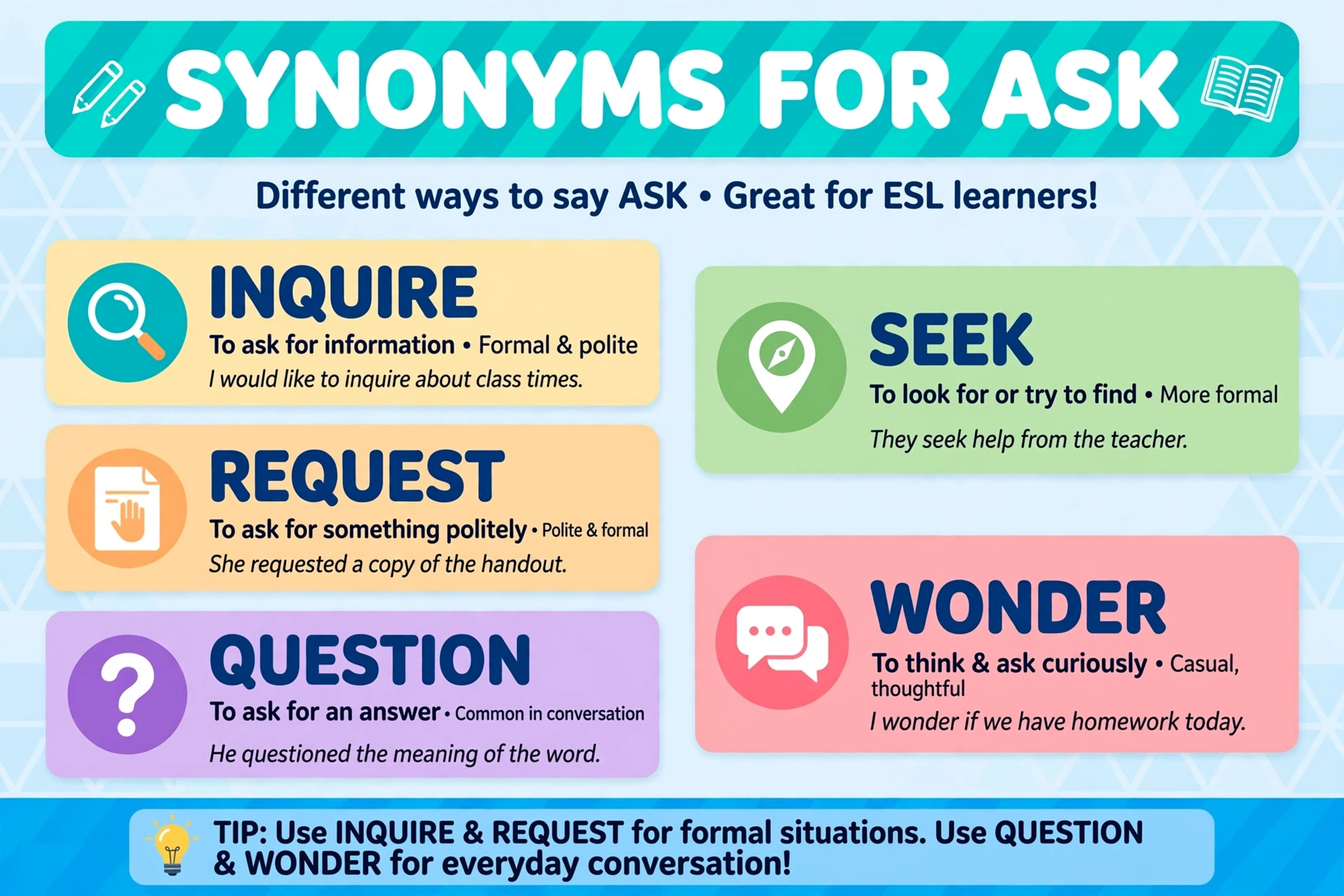
Inquire
Meaning: To ask for information in a polite, formal way.
Example: She called the hotel to inquire about check-in times.
Example 2: He inquired whether the museum offered guided tours.
Request
Meaning: To ask for something politely and respectfully, often in writing.
Example: He requested an extension on the project deadline.
Example 2: She requested a window seat when booking the flight.
Question
Meaning: To ask someone for answers or explanations, sometimes with a hint of doubt.
Example: The reporter questioned the official about the missing funds.
Example 2: The detective questioned three witnesses that evening.
Seek
Meaning: To try to obtain or find something, such as help, advice, or information.
Example: Many students seek guidance from mentors before choosing a career.
Example 2: The company seeks investors for its expansion plan.
Demand
Meaning: To ask for something firmly and strongly, expecting compliance.
Example: The customers demanded a full refund after the event was cancelled.
Example 2: The union demanded safer working conditions.
Ask at a Glance
A quick comparison to lock in the differences:
| Word | Tone | Use it when… |
|---|---|---|
| Inquire | Formal | politely seeking information |
| Request | Polite | asking in writing or professionally |
| Question | Neutral | interviewing, or implying doubt |
| Seek | Literary | purposefully pursuing help or answers |
| Demand | Strong | speaking with authority or urgency |
How to Use These Words
Let formality and force decide. Inquire and request are your professional defaults — safe in emails, applications, and customer service. Seek is elegant and slightly literary, excellent in essays (“seek the truth”). Question fits interviews and investigations, but note its edge of skepticism: “questioning” someone can imply doubt. Demand is the nuclear option — use it only when authority or urgency justifies it, never in a polite request. And when someone asks you for a promise rather than information, the right verb may be “assure,” so keep assure vs ensure in mind too.
A practical trick: imagine the reply you want. If you want a helpful answer, inquire or request — both invite cooperation. If you want the truth under pressure, question. If you want someone to act now, demand — but accept that the relationship pays the price. Most everyday situations want the first two, which is why “Could I request…?” opens more doors than “I demand…” ever will. Tone is strategy, and these five verbs are five different strategies.
Politeness grammar multiplies your options. “Request” loves the conditional: “I would like to request…” or “May I request…” — both softer than a bare “I request.” “Inquire” pairs with “about,” “into,” or “whether”: “inquire about prices,” “inquire whether rooms are available.” “Seek” takes a direct object (“seek advice”) or “to” + verb (“seek to understand”). And “demand” can take “that” + subjunctive in formal style: “they demanded that he resign.” These small frames are what separate fluent asking from awkward asking.
Common Mistakes to Avoid
- “Demand” in polite contexts. “I demand a table for two” at a restaurant sounds rude — “Could I request a table for two?” gets better service and kinder smiles.
- “Question” for innocent curiosity. “Questioning” someone implies doubt or interrogation. For friendly curiosity, use “ask” or “inquire.”
- “Inquire for” instead of “inquire about.” We inquire about details and into matters — “inquire for” is a classic learner error.
- “Seek” with “for” + verb. It is “seek to improve” or “seek advice,” not “seek for to improve.” Drop the extra “for.”
Related Words Worth Learning
- Synonyms for Allow — asking about what matters most
- Synonyms for Analyze — asking well saves everyone’s time
- Synonyms for Ambiguous — smart questions get smart answers
Quick Practice
Choose the best word for each sentence:
- Guests may ___ about late checkout at the front desk. (inquire / demand)
- She ___ a meeting with the director next week. (requested / questioned)
- The committee ___ the manager about the missing budget. (questioned / inquired)
- Workers ___ higher wages during the strike. (demanded / sought)
Answer key: 1. inquire — 2. requested — 3. questioned — 4. demanded
FAQs
What is the most polite synonym for ask?
Request is the most reliably polite, especially in writing. “I would like to request…” softens almost any ask.
What is the difference between ask and inquire?
“Ask” is general and neutral. “Inquire” is more formal and specifically about seeking information — you inquire about something, often by phone, email, or at a desk.
Is “demand” rude?
It can be, because it assumes the other person must comply. It is appropriate from positions of authority or in emergencies, but rude between equals making ordinary requests.
Can “question” mean “doubt”?
Yes. “I question his decision” means you doubt it was right — stronger than simply asking about it. Context decides which meaning applies.
What is the noun form of “request”?
“Request” is both verb and noun: “She made a request.” “Inquiry” is the noun for “inquire”; “demand” is also both: “a list of demands.”
Is “seek” formal?
Somewhat — it is elegant and slightly literary. “Seek help” sounds more serious than “ask for help,” which is why essays and speeches favor it.
Conclusion
How you ask shapes what you get. Inquire politely, request respectfully, question carefully, seek purposefully, and demand only when you must. Five verbs that turn the plain act of asking into a precise social signal — exactly what strong English writing requires.

James Reed is a writer and English language enthusiast with a passion for making vocabulary simple and fun. He writes about words, meanings, and everyday English to help learners speak and write with confidence.