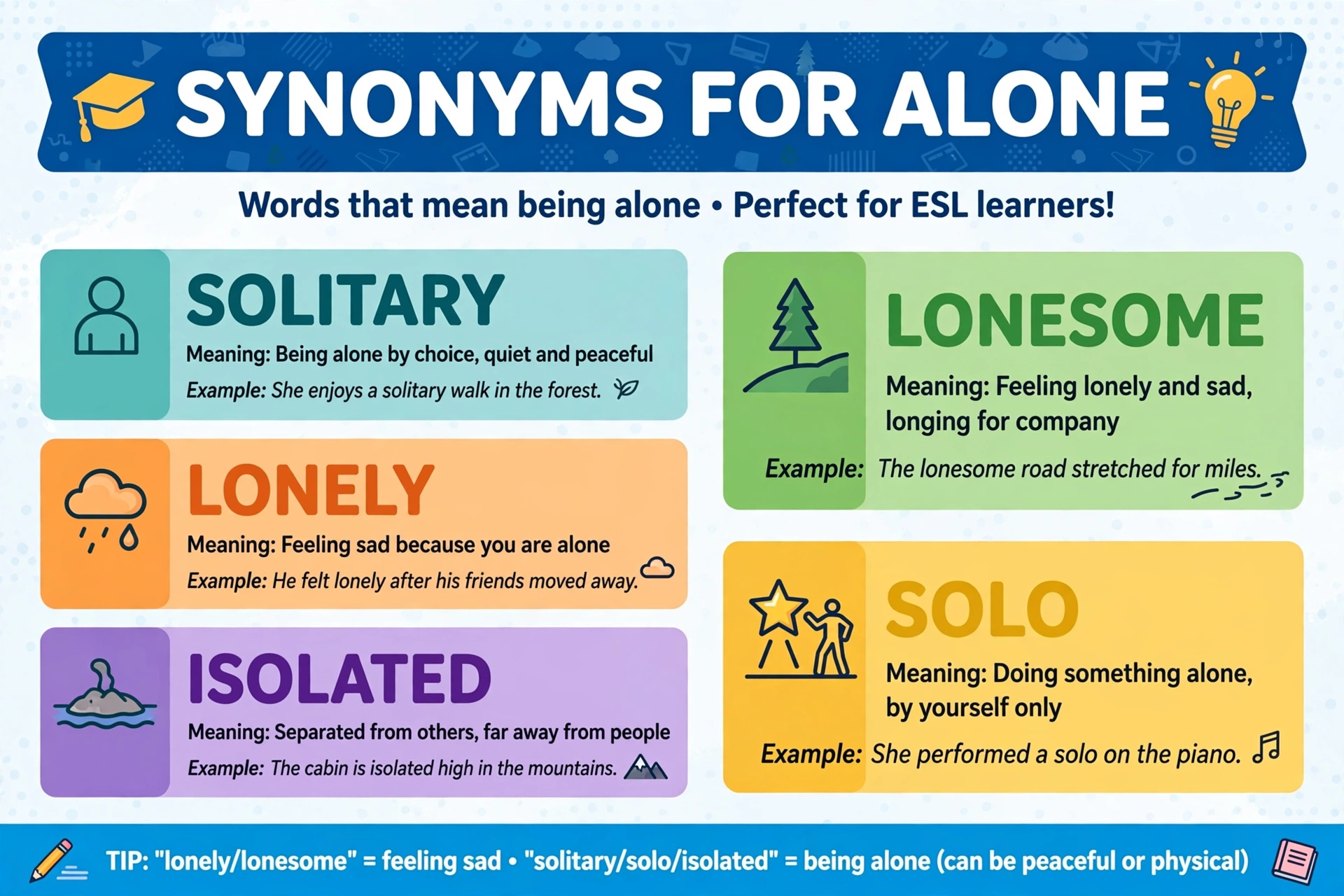
Alone simply means being without other people — but the feeling behind it changes everything. A quiet evening alone can be peaceful, while feeling alone in a crowded room can be painful. Writers and speakers need different words for these different shades: physical solitude, emotional loneliness, and proud independence are not the same thing.
Poets have praised solitude for centuries, calling it the laboratory of the mind. Modern research agrees: time alone can restore focus and spark creativity. Yet the same empty room can feel like a refuge to one person and a prison to another. That is why English refuses to settle for a single word. The five below let you tell the truth about which kind of “alone” you mean — and honesty is what makes readers trust your descriptions of feelings.
The five synonyms below capture those shades. Choosing well keeps your meaning honest — calling chosen solitude “loneliness” misleads the reader, and vice versa. As you read, notice how each word leans positive, negative, or neutral. (And if you ever write about empty, abandoned places, remember the spelling trap in desert vs dessert — one letter decides whether you mean a wasteland or a cake.)
Lonely
Meaning: Feeling sad or empty because you have no one with you; emphasizes the emotion, not just the fact.
Example: He felt lonely during his first month in the new city.
Example 2: The old dog looked lonely after its owner moved away.
Solitary
Meaning: Spent or done completely by yourself, often by choice; calm and neutral in tone.
Example: She enjoys a solitary walk through the park every morning.
Example 2: He rented a solitary cabin in the woods to finish his novel.
Solo
Meaning: Done by one person without a group, especially a performance, trip, or project.
Example: He completed the entire project solo, without any help.
Example 2: She went on a solo road trip across the country.
Isolated
Meaning: Far apart from other people or things, either physically or emotionally; often suggests being cut off.
Example: The small village felt isolated during the heavy winter storms.
Example 2: The lighthouse keeper lived an isolated life on the rocky island.
Independent
Meaning: Able to live, work, or decide things without needing help from others; a positive, strong tone.
Example: After graduation, she became fully independent and rented her own flat.
Example 2: The small business stayed independent instead of joining a large chain.
Alone at a Glance
A quick comparison to lock in the differences:
| Word | Tone | Use it when… |
|---|---|---|
| Lonely | Sad | describing the painful feeling of wanting company |
| Solitary | Calm | describing peaceful, chosen time by yourself |
| Solo | Neutral | describing activities or achievements done single-handedly |
| Isolated | Cold | distance or disconnection is the point |
| Independent | Positive | celebrating self-reliance and freedom |
How to Use These Words
First decide what you really mean. Use lonely only for the sad feeling — never for happy solitude. Use solitary for peaceful, chosen time by yourself. Use solo for activities and achievements done single-handedly. Use isolated when distance or disconnection is the point, and independent when self-reliance is something to admire. A common learner mistake is writing “I was lonely” for a pleasant quiet evening; “solitary” or simply “alone” tells the truth. Precision here is like spelling precision — for instance, knowing when you lose something versus when it is loose, as explained in loosing or losing.
A practical trick: check the feeling before the fact. Ask yourself, “Is the person happy about it?” If yes, reach for solitary, solo, or independent. If no, lonely or isolated tells the truth. This one question prevents the most common mistake learners make — writing “I had a lonely weekend” when they actually enjoyed every quiet hour of it. Honest words build trust with readers, and trust is what keeps them reading your next sentence.
Watch how these words behave grammatically. “Lonely” and “solitary” are adjectives describing people or times (“a lonely child,” “a solitary dinner”). “Solo” works as adjective or adverb (“a solo flight,” “she traveled solo”). “Isolated” often describes places or communities (“an isolated village”). “Independent” takes “of” (“independent of her parents”) or stands alone (“an independent thinker”). Knowing these patterns keeps your sentences sounding natural instead of translated.
Common Mistakes to Avoid
- “Lonely” for pleasant solitude. A peaceful weekend cabin trip was “solitary,” not “lonely.” Using “lonely” for happy alone-time confuses the reader about your feelings.
- “Independent” as a synonym for “alone.” An independent person may have many friends; the word means self-reliant, not solitary. Do not swap them.
- “Isolated” for chosen privacy. Turning off your phone for an evening is not being “isolated” — the word suggests being cut off, often unwillingly.
- “Solo” in formal writing. “He completed the task solo” is casual; in a report, write “independently” or “single-handedly.”
Related Words Worth Learning
- Synonyms for Anger — strength that grows in quiet seasons
- Synonyms for Ambiguous — when being alone feels risky
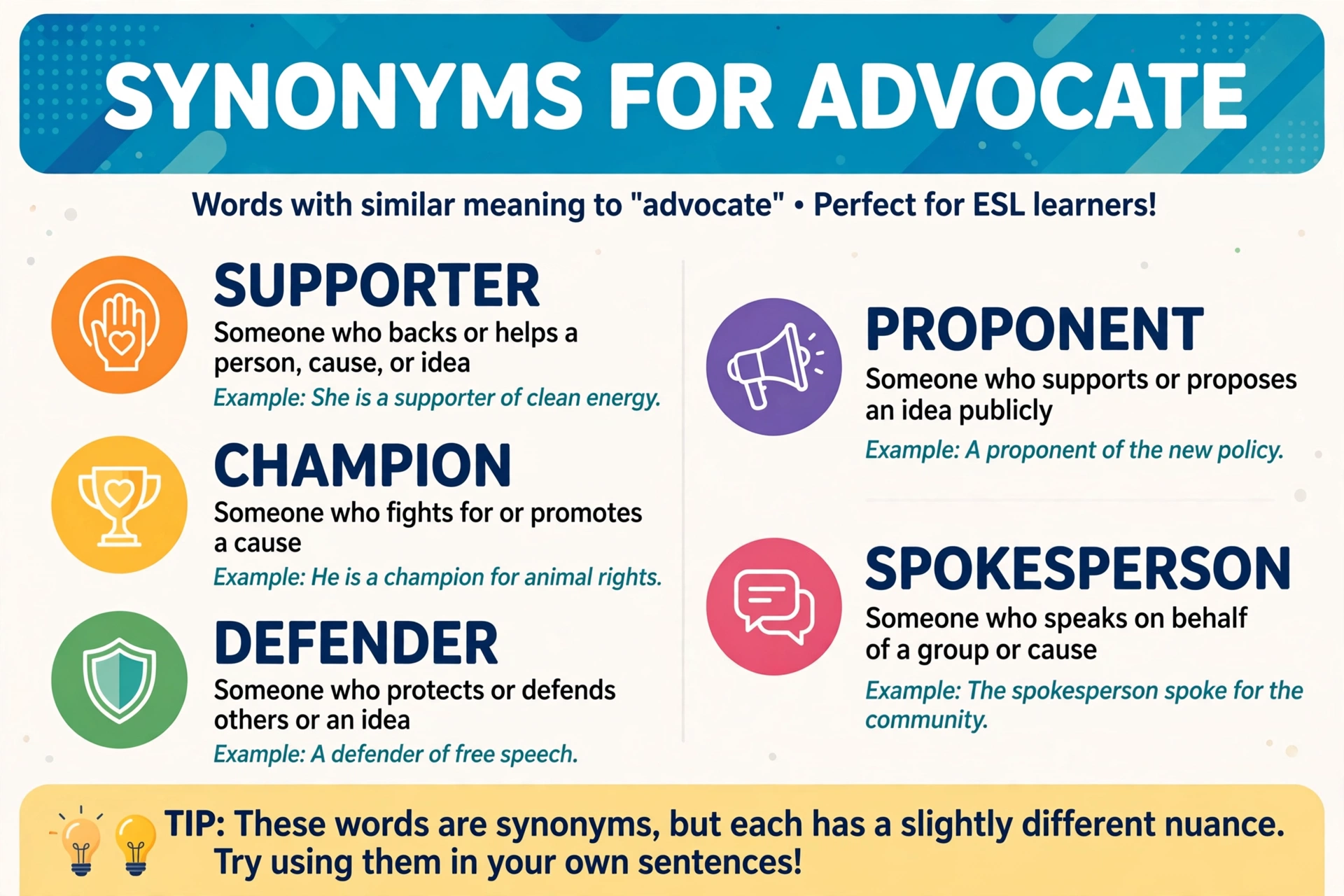
- Synonyms for Advocate — the companion of healthy independence
Quick Practice
Choose the best word for each sentence:
- After the breakup, she felt ___ even at parties. (lonely / solitary)
- He prefers a ___ morning run before the city wakes up. (solitary / isolated)
- The village was ___ by snow for three days. (isolated / independent)
- She learned to be ___ after moving out at eighteen. (independent / lonely)
Answer key: 1. lonely — 2. solitary — 3. isolated — 4. independent
FAQs
What is the difference between alone and lonely?
“Alone” describes the fact of being by yourself — it can be pleasant or unpleasant. “Lonely” describes the sad feeling of wanting company. You can be alone without being lonely, and lonely in a crowd.
Is “solitary” positive or negative?
Mostly neutral to positive. It suggests peaceful, deliberate time by yourself — though “solitary confinement” shows it can turn negative in context.
Can “solo” be used as an adjective?
Yes — “a solo trip,” “a solo performance.” It is casual and modern, common in music, travel, and business contexts.
What is a stronger word for independent?
“Self-reliant” and “self-sufficient” are stronger, emphasizing the ability to manage entirely without help. “Independent” itself is already positive and widely used.
What is the adverb form of “solitary”?
“Solitary” has no natural adverb; we say “alone” or “by oneself” instead: “She lives alone.” The form “solitarily” exists but sounds stiff — avoid it.
Can “alone” come after a noun?
Yes: “the decision alone took an hour” — here “alone” means “only” or “merely,” a different sense worth knowing. “The ticket alone cost fifty dollars.”
Conclusion
Being by yourself is not one single experience, and now your vocabulary shows it. Lonely for the ache, solitary for the peace, solo for the achievement, isolated for the distance, and independent for the strength. Five words, five truths about the same situation. Use them precisely, and your readers will feel exactly what you felt.

Thomas Allen is a language writer and editor who loves exploring the subtle differences between words. He creates clear, practical guides that help readers understand English better — one word pair at a time.