Obvious means easy to see or understand — so clear that anyone would notice it. It is a handy word, and we all use it: “the answer is obvious,” “it was obvious she was tired.” But repeating it makes your writing sound lazy, and worse, “obvious” can sound blunt or even rude, as if you are telling the reader they should have known already.
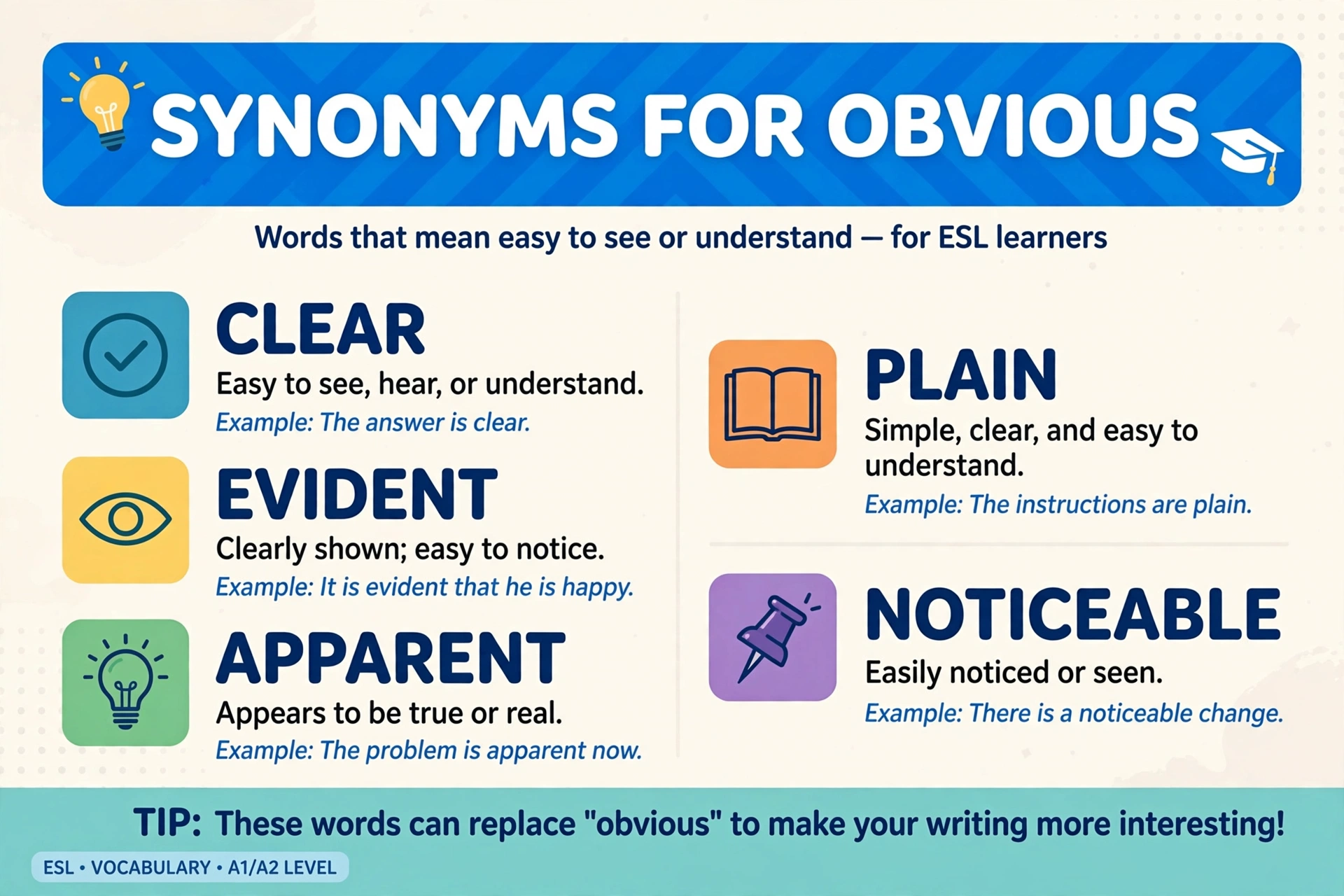
English gives you smoother, more precise options for the same idea. Some sound formal, some gentle, and some carry extra strength. Learning them lets you match your tone to the moment — polite in conversation, precise in essays. Here are five strong synonyms for obvious, with clear meanings and examples.
There is a politeness angle here that many learners miss. “Obvious” secretly judges the listener: if something is obvious and you did not see it, the word implies you were slow. That is why skilled speakers soften it. A diplomat says “it is evident we need more time,” never “it is obvious we need more time.” Learning these gentler alternatives is not just vocabulary work — it is learning to sound respectful.
Clear
Meaning: Easy to see, hear, or understand; free from confusion or doubt.
Example: Her explanation was clear enough for the whole class. The water in the lake was crystal clear. Make your instructions clear before starting the activity.
Evident
Meaning: Easy to notice or understand; a formal and polished choice for writing.
Example: His disappointment was evident to everyone in the room. The benefits of exercise are evident within weeks. It was evident from the empty shelves that the sale had been popular.
Apparent
Meaning: Becoming clear after looking closely or thinking something over; not always instant.
Example: The real problem became apparent during the final test. It was apparent from her smile that she had good news. The risks became apparent only after the project failed.
Plain
Meaning: Very easy to see or understand; simple, direct, and without decoration.
Example: It was plain that she needed some rest. The instructions were written in plain language. The truth was plain to everyone except him.
Noticeable
Meaning: Easy to spot or detect, especially a change, difference, or improvement.
Example: There was a noticeable improvement in his grades this term. She wore a noticeable new hairstyle to the party. The new paint made a noticeable difference to the room.
How to Use These Words
Choose by tone and situation. “Clear” is your everyday workhorse — friendly, neutral, and almost always safe. “Evident” lifts the register for essays, reports, and formal emails. Use “apparent” when something dawns on you after observation rather than hitting you instantly. “Plain” suits simple, direct truths, especially in plain-spoken advice. “Noticeable” is ideal for changes and differences you can point to — improvements, differences, new features.
One caution for polite conversation: soften strong claims. “It is evident that we need more time” sounds more diplomatic than “It is obvious that we need more time,” which can imply the listener was slow to see it. Precision with tone is a real skill — just like telling apart look-alike words in our guide to practice vs practise.
Think about timing too. “Noticeable” and “clear” describe things you spot right away. “Apparent” and “evident” often describe conclusions you reach after evidence piles up — a detective finds the truth apparent, a scientist calls the pattern evident. Matching the word to the moment of discovery makes your writing feel thoughtful rather than rushed.
Common Mistakes to Avoid
- Writing “obviously” at the start of arguments. “Obviously, we should invest more” insults anyone who disagrees by implying they are blind. In persuasive writing, “clearly” or “evidently” carries the same meaning with far less arrogance.
- Using “plain” for people. “Plain” meaning clear is fine (“the plain truth”), but “a plain woman” means unattractive — a completely different and hurtful sense. Keep the clarity sense for ideas, facts, and language.
- Confusing “apparent” with “appearing.” “Apparent” means seeming clear; “appearing” means coming into view. “An apparent mistake” is a mistake that looks real; “an appearing mistake” is not standard English at all.
- Overusing “noticeable” for abstract ideas. “Noticeable” works best for things you can point to — changes, differences, features. “A noticeable sadness” is possible but strained; “evident sadness” or “clear disappointment” sounds more natural.
Quick Practice
Choose the best word from this article: clear, evident, apparent, plain, noticeable.
- It was ______ that he had been crying, though he denied it.
- Speak in ______ terms so the customer understands the price.
- There has been a ______ drop in complaints since the new system launched.
- The mistake became ______ when we checked the final totals.
Answer key: 1. evident (plain also fits) 2. plain 3. noticeable 4. apparent
Now rewrite this blunt sentence twice, softening it each time: “It is obvious that your plan will fail.” Try “evident” first, then “apparent,” and feel the tone shift.
Related Words Worth Learning
- 5 Powerful Synonyms for Normal (With Meanings & Examples)
- 5 Powerful Synonyms for Intelligent (With Meanings & Examples)
- 5 Powerful Synonyms for Efficient (With Meanings & Examples)
FAQs
What is a formal synonym for obvious?
“Evident” and “apparent” are the best formal choices for essays and reports. “Manifest” works too, though it is less common in everyday writing and can sound literary.
What is the difference between obvious and apparent?
“Obvious” hits you immediately — no effort needed. “Apparent” often becomes clear only after you look, listen, or think. The truth can be apparent without being obvious at first glance.
What is the strongest synonym for obvious?
“Unmistakable” and “undeniable” are among the strongest — they leave no room for doubt at all. “Indisputable” is another powerful option for facts nobody can argue with.
Can “clear” always replace “obvious”?
Almost always, and more politely. But remember that “clear” also means transparent (“clear water”) and understandable (“clear instructions”), so check that your sentence keeps its intended meaning.
How do I say “obvious” politely in a disagreement?
Soften it with phrases like “as you may have noticed,” “it seems clear that,” or “the evidence suggests.” These keep your meaning while showing respect for the other person’s view.
What is the difference between “evident” and “self-evident”?
“Evident” means clear from the evidence or situation. “Self-evident” means so clear it needs no evidence at all — famously used in the phrase “we hold these truths to be self-evident.” Use “self-evident” only for things nobody could possibly dispute.
Conclusion
Obvious gets the job done, but clear, evident, apparent, plain, and noticeable do it with more finesse. The right choice depends on formality, tone, and timing — and mastering these small decisions is exactly what turns good English into great English.

Thomas Allen is a language writer and editor who loves exploring the subtle differences between words. He creates clear, practical guides that help readers understand English better — one word pair at a time.