The word “popular” shows up everywhere: popular songs, popular opinions, popular restaurants, popular posts. It simply means liked or enjoyed by many people — but it is also one of the most overused words in English writing. When every other sentence says “popular,” your writing starts to sound flat.
That is where synonyms help. Each alternative carries its own shade of meaning. “Famous” points to being widely known, “trendy” points to current fashion, and “admired” points to respect. Picking the right one makes your sentence sharper and more precise.
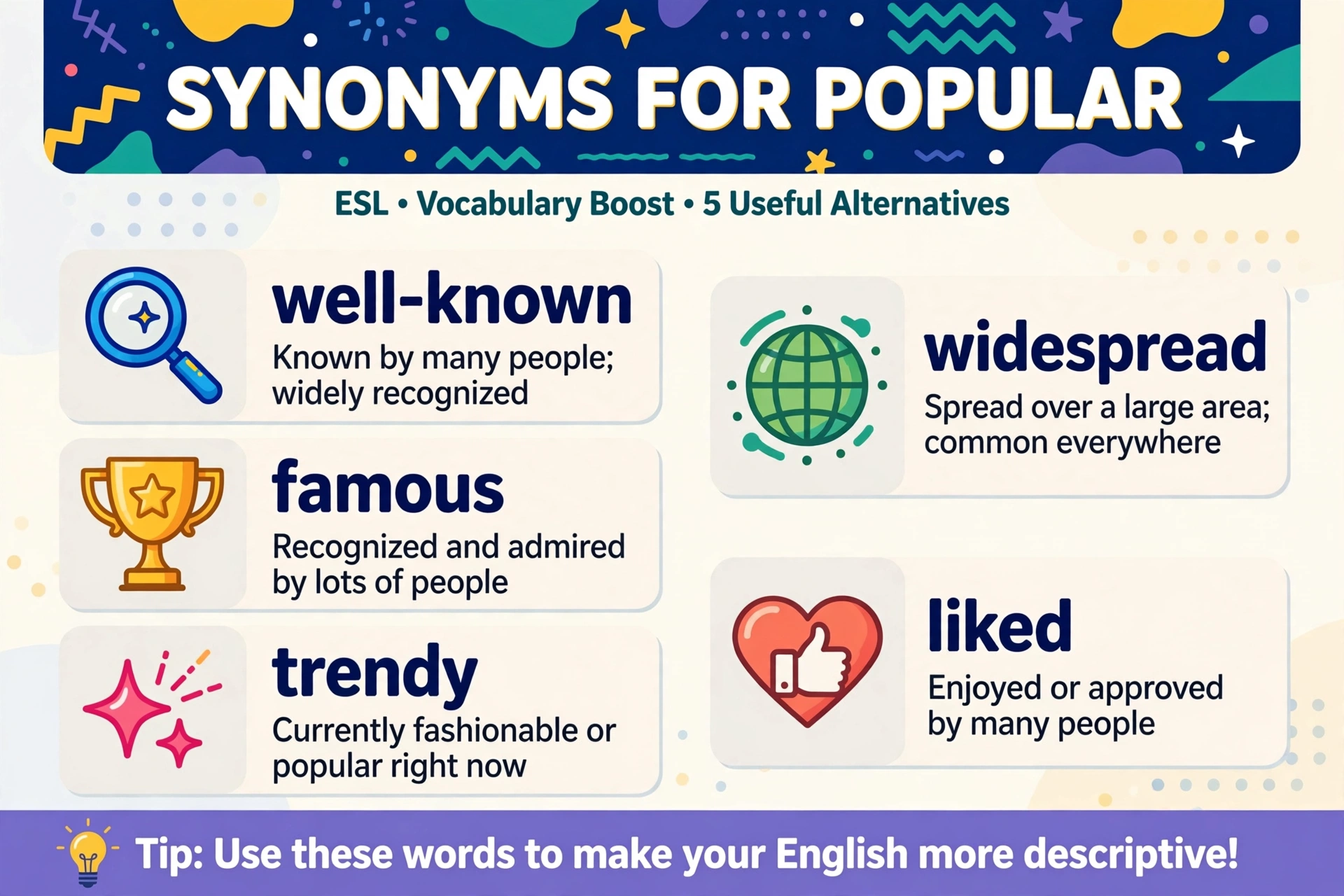
Think about how often you see “popular” in headlines and ads — “the most popular phone,” “a popular opinion.” The word has become background noise. When you replace it with something exact, readers pay attention again. A “renowned” chef sounds more impressive than a “popular” one, and a “trendy” jacket sounds more current than a “popular” jacket. That small upgrade is the whole point of building vocabulary. Below are five strong synonyms for “popular,” each with a clear meaning and a natural example sentence.
Teachers and examiners notice word repetition instantly. An essay that says “popular” six times feels tired, while one that rotates through “famous,” “well-known,” and “admired” feels confident and controlled. This is not about showing off — it is about accuracy. “Popular” tells your reader that many people like something, but it never tells them why. The synonyms below answer the “why”: recognition, respect, admiration, or fashion. Learning them is one of the fastest ways to make your English sound mature.
Famous
Meaning: Known by a very large number of people, often across the country or the world.
Example: The famous singer filled the stadium with thousands of cheering fans.
Another example: The famous waterfall attracts millions of visitors every single year.
Well-known
Meaning: Familiar to many people, especially within a particular city, field, or community.
Example: Our neighborhood bakery is well-known for its fresh almond croissants.
Another example: He is well-known among local runners for organizing weekend charity races.
Renowned
Meaning: Famous in a way that includes deep respect for someone’s skill, knowledge, or achievements.
Example: The renowned scientist received an award for her research on clean water.
Another example: The renowned chef opened a cooking school to train young talent.
Admired
Meaning: Liked and respected because of good qualities, actions, or character.
Example: The young nurse is admired by her patients for her patience and kindness.
Another example: The retiring principal was admired for treating every student with respect.
Trendy
Meaning: Popular for a short period because it matches what is fashionable right now.
Example: The café became trendy after a food blogger posted photos of its colorful drinks.
Another example: Oversized jackets became trendy again after the winter fashion show.
How to Use These Words
Start by asking what kind of popularity you mean. If it is about being widely recognized, choose “famous” or “well-known.” If it is about respect, “renowned” and “admired” fit better. If it is about fashion or the current moment, “trendy” is the natural pick. Mixing these up — calling a respected teacher “trendy,” for example — can sound strange, so match the word to the situation.
Another tip: read your sentence aloud with the synonym in place. If “trendy” feels too light for a serious topic, switch to “well-known.” And remember that some synonyms share the same grammar — “famous for” and “renowned for” take the same preposition, so you can often swap them directly. Small word choices change meaning more than most learners expect, which is why guides like chose vs choose and adapt vs adopt are worth a read: one letter can flip an entire sentence.
Also pay attention to scale. “Famous” usually means national or worldwide recognition, while “well-known” can be limited to a town, a school, or a profession. “Renowned” sits between them but adds respect for achievement — you would call a Nobel winner renowned, not just famous. “Admired” is the warmest of the five; it always carries personal respect, which is why it pairs so naturally with “for” plus a quality: admired for honesty, admired for courage.
Common Mistakes to Avoid
- Calling a respected person “trendy.” “Trendy” is about fashion and the current moment, not respect. A respected doctor is “renowned” or “admired,” never “trendy.”
- Using “famous” for something only known locally. A bakery loved in one neighborhood is “well-known,” not “famous.” Save “famous” for recognition on a much bigger stage.
- Repeating “popular” in every sentence. Variety shows control. If you catch yourself writing “popular” three times in one paragraph, swap in the exact synonym for each case.
- Using “admired” without a reason. “Admired” almost always needs “for” plus a quality or action: “admired for her kindness.” Without the reason, the sentence feels unfinished.
Quick Practice
Choose the best word for each sentence: famous, well-known, renowned, admired, trendy.
- The ___ surgeon wrote a book about her thirty-year career. (recognition + respect)
- Neon colors became ___ this summer, but nobody wears them now.
- She is ___ by her colleagues for her honesty and hard work.
Answer key: 1. renowned — 2. trendy — 3. admired
Related Words Worth Learning
FAQs
What is the difference between “popular” and “famous”?
“Popular” means liked by many people, while “famous” means known by many people. A street food stall can be popular in its neighborhood without being famous worldwide. Fame is about recognition; popularity is about approval.
Can “trendy” describe a person?
Yes, but carefully. Calling someone “trendy” usually means they follow current fashion, not that they are deeply respected. For a respected person, “admired” or “renowned” is a better choice.
Is “renowned” a formal word?
It is slightly formal and works best in writing — essays, articles, news reports. In casual speech, “famous” or “well-known” sounds more natural.
Which synonym fits a product or brand?
“Well-known” and “renowned” suit established brands with a good reputation. “Trendy” fits new products riding a wave of fashion. “Admired” works when customers respect the brand’s values.
What is the difference between “well-known” and “famous”?
Scale. “Famous” usually means recognized across a country or the world — a famous actor, a famous landmark. “Well-known” can be much smaller: well-known in your city, well-known among doctors, well-known in the gaming community. If the recognition is limited to one group, “well-known” is the accurate choice.
Can “popular” have a negative meaning?
Sometimes, yes. In phrases like “a popular misconception” or “a popular myth,” it means many people believe something that is actually wrong. Here “popular” describes how widespread the belief is, not that it is good. Context decides the tone.
Conclusion
“Popular” is a useful word, but it is not always the best word. “Famous” and “well-known” describe recognition, “renowned” and “admired” describe respect, and “trendy” describes the fashion of the moment. Learning these five alternatives gives you sharper tools for essays, emails, and everyday conversation.
Try replacing “popular” with the most precise synonym in your next piece of writing and notice how much clearer it sounds. Keep a small notebook or phone note of new synonyms you meet, review it weekly, and try using one new word each day. Within a month, “popular” will be just one option among many — and usually not the best one.

Thomas Allen is a language writer and editor who loves exploring the subtle differences between words. He creates clear, practical guides that help readers understand English better — one word pair at a time.