Quiet is a small word with a big range. It can describe a room with no sound, a calm mood, a peaceful morning, or a person who rarely speaks. That flexibility is useful — but it also means “quiet” often says less than you think. The right synonym tells your reader exactly which kind of quiet you mean.
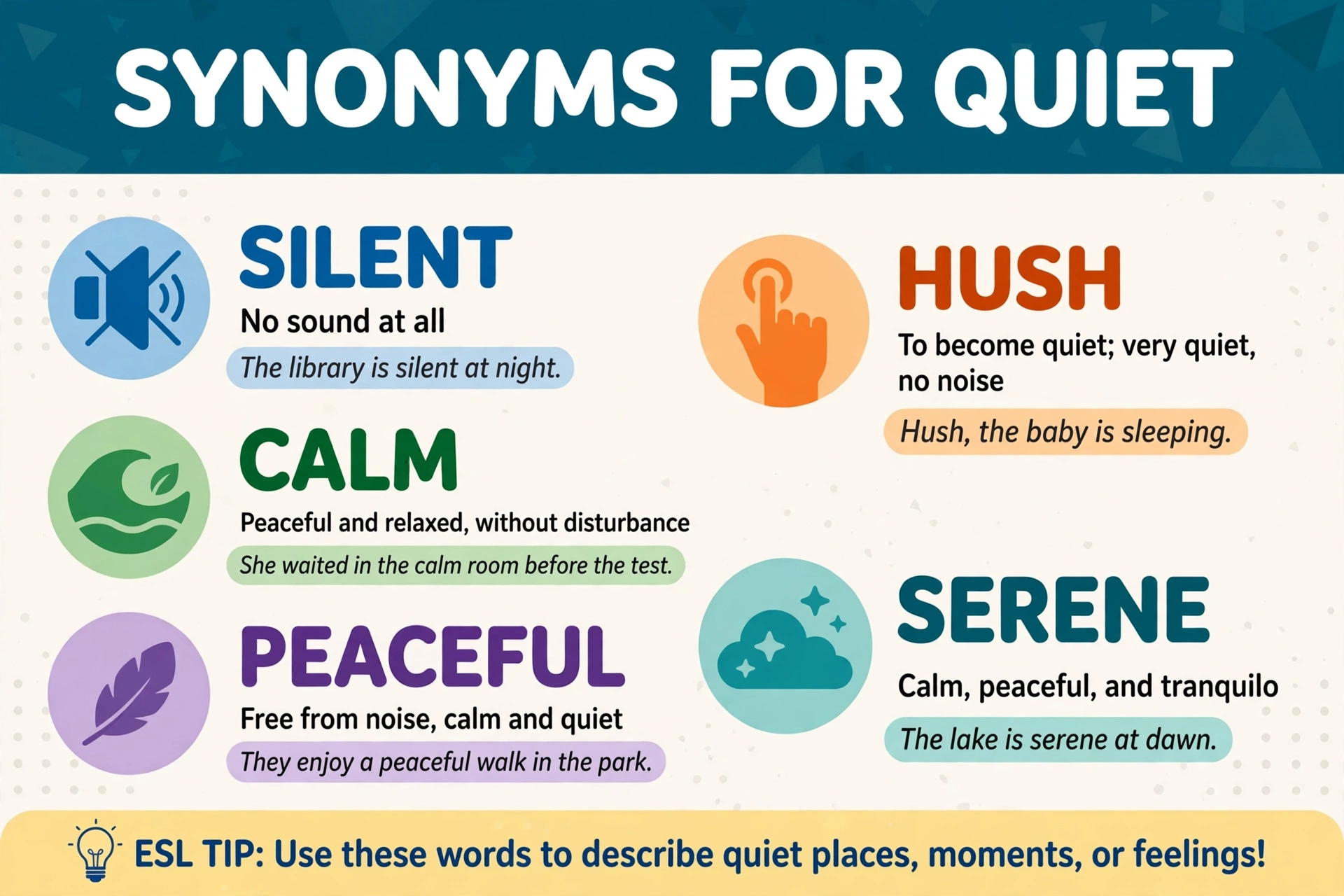
The trick is sorting sound from mood from personality. Here are five of the most useful synonyms for quiet, each with a clear meaning and an example sentence.
Think about how many different silences you know. The tense silence of an exam hall before the papers are handed out. The soft silence of early morning before the city wakes. The comfortable silence between old friends who need no words. English has a separate word for each of these because they feel completely different — and using the exact one is what turns a flat description into a vivid scene. Writers who master these shades can make readers hear the silence on the page.
That is also why “quiet” is a favorite exam word. Teachers ask you to describe a place, a morning, or a person, and the students who reach for “tranquil,” “serene,” or “hushed” immediately stand out from those who write “quiet” five times. The synonyms below are your upgrade kit — five precise words that say more than “quiet” ever could, each with its own natural home.
Silent
Meaning: Completely without sound; total absence of noise.
Example: The library was silent except for the turning of pages.
Another example: The classroom fell silent the moment the principal walked in.
Calm
Meaning: Peaceful and free from agitation, noise, or excitement.
Example: She kept a calm voice even though the situation was tense.
Another example: A calm morning by the river is the best time for a slow walk.
Peaceful
Meaning: Full of quiet comfort; undisturbed and relaxing.
Example: We spent a peaceful weekend at a cabin far from the city.
Another example: The baby slept with a peaceful expression on her tiny face.
Tranquil
Meaning: Deeply calm and still, often describing places or moments of rare serenity.
Example: The tranquil lake reflected the mountains like a mirror.
Another example: They found a tranquil spot under the old trees for their picnic.
Reserved
Meaning: Describing a person who speaks little and keeps thoughts private.
Example: He is reserved in meetings but brilliant in one-on-one conversations.
Another example: The reserved newcomer slowly opened up to the team over several weeks.
How to Use These Words
First ask: sound, mood, or person? For sound, reach for silent (no sound at all) or calm (gentle, unexciting sound). For atmosphere and mood, peaceful and tranquil work best — tranquil is the more poetic, formal choice. For people, reserved is your word; it describes personality, not volume. Mixing these up sounds odd: a “silent person” sounds eerie, while a “reserved room” makes no sense at all.
Go one step deeper and consider intensity. “Silent” is absolute — zero sound, like a switched-off room. “Calm” is softer — low sound, low excitement, like a gentle evening. “Peaceful” adds comfort to the quietness; a peaceful place feels good to be in. “Tranquil” is peaceful raised to poetry — it belongs in travel writing and novels more than in text messages. And “reserved” never describes sound at all; it describes a person’s habit of holding back words. Ask two questions — how much sound, and what kind of subject — and the right word appears.
Common Mistakes to Avoid
- Calling a quiet person “silent.” A “silent person” sounds eerie or angry, as if they refuse to speak. For a naturally soft-spoken person, “reserved” or “quiet” is respectful and accurate.
- Using “reserved” for places. “Reserved” describes personality, not rooms. A “reserved hall” makes no sense — say “a quiet hall” or “a silent hall.”
- Treating “calm” and “quiet” as identical. “Calm” is about agitation, “quiet” about sound. A quiet room can still feel tense before an exam; a calm room feels settled and easy.
- Using “tranquil” in casual chat. “Tranquil” leans formal and poetic. Telling a friend “my evening was tranquil” sounds stiff — “peaceful” or “calm” fits conversation better.
Quick Practice
Choose the best word for each sentence: silent, calm, peaceful, tranquil, reserved.
- The empty streets were completely ___ at five in the morning.
- She gave him a ___ smile before giving her answer.
- He is too ___ to speak up at large gatherings.
Answer key: 1. silent — 2. calm — 3. reserved
Related Words Worth Learning
- Synonyms for Relax — the calm state that quiet moments create
- Synonyms for Confidence — quiet strength is still strength
- Synonyms for Reason — thinking clearly needs a quiet mind
FAQs
What is the strongest synonym for quiet?
“Silent” is the strongest for sound — it means zero noise. For mood, “tranquil” carries the deepest sense of calm.
What do you call a quiet person?
“Reserved” is the most neutral and respectful choice. “Introverted” describes someone who recharges alone, while “taciturn” is more formal and literary.
Can “calm” and “quiet” be used interchangeably?
Often, but not always. “Calm” emphasizes the absence of agitation — a calm sea, a calm voice. “Quiet” emphasizes the absence of sound. A quiet room can still feel tense; a calm room feels settled.
Is “tranquil” too formal for everyday use?
It leans formal and poetic, so it fits writing better than casual chat. In conversation, “peaceful” or “calm” usually sounds more natural.
What is the difference between “quiet” and “quite”?
They are completely different words that learners often mix up in spelling. “Quiet” (with the “ie”) means little or no noise. “Quite” (with “ui”) means fairly or very — “quite good,” “quite tired.” The vowel order is the whole difference, so double-check it every time you write.
What does “keep quiet” mean?
It means to stay silent — “Please keep quiet during the test.” A close cousin is “keep it quiet,” which means to keep something secret: “Keep it quiet, but I am planning a surprise party.” Same verb, two useful meanings.
Conclusion
Quiet wears many hats, and now you have a word for each one. Call absence of sound silent, gentle mood calm, deep comfort peaceful or tranquil, and a soft-spoken person reserved. Choose the right shade, and your descriptions will feel vivid instead of vague.
Try this tonight: describe your room, your street, or your morning using two of these synonyms instead of “quiet.” Then read both versions aloud. The upgraded one will sound like it was written by a more confident English user — because it was.

James Reed is a writer and English language enthusiast with a passion for making vocabulary simple and fun. He writes about words, meanings, and everyday English to help learners speak and write with confidence.