Something ambiguous can be understood in more than one way — its meaning is not settled. A contract clause, a text message, or a politician’s answer can all be ambiguous, and the uncertainty is often the whole point. English has many words for “not clear,” but they are not interchangeable: some describe missing detail, others describe deliberate evasion, and others describe genuine doubt.
Unclear language costs real money and real trust. A vague contract sparks lawsuits, an equivocal job offer wastes months, and confusing instructions cause expensive mistakes. That is why naming what kind of unclear you face is a professional skill, not just a vocabulary exercise. Editors, lawyers, and managers all get paid to spot these differences — and the five words below are their tools.
Learning these distinctions makes your criticism sharper and your own writing clearer. The five words below move from the everyday to the precise. And since unclear wording is often where word pairs get tangled, readers who enjoy this topic also like guides to easily confused pairs such as trouper or trooper.
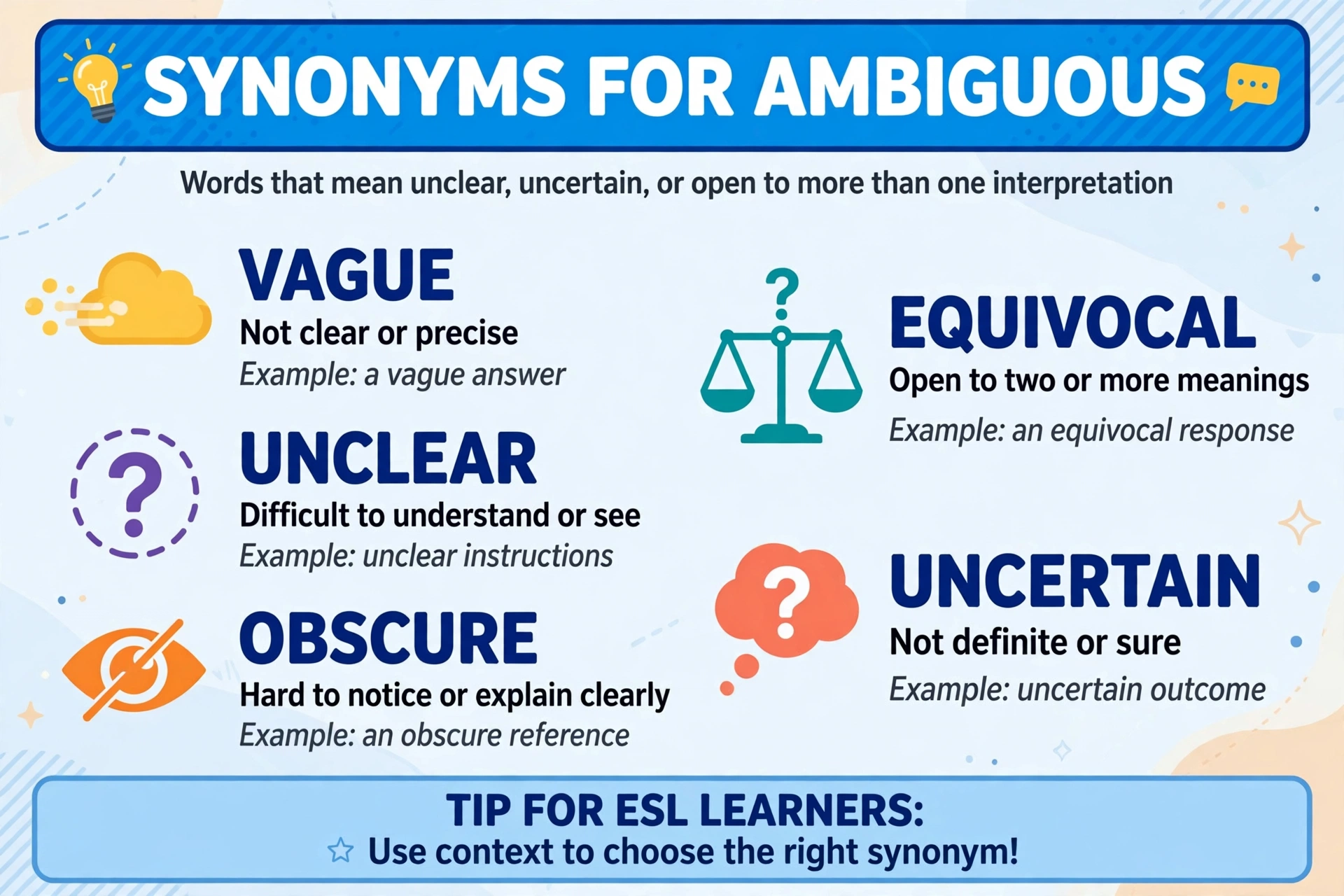
Unclear
Meaning: Difficult to understand; the general, everyday word for something whose meaning is not obvious.
Example: The teacher’s instructions were unclear, so half the class did the wrong task.
Example 2: The map was unclear about which exit to take.
Vague
Meaning: Lacking specific details; gives only a rough or blurry idea instead of exact information.
Example: He gave a vague answer when I asked what time he would arrive.
Example 2: Her plans for the weekend remained vague.
Equivocal
Meaning: Open to more than one interpretation, often deliberately, to avoid giving a direct answer.
Example: The spokesperson gave an equivocal reply about the company’s future plans.
Example 2: His equivocal statement left reporters guessing.
Uncertain
Meaning: Not known or decided for sure; emphasizes doubt rather than wording.
Example: The outcome of the match is still uncertain.
Example 2: The weather for Saturday remains uncertain.
Confusing
Meaning: Hard to follow or understand because it lacks order, clarity, or consistency.
Example: The new tax rules are confusing for small business owners.
Example 2: The assembly instructions were confusing without diagrams.
Ambiguous at a Glance
A quick comparison to lock in the differences:
| Word | Tone | Use it when… |
|---|---|---|
| Unclear | Neutral | giving the general, everyday verdict |
| Vague | Neutral | details are missing or blurry |
| Equivocal | Formal | someone deliberately avoids a straight answer |
| Uncertain | Neutral | the answer itself is genuinely unknown |
| Confusing | Neutral | the whole thing is tangled and hard to follow |
How to Use These Words
Start with the cause of the unclarity. If details are missing, say vague. If the wording itself is hard to grasp, say unclear or confusing. If someone is deliberately avoiding a straight answer, equivocal is the precise, slightly formal choice. If nobody knows the answer yet, the issue is not wording at all — it is uncertain. In essays, “vague” is a fair criticism of weak arguments, while “equivocal” suits political or legal analysis. Choosing exactly the right one shows readers you can diagnose unclear thinking, not just complain about it — the same precision that separates close pairs like adapt vs adopt.
A practical trick: blame the right culprit. If the writer left out details, call it vague. If the wording hides the meaning on purpose, call it equivocal. If nobody knows yet, the honest word is uncertain. Getting the culprit right turns a lazy complaint (“this is confusing”) into a sharp diagnosis (“the proposal is vague on costs but equivocal on timelines”) — and sharp diagnoses are what make editors, teachers, and clients take your writing seriously.
Formality guides the choice too. In a casual chat you would say “his text was unclear,” not “his text was equivocal.” Save “equivocal” for political, legal, or academic analysis, where its precision earns its place. “Vague” is a fair, common criticism in essays and reviews. “Uncertain” belongs to forecasts and outcomes, never to sentences — a sentence is never “uncertain,” though its meaning can be. Matching the word to the register keeps you sounding natural in every setting.
Common Mistakes to Avoid
- Calling a person “ambiguous.” People are not ambiguous; their words or behavior are. Write “her reply was ambiguous,” not “she is ambiguous.”
- Using “uncertain” for bad writing. If a paragraph is badly written, it is “unclear” or “confusing” — “uncertain” means the truth itself is unknown, not the wording.
- A vague use of “vague.” Saying “your essay is vague” without saying where repeats the sin. Name the missing detail: “vague about costs, silent on timelines.”
- Overusing “confusing.” If everything is “confusing,” nothing is diagnosed. Reach for “vague,” “equivocal,” or “unclear” to show you know the cause.
Related Words Worth Learning
- Synonyms for Analyze — clarity begins with sharp thinking
- Synonyms for Alone — when unclear wording leaves people exposed
- Synonyms for Analyze — breaking down what is hard to understand
Quick Practice
Choose the best word for each sentence:
- The contract clause was so ___ that both sides claimed victory. (ambiguous / uncertain)
- He gave only a ___ outline of his plans. (vague / equivocal)
- The minister’s ___ answer avoided every direct question. (equivocal / unclear)
- Whether it will rain tomorrow is still ___. (uncertain / confusing)
Answer key: 1. ambiguous — 2. vague — 3. equivocal — 4. uncertain
FAQs
What is the simplest synonym for ambiguous?
Unclear — it is the most common and neutral choice, and it works in almost every situation where “ambiguous” fits.
What is the difference between vague and ambiguous?
“Vague” means lacking detail (a blurry picture). “Ambiguous” means having two or more possible meanings (a picture that could show two things). Something can be vague without being ambiguous.
Is “equivocal” formal?
Yes, it is formal and most common in writing about politics, law, and diplomacy. In casual speech, people usually say “noncommittal” or “evasive” instead.
Can a person be ambiguous?
Usually we call a person’s words or behavior ambiguous, not the person. Saying “he is ambiguous” sounds odd; “his answer was ambiguous” is natural.
What is the noun form of “ambiguous”?
“Ambiguity” — the quality of having more than one meaning: “The contract was full of ambiguities.” Note the spelling change: ambiguous becomes ambiguity.
Is “equivocal” ever positive?
Rarely. It usually suggests evasion. In diplomacy it can be a skill — “an equivocal statement kept negotiations alive” — but in everyday contexts it reads as dodging the question.
Conclusion
Unclear language comes in flavors: unclear for the general fog, vague for missing detail, equivocal for deliberate dodge, uncertain for genuine doubt, and confusing for tangled messes. Name the right flavor and your critique lands — whether you are editing an essay, decoding a contract, or simply asking someone to say what they actually mean.

Thomas Allen is a language writer and editor who loves exploring the subtle differences between words. He creates clear, practical guides that help readers understand English better — one word pair at a time.